Qiyam
QiyamRevision
How Spaced Repetition Works for Quran Memorization
Spaced repetition brings each verse back just before you forget it: weak verses soon, solid ones weeks later. How it works for hifz and what research shows.
By Amine Benlaroui, , updated , 6 min read
Spaced repetition means reviewing each verse just as it starts to fade, then waiting longer every time you recite it well. For Quran memorization, it replaces "revise everything on a fixed cycle" with a schedule for each verse: the ones you stumble on come back soon, the solid ones wait weeks. Research on spacing, done with word pairs, facts and vocabulary rather than the Qur'an, suggests the same revision time spread this way keeps far more than revision done in blocks.
Why do surahs you memorized fade?
You can memorize a surah well, revise it for a week, then find a month later that the middle has gone. Meanwhile Al-Fatiha never fades. If you recite it in every rak'ah of the five obligatory prayers, that is 17 times a day: it never gets the chance.
Forgetting is not even. Across three experiments, with people recalling words, recognising faces, and pigeons, forgetting followed a power curve: a steep drop at first, then a slower decline1. For hifz, that means the first days after you memorize a page matter most, and a page you have held for years loses ground slowly.
The Prophet ﷺ described this upkeep in a hadith in Sahih al-Bukhari: "The example of the person who knows the Qur'an by heart is like the owner of tied camels. If he keeps them tied, he will control them, but if he releases them, they will run away."2 Spaced repetition is one way to decide when each rope needs checking.
What is spaced repetition, exactly?
It rests on two ideas that work together.
- Spacing. Reviews are spread out, with gaps that grow as a verse gets stronger, instead of being repeated many times in one sitting.
- Recall. Each review is a test: you recite from memory, then check. Reading the page again does not count.
The aim is to review a verse while you can still recall it, but only just. Too early, and you spend time on something you already hold. Too late, and you are memorizing it again instead of revising it.
What does the research say about spacing?
None of these studies used the Qur'an. They tested word pairs, facts, flashcards and prose passages. What they show about memory points in one direction, but read them as "suggests", not "proves" for hifz.
- The best gap grows with how long you need to remember. A review of 317 experiments from 184 articles (839 assessments) found that the gap between study sessions and the time until the test work together: the gap that gave the best retention grew as the test moved further away3.
- For long-term memory, the gaps should be long. More than 1,350 people learned facts, reviewed them after a gap of up to 3.5 months, and were tested up to a year later. The best gap was about 20 to 40% of the delay for a test one week away, and about 5 to 10% for a test one year away4. You want your hifz for life, which argues for long gaps on pages you hold well.
- Spaced maintenance can halve the sessions. In a 9-year study, 4 people learned and relearned 300 word pairs. Thirteen relearning sessions 56 days apart gave retention comparable to 26 sessions 14 days apart5. Only four participants, but the pattern matters for anyone maintaining a large hifz.
- The total spacing matters more than a perfect pattern. People who recalled items on 3 spaced tests with long gaps retained 200% more than people whose tests had no spacing. Whether the gaps expanded, stayed equal or shrank made no measurable difference6. You don't need a flawless expanding schedule; you need the gaps to be long enough.
- Reciting beats rereading, later on. Students who recalled prose passages from memory did worse than rereaders on a test 5 minutes later, but substantially better 2 days and 1 week later, even though rereading made them feel more confident7.
Why does a fixed revision cycle waste time?
Many memorizers revise on a fixed rotation: a juz a day, the whole hifz every month, or Juz Amma every Friday. A rotation is already a form of spacing, and it is simple, which is a real strength. You can read more about where it works in the traditional hifz schedule.
Its limit is that every page gets the same gap. A surah you have recited for twenty years comes back as often as one you finished last month. The strong page is reviewed too early, which costs time, and the weak page too late, which costs the page.
It also feels better than it works. In a flashcard study on word pairs, studying one large spaced stack beat four small massed stacks for 90% of participants, yet after the first session 72% believed massing had worked better8. Revising one page over and over in a sitting feels productive. Letting it come back after a gap feels harder, and holds longer.
How does a schedule decide when a verse comes back?
The right moment to review depends on how likely you are to recall the verse right now. Researchers who treated review timing as an optimisation problem found exactly this: the best schedule is governed by the probability of recall, and Duolingo learners whose reviews followed their algorithm memorized more effectively than learners on schedules set by simple rules9.
A schedule cannot read your mind, so it needs a signal from you: how well you recalled. That is why spaced repetition apps ask you to grade yourself after each review. SM-2, one of the oldest spaced repetition algorithms, uses that grade to shorten the next gap after a weak recall and lengthen it after a clean one.
| How it went | What it means | What the gap does |
|---|---|---|
| Again | You couldn't recall it | It resets: the verse comes back soon |
| Hard | You got there, with effort | It grows a little |
| Good | You recited it cleanly | It grows more |
The grade only helps if it is honest. A "Good" given to a verse you hesitated on pushes it further away than it should go.
How can you use spaced repetition on your own?
You can apply the method with a notebook and a mushaf.
- Recite from memory first. Close the mushaf, recite the page, then open it and check. Mark every hesitation, not only outright mistakes.
- Grade each page. Couldn't recall, recalled with effort, or clean.
- Set the next date from the grade. A weak page comes back tomorrow. A page recalled with effort, in a few days. A clean page, a week later, then longer each time it stays clean.
- Revise verses in context. You recite the Qur'an in passages, so revise in passages. If you slip on one verse, its neighbours deserve a look too.
- Spread a backlog over several days. After a gap, revising everything overdue in one sitting turns spacing back into cramming.
The hard part is the bookkeeping. A few surahs are easy to track by hand. A few juz, page by page, become a spreadsheet.
What does Qiyam do with spaced repetition?
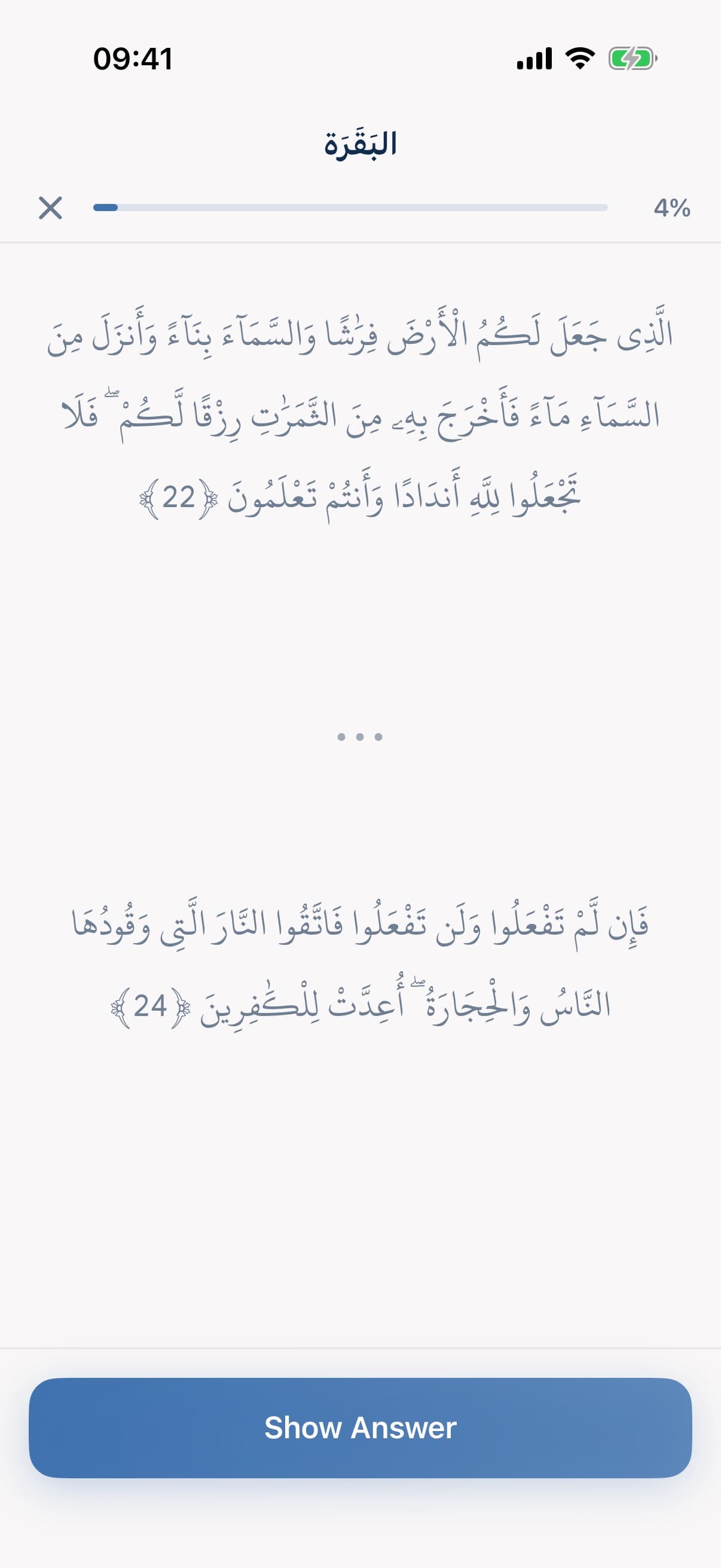
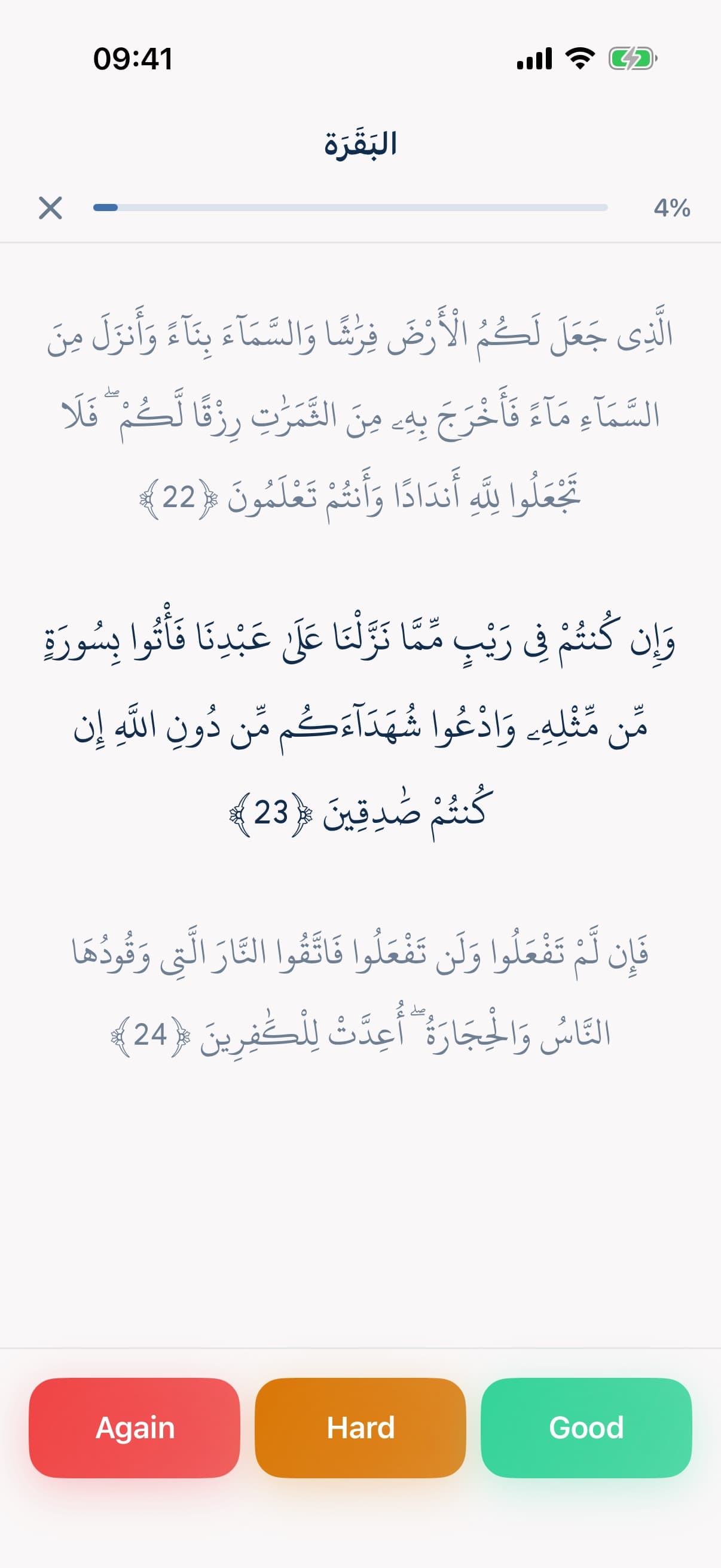
This scheduling is what Qiyam does for you. Every verse has its own review schedule, using SM-2: verses you struggle with come back sooner, solid ones later. Each quiz shows the verse before and the verse after, and you recite what's in between from memory. You reveal the answer, then rate yourself Again, Hard or Good, and "Again" brings the verse back the next day.
A few details follow from how the Qur'an is recited. Verses quizzed together share one rating, so a slip on one verse brings its neighbours back too. Surahs you add as solid start with longer gaps instead of going through every early review. Reviews are spread so one day doesn't pile up, and all overdue verses are shown rather than hiding a backlog.
What to remember
Spaced repetition is not a new way to memorize. It is a way to decide when to revise, so that your time goes to the verses that need it. Recite from memory, grade yourself honestly, let strong pages wait longer, and bring weak ones back soon. Whether you keep the schedule in a notebook or let an app keep it, those four habits are the method.
Sources
- 1Wixted JT, Ebbesen EB (1991). On the Form of Forgetting. Psychological Science.
- 2al-Bukhari Sahih al-Bukhari 5031: the owner of tied camels. Sahih al-Bukhari.
- 3Cepeda NJ, Pashler H, Vul E, Wixted JT, Rohrer D (2006). Distributed practice in verbal recall tasks: A review and quantitative synthesis.. Psychological Bulletin.
- 4Cepeda NJ, Vul E, Rohrer D, Wixted JT, Pashler H (2008). Spacing Effects in Learning. Psychological Science.
- 5Bahrick HP, Bahrick LE, Bahrick AS, Bahrick PE (1993). Maintenance of Foreign Language Vocabulary and the Spacing Effect. Psychological Science.
- 6Karpicke JD, Bauernschmidt A (2011). Spaced retrieval: Absolute spacing enhances learning regardless of relative spacing.. Journal of Experimental Psychology: Learning, Memory, and Cognition.
- 7Roediger HL, Karpicke JD (2006). Test-Enhanced Learning. Psychological Science.
- 8Kornell N (2009). Optimising learning using flashcards: Spacing is more effective than cramming. Applied Cognitive Psychology.
- 9Tabibian B, Upadhyay U, De A, Zarezade A, Schölkopf B, Gomez-Rodriguez M (2019). Enhancing human learning via spaced repetition optimization. Proceedings of the National Academy of Sciences.
Frequently asked questions
How often should I revise a surah I have memorized?
There is no single number: it depends on how well you hold it. A page you stumble on should come back the next day; a page you recite cleanly can wait a few days, then a week, then longer each time it stays clean. Research on facts and vocabulary suggests the best gap grows with how long you need to remember, and hifz is for life.
Is spaced repetition better than the traditional hifz revision cycle?
A fixed cycle is already a form of spacing, with one gap for every page, and its simplicity is a strength. Spaced repetition adjusts the gap page by page, so strong pages take less of your time and weak ones get more. The studies behind it used word pairs and facts, not the Qur'an, so they suggest rather than prove the benefit for hifz.
Does listening to a recitation count as a review?
Not for spaced repetition. A review means reciting from memory first, then checking. Listening or reading lets you recognise the verses, and in studies of prose passages, recalling from memory gave better retention after 2 days and 1 week than rereading.
What is SM-2?
SM-2 is one of the oldest spaced repetition algorithms, used by many flashcard apps. After each review you grade how well you recalled, and it uses that grade to set the next gap: shorter after a weak recall, longer after a clean one. Qiyam uses it to give every verse its own schedule.
Can I use spaced repetition without an app?
Yes. Keep a notebook with each page, the date you revised it, how it went, and the date it is next due. It works well for a few surahs; with several juz, the bookkeeping becomes the hard part.