Qiyam
QiyamAl-Fatiha
How to Memorize Al-Fatiha, the Seven Oft-Repeated Verses
Memorize Al-Fatiha one verse at a time, reciting from memory before adding the next. Why it is called the seven oft-repeated verses, and how to keep it exact.
By Amine Benlaroui, , updated , 5 min read
To memorize Al-Fatiha, take it one verse at a time: listen to a careful reciter, repeat the verse until you can say it without looking, then recite it from memory before adding the next one, always starting again from the beginning. It has only seven verses, and once you know it, every prayer revises it for you. The real work is getting each word right from the start and keeping your attention on what you are saying.
Why is Al-Fatiha called the seven oft-repeated verses?
The name comes from the Qur'an and the Sunnah. Allah says in Surah Al-Hijr:
وَلَقَدْ ءَاتَيْنَٰكَ سَبْعًۭا مِّنَ ٱلْمَثَانِى وَٱلْقُرْءَانَ ٱلْعَظِيمَ
And We have certainly given you, [O Muhammad], seven of the often repeated [verses] and the great Qur'an.
In Sahih al-Bukhari, Abu Sa'id bin Al-Mu'alla reports that the Prophet ﷺ promised to teach him "the greatest Sura in the Qur'an", then said: "Al-Hamdu-Li l-lah Rabbi-l-ʿalamin (i.e. Praise be to Allah, the Lord of the worlds) which is Al-Sab'a Al-Mathani (i.e. seven repeatedly recited Verses) and the Grand Qur'an which has been given to me."1
In Jami' at-Tirmidhi, in a hadith from Abu Hurairah graded sahih, the Prophet ﷺ says of Umm al-Qur'an: "The like of it has neither been revealed in the Tawrah, nor the Injil nor the Zabur, nor in the Furqan. It is the seven oft-repeated, and the Magnificent Qur'an which I was given."2
The repetition is visible in your day. If you recite Al-Fatiha in every rak'ah of the five obligatory prayers, that is 17 times a day. The Prophet ﷺ said: "Whoever does not recite Al-Fatiha in his prayer, his prayer is invalid."3 It is the surah most people learn first, and the one they recite most.
How do you memorize Al-Fatiha step by step?
Whether you are a new Muslim, teaching a child, or relearning it with correct pronunciation, the same steps work.
- Listen first. Play one verse from a slow, careful recitation, several times, while following the text. If you can, learn it from a teacher who hears you recite. Pronunciation learned wrong at the start is hard to undo later, because you will recite it many times a day.
- Repeat one verse until you can say it without looking. Short verses come quickly. Longer ones, like the last verse, take more repetitions.
- Close the text and recite it from memory. This step matters most. Students who recalled passages from memory remembered substantially more 2 days and 1 week later than students who reread them the same number of times, even though rereading made them feel more confident4. Words people produce themselves are also remembered better than the same words simply read5.
- Add the next verse, and start from the beginning each time. Recite verse 1, then verses 1 and 2, then 1 to 3. In prayer you never recite verse 5 alone; you arrive at it from verse 4. Practise the joins, not only the verses.
- Sleep on it, then check in the morning. In one study, 40 people learned foreign vocabulary in two sessions 12 hours apart. Those who slept between the sessions needed half the practice to relearn the words and kept them much better a week and 6 months later6. Learn a few verses in the evening and recite them from memory the next morning before checking.
- Have someone listen. A teacher, a parent or a friend who knows the surah well will hear what you can't: a skipped letter, a shortened vowel.
The studies above used vocabulary and prose, not the Qur'an. They suggest why reciting from memory and spacing your sessions work better than rereading the page many times.
What does each verse of Al-Fatiha say?
Knowing the meaning makes memorizing easier, because each verse leads into the next. It also changes how the surah feels in prayer. In a hadith in Sahih Muslim, the Prophet ﷺ said that Allah the Exalted says: "I have divided the prayer into two halves between Me and My servant, and My servant will receive what he asks."7 The hadith then answers the verses one by one.
ٱلْحَمْدُ لِلَّهِ رَبِّ ٱلْعَٰلَمِينَ
[All] praise is [due] to Allah, Lord of the worlds -
"When the servant says: Praise be to Allah, the Lord of the universe, Allah the Most High says: My servant has praised Me."
ٱلرَّحْمَٰنِ ٱلرَّحِيمِ
The Entirely Merciful, the Especially Merciful,
"And when he (the servant) says: The Most Compassionate, the Merciful, Allah the Most High says: My servant has lauded Me."
مَٰلِكِ يَوْمِ ٱلدِّينِ
Sovereign of the Day of Recompense.
"And when he (the servant) says: Master of the Day of judgment, He remarks: My servant has glorified Me."
إِيَّاكَ نَعْبُدُ وَإِيَّاكَ نَسْتَعِينُ
It is You we worship and You we ask for help.
"And when he (the worshipper) says: Thee do we worship and of Thee do we ask help, He (Allah) says: This is between Me and My servant, and My servant will receive what he asks for."
ٱهْدِنَا ٱلصِّرَٰطَ ٱلْمُسْتَقِيمَ
Guide us to the straight path -
صِرَٰطَ ٱلَّذِينَ أَنْعَمْتَ عَلَيْهِمْ غَيْرِ ٱلْمَغْضُوبِ عَلَيْهِمْ وَلَا ٱلضَّآلِّينَ
The path of those upon whom You have bestowed favor, not of those who have evoked [Your] anger or of those who are astray.
"Then, when he (the worshipper) says: Guide us to the straight path, the path of those to whom Thou hast been Gracious not of those who have incurred Thy displeasure, nor of those who have gone astray, He (Allah) says: This is for My servant, and My servant will receive what he asks for."
Read the hadith once before you memorize, and again once you know the surah. Its order follows the surah's own: praise, then the One praised, then the Day of Judgment, then worship and asking for help, then the request for guidance. If you lose your place, that order brings you back.
What if you find Al-Fatiha hard to memorize?
Adults who learn Arabic letters late, and children who are just starting, often find the longer verses slow going. That is normal, and it is not a reason to feel behind. The Prophet ﷺ said: "One who is proficient in the Qur'an is associated with the noble, upright, recording angels; and he who falters in it, and finds it difficult for him, will have two rewards."8
Practical help for a hard verse:
- Split it at a natural pause and memorize each half, then join them.
- Recite it aloud, not in your head. You need to hear your own pronunciation.
- Come back to it after a gap. A verse that refuses to stick in a long sitting often comes easily after a night's sleep.
How do you keep Al-Fatiha exact for life?
Once you know Al-Fatiha, forgetting it is rarely the risk. You recite it too often. Two other things drift instead.
Pronunciation. A small mistake, repeated 17 times a day, becomes the most practised version of the verse. Every few months, recite it slowly to a teacher or to someone whose recitation you trust, or record yourself and compare it with a careful reciter.
Attention. The more fluent a surah becomes, the easier it is to recite it while your mind is elsewhere. Reading the hadith from Sahih Muslim again, and pausing on its answers when you pray, is one way to keep each verse meaningful.
Where does Qiyam fit with Al-Fatiha?
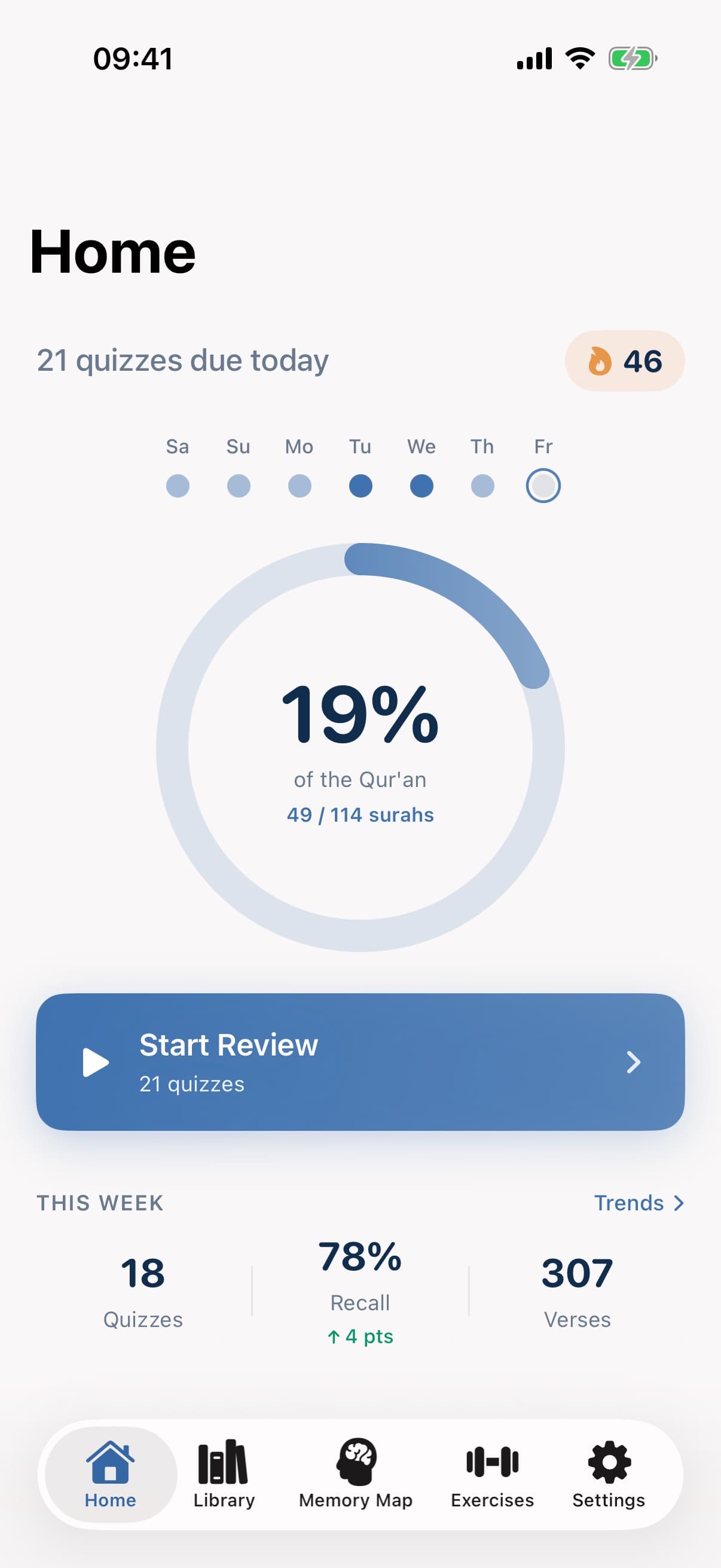
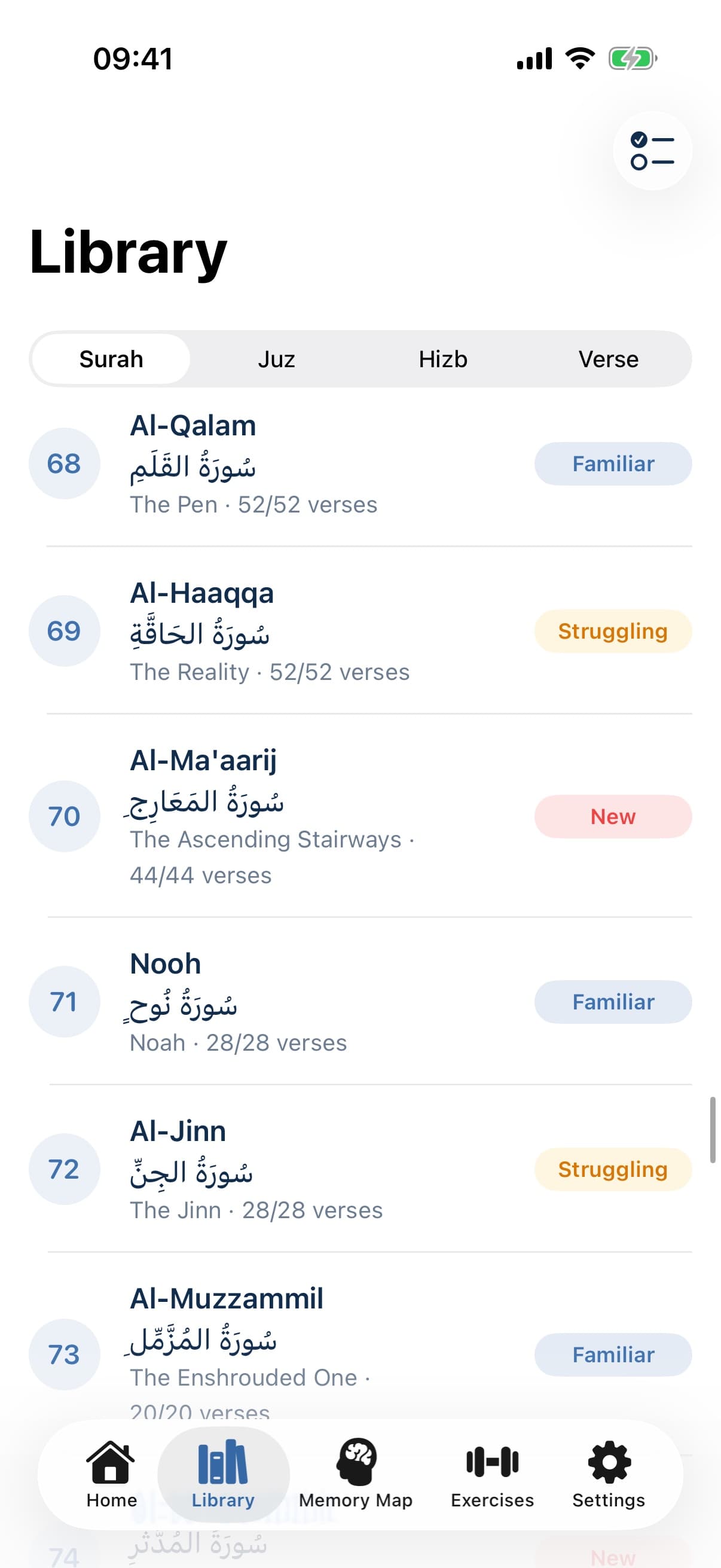
Al-Fatiha is the one surah that doesn't need a revision schedule, because the prayer already revises it. In Qiyam you can exclude a surah you recite every day from reviews, and include it again anytime, so your reviews go to the surahs that don't get that daily repetition: the ones you memorized for prayer, for Juz Amma, or beyond.
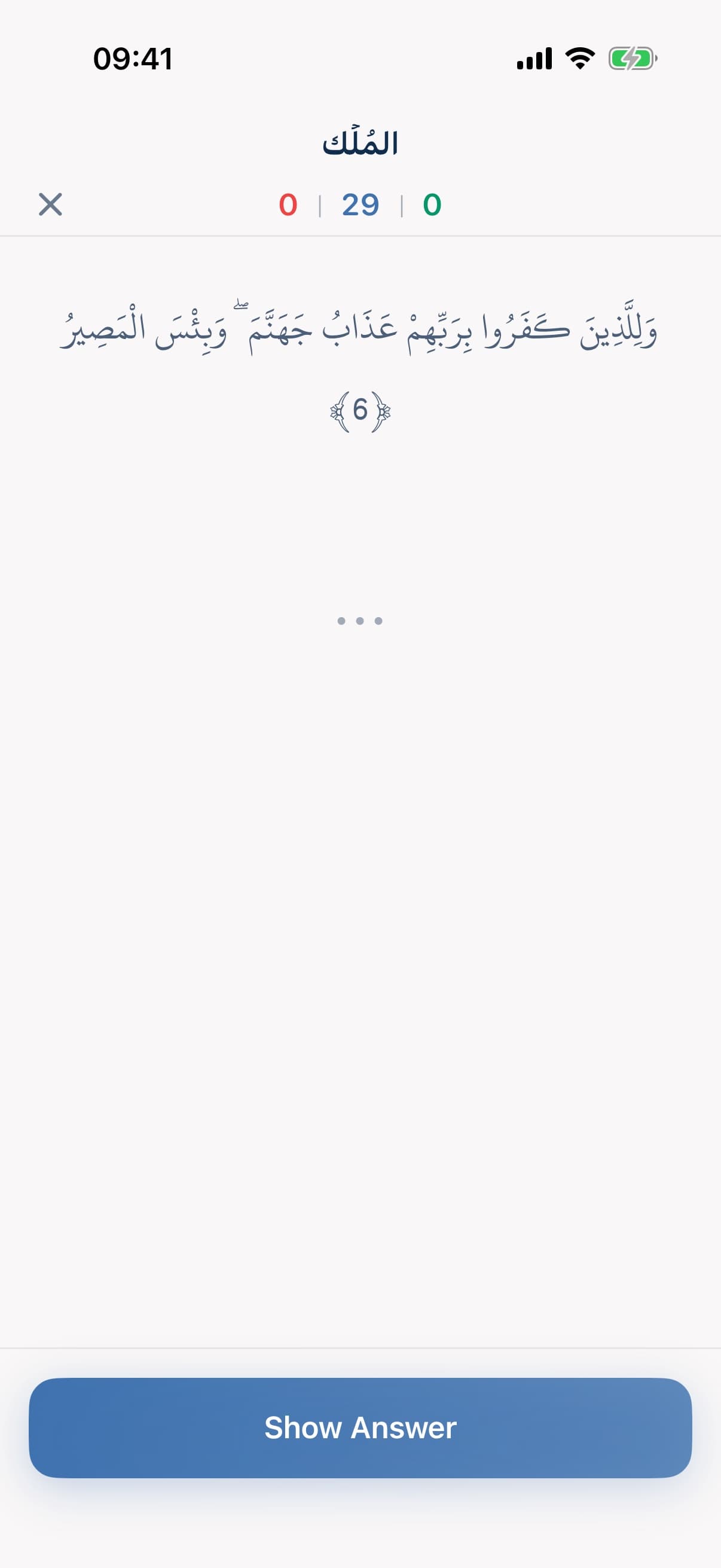
The joins between verses are worth practising for every surah you memorize. In Exercises, Verse by Verse shows you one verse and you recite only the next one, the link that matters in recitation. Here it is in Surah Al-Mulk:
Start today
Pick a quiet moment, play the first verse of Al-Fatiha, and repeat it until you can say it without looking. Recite it from memory before you add the next. If you already know the surah, read the hadith of the divided prayer once more and recite slowly in your next prayer. Seven verses, learned well, are recited for the rest of your life.
Sources
- 1al-Bukhari Sahih al-Bukhari 4474: the greatest surah in the Qur'an. Sahih al-Bukhari.
- 2al-Tirmidhi Jami' at-Tirmidhi 2875: the seven oft-repeated (graded sahih). Jami' at-Tirmidhi.
- 3al-Bukhari Sahih al-Bukhari 756: reciting Al-Fatiha in prayer. Sahih al-Bukhari.
- 4Roediger HL, Karpicke JD (2006). Test-Enhanced Learning. Psychological Science.
- 5Slamecka NJ, Graf P (1978). The generation effect: Delineation of a phenomenon.. Journal of Experimental Psychology: Human Learning and Memory.
- 6Mazza S, Gerbier E, Gustin MP, Kasikci Z, Koenig O, Toppino TC, Magnin M (2016). Relearn Faster and Retain Longer. Psychological Science.
- 7Muslim ibn al-Hajjaj Sahih Muslim 395a: the prayer divided into two halves. Sahih Muslim.
- 8Muslim ibn al-Hajjaj Sahih Muslim 798a: the one who falters has two rewards. Sahih Muslim.
Frequently asked questions
How long does it take to memorize Al-Fatiha?
There is no fixed time: it depends on how familiar the Arabic sounds are to you. Short daily sessions, one verse at a time, with a check from memory the next morning, work better than one long sitting. The studies on recall and sleep cited in this article point the same way.
Why is Al-Fatiha called the seven oft-repeated verses?
The name comes from Surah Al-Hijr (15:87) and from the Prophet ﷺ, who called Al-Fatiha "Al-Sab'a Al-Mathani (i.e. seven repeatedly recited Verses)" in a hadith in Sahih al-Bukhari (4474). It has seven verses and is recited in every prayer.
What is the hadith of the divided prayer?
In Sahih Muslim (395a), the Prophet ﷺ reports that Allah says: "I have divided the prayer into two halves between Me and My servant, and My servant will receive what he asks." The hadith then answers each verse of Al-Fatiha in turn, from the praise in verse 2 to the request for guidance at the end.
Should I learn the meaning before memorizing Al-Fatiha?
You don't need to, but reading the translation once first helps: you know where each verse leads, which makes the order easier to hold. Reading the hadith of the divided prayer alongside it gives you the surah's structure in plain words.
How can I check my pronunciation of Al-Fatiha?
Recite it slowly to a teacher or someone whose recitation you trust. If no one is available, record yourself and compare it, verse by verse, with a slow and careful reciter. Do it every few months, because a small mistake repeated in every prayer becomes the version you know best.