Qiyam
QiyamHifz
How to Memorize the Stories of the Prophets in the Quran
Memorize the prophets' stories passage by passage: start with Surah Yusuf, learn each story scene by scene, and revise retold passages side by side.
By Amine Benlaroui, , updated , 5 min read
To memorize the stories of the prophets in the Quran, treat each story as a passage with a beginning and an end. Start with Surah Yusuf, which tells one story across almost the whole surah, then add the longer single accounts, such as Musa in Surah Ta-Ha, before the shorter retellings spread across other surahs. Learn the order of events before the words, and when a prophet's story appears in several surahs, revise those passages side by side so their wording doesn't blur.
How are the prophets' stories laid out in the Quran?
Some stories are told once, in one place. Others return again and again. Counting where each prophet is named in the Arabic text shows how different they are:
| Prophet | Surahs that name him | Some of the longer accounts |
|---|---|---|
| Musa (Moses) | 34 | Al-A'raf, Ta-Ha, Ash-Shu'ara, Al-Qasas |
| Ibrahim (Abraham) | 24 | Al-An'am, Maryam, Al-Anbiya, Ash-Shu'ara, As-Saffat |
| Yusuf (Joseph) | 3 | Surah Yusuf, which holds 24 of the 26 verses that name him |
Musa is named in more than 130 verses. Yusuf is named in Surah Al-An'am, in Surah Ghafir, and throughout his own surah. For memorizing, this is the difference that matters: a story told once is one passage to learn, and a story told many times is several passages that resemble each other.
The last verse of Surah Yusuf says what these stories are for:
لَقَدْ كَانَ فِى قَصَصِهِمْ عِبْرَةٌۭ لِّأُو۟لِى ٱلْأَلْبَٰبِ ۗ مَا كَانَ حَدِيثًۭا يُفْتَرَىٰ وَلَٰكِن تَصْدِيقَ ٱلَّذِى بَيْنَ يَدَيْهِ وَتَفْصِيلَ كُلِّ شَىْءٍۢ وَهُدًۭى وَرَحْمَةًۭ لِّقَوْمٍۢ يُؤْمِنُونَ
There was certainly in their stories a lesson for those of understanding. Never was the Qur'an a narration invented, but a confirmation of what was before it and a detailed explanation of all things and guidance and mercy for a people who believe.
Why does a story help you memorize?
A story gives you a second thread besides the words. When you know what happens next, you know roughly which verse comes next. Yusuf's brothers put him into a well, travellers find him, he is sold, he is tested in the house of al-'Azeez, he is imprisoned. Each event leads to the next, and that order holds the verses in place.
This helps most at the joins, where a memorizer usually stalls: the end of one scene and the start of the next. If you know the next scene, you have somewhere to go. It doesn't replace the words. You still memorize every verse, and you still recite from memory to check it.
Where should you start?
Start with Surah Yusuf. It opens by calling what follows the best of stories:
نَحْنُ نَقُصُّ عَلَيْكَ أَحْسَنَ ٱلْقَصَصِ بِمَآ أَوْحَيْنَآ إِلَيْكَ هَٰذَا ٱلْقُرْءَانَ وَإِن كُنتَ مِن قَبْلِهِۦ لَمِنَ ٱلْغَٰفِلِينَ
We relate to you, [O Muhammad], the best of stories in what We have revealed to you of this Qur'an although you were, before it, among the unaware.
Then the story runs from Yusuf's dream in verse 4 to his parents' arrival in verse 101: 98 verses, from page 235 to page 247 of the standard mushaf, across the end of juz 12 and the start of juz 13. Split it into scenes and memorize one scene at a time:
| Scene | Verses |
|---|---|
| The dream | 12:4–6 |
| The brothers and the well | 12:7–18 |
| Found by travellers, sold in Egypt | 12:19–22 |
| In the house of al-'Azeez | 12:23–29 |
| The women of the city, then prison | 12:30–35 |
| The two prisoners' dreams | 12:36–42 |
| The king's dream | 12:43–49 |
| Yusuf is cleared and given charge | 12:50–57 |
| The brothers come for grain | 12:58–68 |
| Binyamin and the king's cup | 12:69–79 |
| The brothers return to Ya'qub | 12:80–87 |
| Yusuf makes himself known | 12:88–93 |
| The family reunited | 12:94–101 |
Each scene is 3 to 12 verses. Before you memorize a scene, read its translation once, so you know what happens in it.
Which passages come next?
Once Surah Yusuf is solid, the longer accounts that sit in one place are the natural next step. Each is a continuous passage, so you memorize it the same way: scene by scene, in order.
| Passage | Verses | Length | Pages |
|---|---|---|---|
| Musa, from the fire to the calf | Ta-Ha 20:9–98 | 90 verses | 312–318 |
| Musa, from his birth to Pharaoh's end | Al-Qasas 28:3–43 | 41 verses | 385–390 |
| Ibrahim and the idols | Al-Anbiya 21:51–73 | 23 verses | 326–328 |
| Zakariyya and Yahya | Maryam 19:2–15 | 14 verses | 305–306 |
| Maryam and 'Isa | Maryam 19:16–36 | 21 verses | 306–307 |
| Dawud and Sulayman | Sad 38:17–40 | 24 verses | 454–455 |
| Dhul-Qarnayn | Al-Kahf 18:83–98 | 16 verses | 302–304 |
| Luqman's advice to his son | Luqman 31:12–19 | 8 verses | 412 |
If you already memorize surah by surah, you don't have to follow this order. Use it to notice which story you are inside when you reach these pages, and to split long surahs at the story's edges rather than at random.
Does meeting a story again in another surah count as revision?
Only partly. Hearing Musa's story in Al-Qasas after you have memorized it in Ta-Ha revises the story: what happens, and in what order. It does not revise the words of Ta-Ha, because the words are different.
That difference is where the risk lies. The retellings often share their opening words and then branch. Musa sees a fire and is called when he reaches it, in three surahs:
فَلَمَّآ أَتَىٰهَا نُودِىَ يَٰمُوسَىٰٓ
And when he came to it, he was called, "O Moses,
فَلَمَّا جَآءَهَا نُودِىَ أَنۢ بُورِكَ مَن فِى ٱلنَّارِ وَمَنْ حَوْلَهَا وَسُبْحَٰنَ ٱللَّهِ رَبِّ ٱلْعَٰلَمِينَ
But when he came to it, he was called, "Blessed is whoever is at the fire and whoever is around it. And exalted is Allah, Lord of the worlds.
فَلَمَّآ أَتَىٰهَا نُودِىَ مِن شَٰطِئِ ٱلْوَادِ ٱلْأَيْمَنِ فِى ٱلْبُقْعَةِ ٱلْمُبَٰرَكَةِ مِنَ ٱلشَّجَرَةِ أَن يَٰمُوسَىٰٓ إِنِّىٓ أَنَا ٱللَّهُ رَبُّ ٱلْعَٰلَمِينَ
But when he came to it, he was called from the right side of the valley in a blessed spot - from the tree, "O Moses, indeed I am Allah, Lord of the worlds."
Ta-Ha and Al-Qasas open this verse with the same three words; An-Naml uses a different verb in second place. Then each continues differently. When you recite at speed, the shared opening can carry you into the wrong surah. Why this happens in prayer and not at your desk is explained in why you mix up similar verses.
Research on memory points to a reason to take this seriously. In three studies, people who repeatedly recalled some members of a category, such as some fruits, later recalled the other, unpractised members of that category less well1. These were word lists, not verses. It suggests that always reciting one version of a shared phrase may make the other version harder to reach.
What helps:
- Revise parallel passages together. When you revise Ta-Ha 20:9–24, recite An-Naml 27:7–12 and Al-Qasas 28:29–35 in the same session.
- Name the difference. Say out loud which word each surah uses at the fork, and what comes after it.
- Mix them, even if it feels worse. People who studied paintings by different artists mixed together were better at recognising each artist's style in new paintings than those who studied one artist at a time, yet they rated the grouped way as more effective, even after their own results showed the opposite2.
How do you memorize a long story passage?
- Read the translation of the whole story first, once, so you know where it goes.
- Split it into scenes of a size you can learn in a sitting.
- Memorize scene by scene, reciting from memory before you check. Students who recalled passages from memory retained substantially more after 2 days and 1 week than students who reread them, though rereading felt more reliable3.
- Practise the joins. Recite the last verse of one scene and continue into the next without looking.
- Revise in passages, not single verses, and spread the reviews out so each scene comes back after a gap.
How does Qiyam help with story passages?
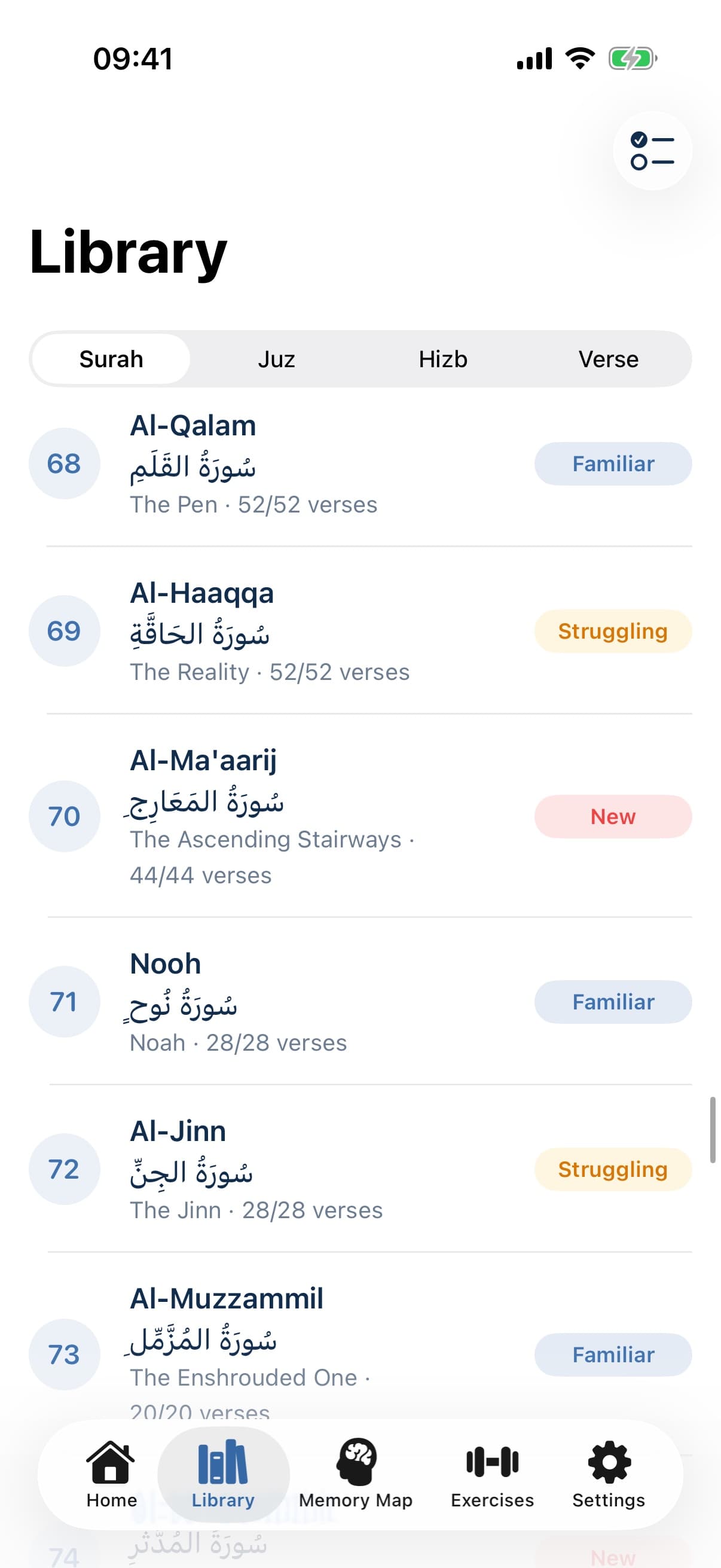
Qiyam lets you add what you've memorized by verse, surah, juz, hizb or page, so you can add a story scene by scene as you learn it, and set how well you know it. The library then shows each surah with how much of it you've added and its level.
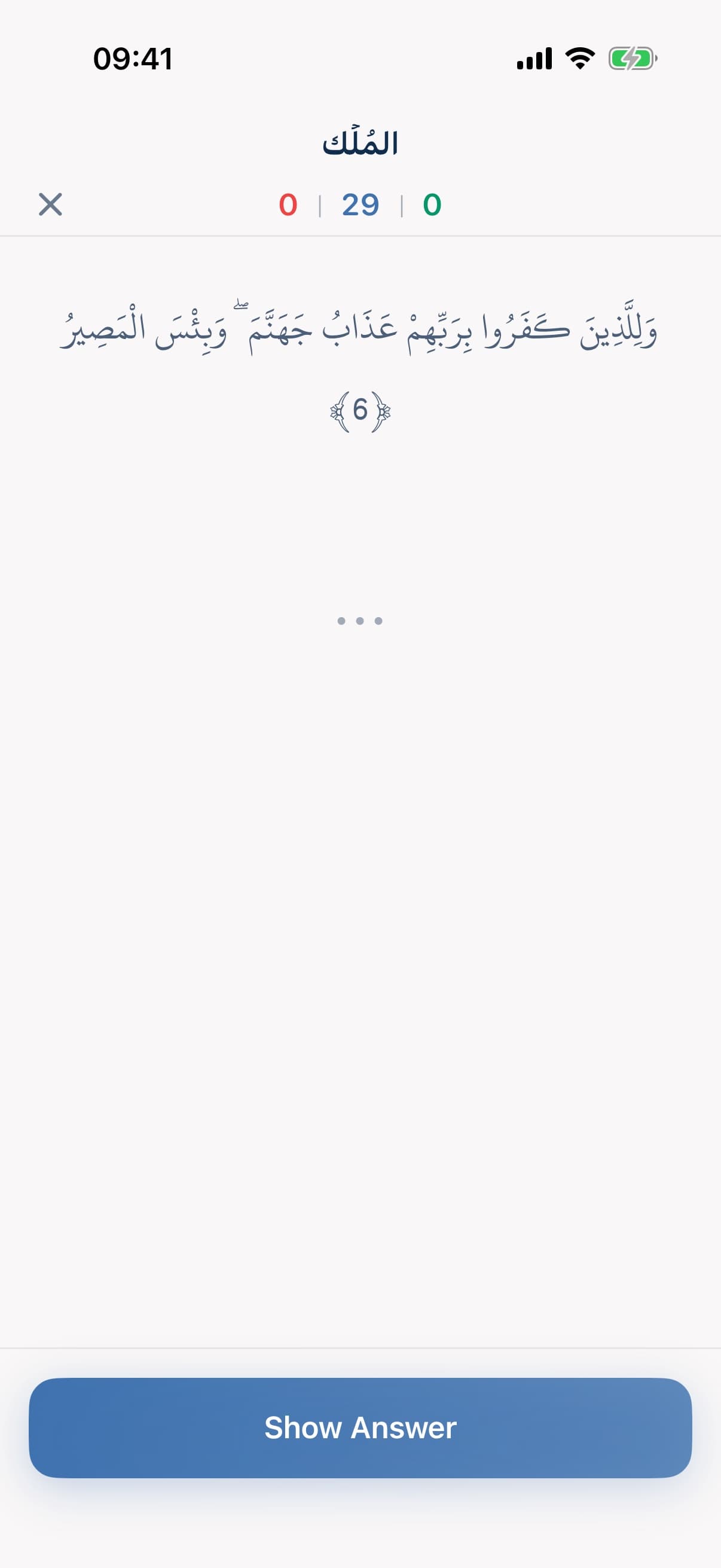
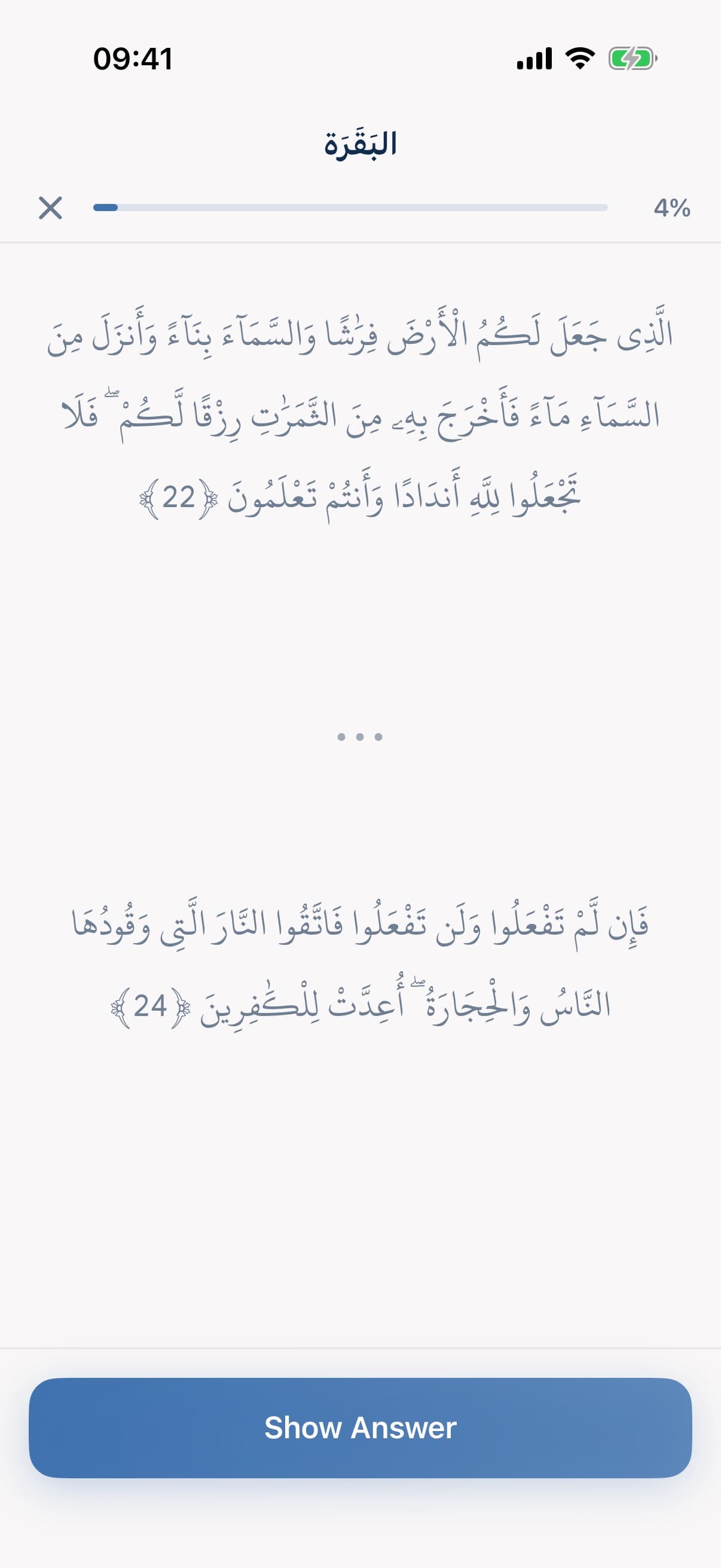
Every verse has its own review schedule, and the verses due on a day are grouped into short passages from the same surah, up to 150 words each, filling small gaps so you recite a continuous stretch. Verses quizzed together share one rating, because the Qur'an is recited in context: a slip on one verse of a scene brings its neighbours back too. For the joins, Verse by Verse in Exercises shows one verse and you recite only the next one.
Your next step
Pick one story. Surah Yusuf is the easiest place to begin because it stays in one place. Read the translation of its first scene, 12:4–6, then memorize those three verses this week and recite them from memory before you add the brothers and the well.
Sources
- 1Anderson MC, Bjork RA, Bjork EL (1994). Remembering can cause forgetting: Retrieval dynamics in long-term memory.. Journal of Experimental Psychology: Learning, Memory, and Cognition.
- 2Kornell N, Bjork RA (2008). Learning Concepts and Categories. Psychological Science.
- 3Roediger HL, Karpicke JD (2006). Test-Enhanced Learning. Psychological Science.
Frequently asked questions
Which prophet's story should I memorize first?
Surah Yusuf is the easiest place to start, because the story stays in one place: from Yusuf's dream in 12:4 to the family's reunion in 12:101, 98 verses over about 13 pages. Split it into scenes of 3 to 12 verses and learn one scene at a time.
Which prophet is mentioned most in the Quran?
By name, Musa: a count of the Arabic text finds him named in 34 surahs and more than 130 verses. Ibrahim is named in 24 surahs. Yusuf is named in only 3, and 24 of those 26 verses are in Surah Yusuf.
Why do I mix up the story of Musa in different surahs?
Because the retellings often share their opening words and then branch. When Musa reaches the fire, Ta-Ha (20:11) and Al-Qasas (28:30) open the verse with the same three words, An-Naml (27:8) changes the second, and all three continue differently. Revising the parallel passages in the same session, and naming the word where they split, helps keep them apart.
Should I memorize the Quran by story instead of in order?
You don't have to choose. Most people memorize surah by surah; the story passages are useful as natural units inside that order, so you split long surahs at the edges of a story rather than at random. Memorizing one prophet's passages together is mainly useful when you revise similar retellings.