Qiyam
Revision
How Busy Professionals Can Memorize and Keep the Quran
With a demanding job, hifz works in short daily sessions: memorize a little in the evening, recite it from memory next morning, and revise on growing gaps.
By Amine Benlaroui, , updated , 5 min read

Busy professionals can memorize the Quran and keep it with one or two short sessions a day, tied to moments the day already has. Memorize a small amount, recite it from memory rather than rereading it, and bring older pages back after growing gaps. Research on learning, done with vocabulary, facts and maths rather than the Qur'an, suggests short spaced sessions keep more than long sessions you can only fit in at weekends.
Why doesn't waiting for a quieter season work?
The common plan is to start seriously once work calms down. Work rarely calms down for long: one project ends and another begins. A plan that needs free hours fails in the weeks that matter most, and those are most weeks.
A plan built for your busiest week survives your quiet ones too. That means a plan measured in minutes, not hours, and one that expects missed days rather than breaking on them.
How much time do you need each day?
Less than most people think, as long as it is spread out. In one study, 216 college students learned a kind of maths problem. Splitting the same 10 practice problems across two sessions a week apart made no difference on a test 1 week later, but an extremely large difference on a test 4 weeks later. Doing 9 problems instead of 3 in a single session had no effect on scores 1 or 4 weeks later1.
For hifz, that suggests reciting a page ten more times tonight is not what keeps it next month. Bringing it back next week is.
Spacing also saves time once you are maintaining what you know. In a 9-year study, 4 people learned and relearned 300 word pairs. Thirteen relearning sessions spaced 56 days apart gave retention comparable to 26 sessions spaced 14 days apart2. Only four people took part, but the pattern is the one a busy person needs: wider gaps, fewer sessions, the same result.
There is more on this in you don't need 2 hours a day.
When should you fit it in?
Tie each session to something you already do every day, so you don't have to remember to start it:
- after Fajr, before you open your phone;
- in the car or on the train, before you walk into the office;
- after you pray Dhuhr at work;
- after Isha, before you go to bed.
Two sessions work well: new memorization in the evening, revision in the morning. In one study, 40 people practised foreign vocabulary to a perfect level in two sessions 12 hours apart. Those who learned in the evening, slept, and relearned the next morning needed half the practice to relearn and retained much more a week and 6 months later than those who did both sessions in one day3. In another, high-school students remembered vocabulary better when sleep followed within a few hours of learning, whatever the time of day4.
So the new lines go in the evening and the check comes the next morning. More on timing in the best time of day for Quran memorization.
Can you memorize on your commute?
Yes, but recite, don't only listen. Listening to a reciter helps you learn how a new passage sounds. For revision, it lets you recognise the verses rather than produce them.
Students who recalled prose passages from memory did worse than rereaders on a test 5 minutes later, but substantially better 2 days and 1 week later, even though rereading made them more confident5. In another study, once students could recall a word, studying it again had no effect on later recall, while testing it again had a large positive effect, and their predictions of their own performance were unrelated to how they actually did6.
A commute routine that uses this:
- Play the first verse of the page you are revising.
- Pause the audio and recite the next few verses from memory.
- Play them to check.
- Note where you hesitated, and start there tomorrow.
How much should you memorize at once?
Less than your ambition says, and revise more than you memorize. A target of a page a day often collapses in the first heavy week at work, and the pages that went in fast come out fast.
One study gives a useful rule of thumb. Across 3 experiments, 533 students learned concepts by recalling them, and relearning sessions had large effects on retention 1 to 4 months later at little extra cost. The authors recommend recalling an item correctly 3 times when first learning it, then relearning it 3 times at widely spaced intervals7. The material was concepts, not memorised text, but it translates simply to hifz:
- On the day: recite the new lines correctly from memory 3 times.
- Afterwards: bring them back the next morning, again a few days later, and again a week or more after that.
What does a realistic week look like?
| When | How long | What |
|---|---|---|
| Weekday mornings | 10 minutes | Recite from memory what you learned last night, then the pages due for revision |
| Weekday evenings | 10 minutes | Memorize two or three new lines, recite them 3 times from memory |
| Commute | as it comes | Pause-and-recite revision of older pages |
| One weekend morning | 30 minutes | Revise older pages; no new memorization |
These are starting numbers, not rules. If a week at work is heavy, drop the evening session and keep the morning one. Revision protects what you already hold; new lines can wait a week.
What should you do after a bad week?
You will have weeks where work takes everything: a launch, a deadline, a sick child. Don't restart from the beginning, and don't plan to make it all up on Saturday. Cramming the missed revision into one long sitting turns spacing back into massing.
Start again the next morning with one short session, on the pages that have waited longest. If a passage feels hard to get back, the Prophet ﷺ said: "One who is proficient in the Qur'an is associated with the noble, upright, recording angels; and he who falters in it, and finds it difficult for him, will have two rewards."8
It also helps to tell your family. Say which surah you are working on this month. A spouse can hold the mushaf while you recite after dinner; a child can follow along and stop you at a mistake. The Prophet ﷺ said: "The best among you (Muslims) are those who learn the Qur'an and teach it."9 At home, teaching can be as simple as reciting together.
How does Qiyam fit into a busy day?
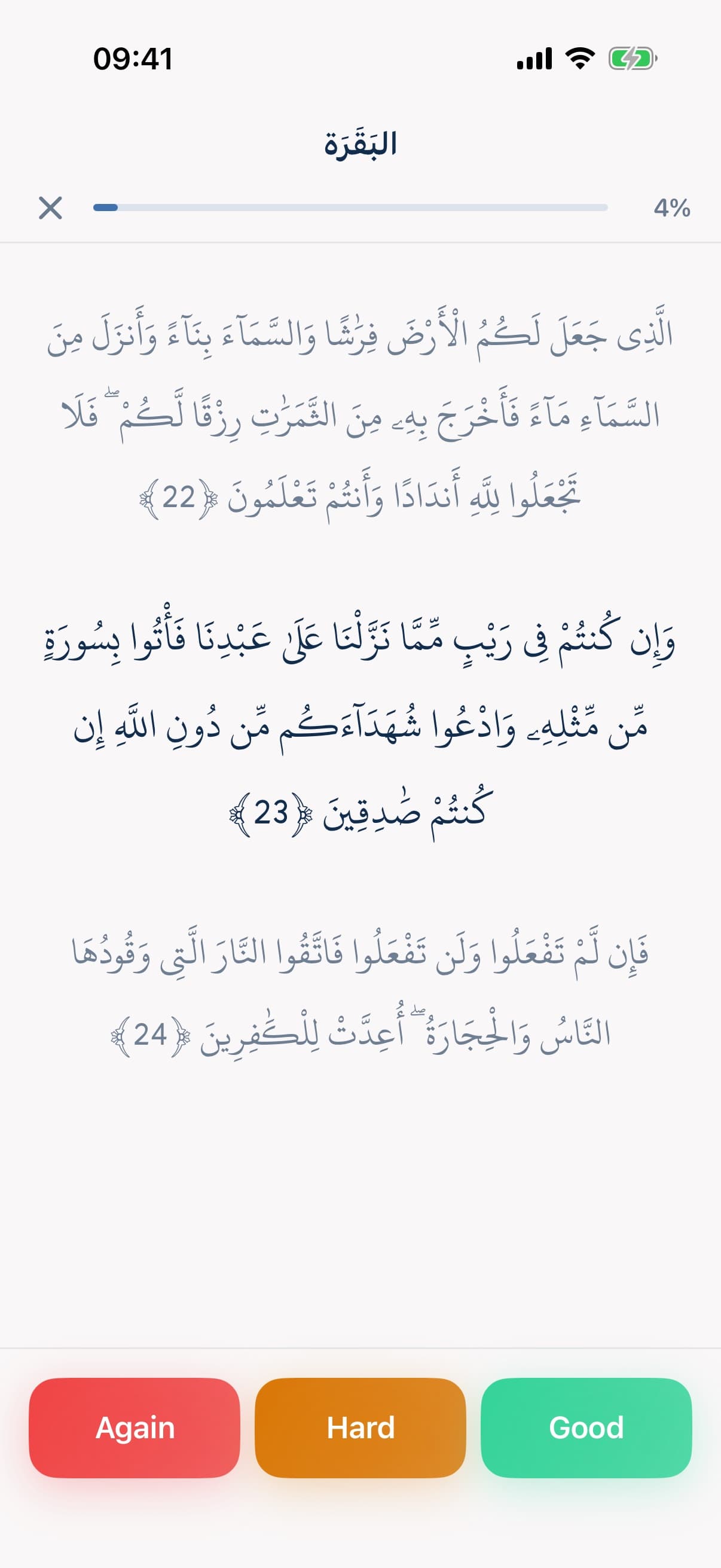
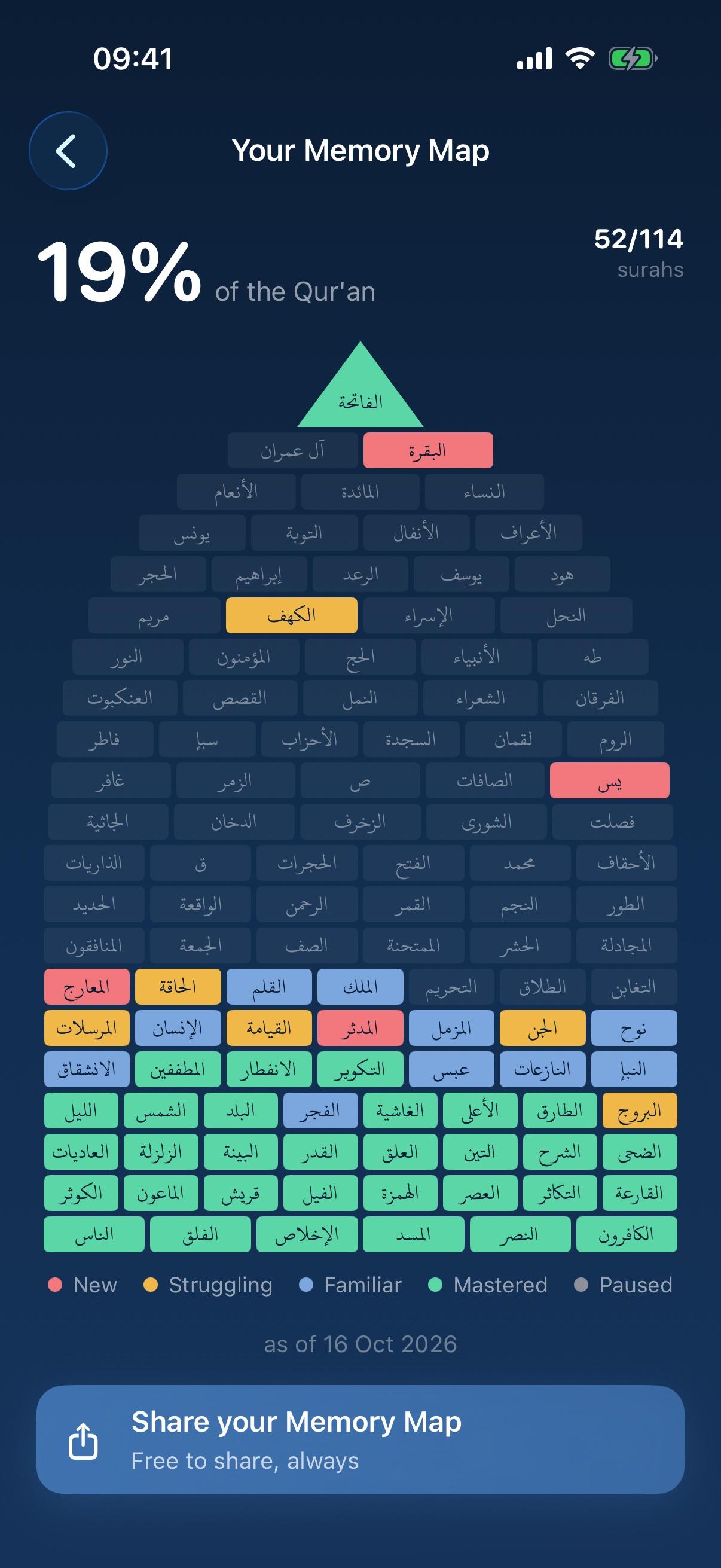
The hardest part of this plan is the bookkeeping: which pages are due, which can wait. That is what Qiyam keeps for you. Every verse has its own review schedule: verses you struggle with come back sooner, solid ones later. Home shows the quizzes due today.
The verses due on a day are grouped into short passages from the same surah, up to 150 words each, which suits a session between meetings. Reviews are spread so one day doesn't pile up, and all overdue verses are shown rather than hiding a backlog. One daily reminder arrives at the hour you usually review, with the number of quizzes due.
The whole Qur'an ships inside the app, so you can review without a connection, on a train or a plane. The daily streak counts the days the schedule legitimately leaves empty, so a quiet day never breaks it, and a freeze protects a missed day.
The short version
Memorize a little in the evening. Recite it from memory the next morning. Let older pages come back after growing gaps, and use your commute to recite, not only to listen. When work takes a week from you, start again with one short session. A hifz kept in ten-minute pieces is still a hifz kept.
Sources
- 1Rohrer D, Taylor K (2006). The effects of overlearning and distributed practise on the retention of mathematics knowledge. Applied Cognitive Psychology.
- 2Bahrick HP, Bahrick LE, Bahrick AS, Bahrick PE (1993). Maintenance of Foreign Language Vocabulary and the Spacing Effect. Psychological Science.
- 3Mazza S, Gerbier E, Gustin MP, Kasikci Z, Koenig O, Toppino TC, Magnin M (2016). Relearn Faster and Retain Longer. Psychological Science.
- 4Gais S, Lucas B, Born J (2006). Sleep after learning aids memory recall. Learning & Memory.
- 5Roediger HL, Karpicke JD (2006). Test-Enhanced Learning. Psychological Science.
- 6Karpicke JD, Roediger HL (2008). The Critical Importance of Retrieval for Learning. Science.
- 7Rawson KA, Dunlosky J (2011). Optimizing schedules of retrieval practice for durable and efficient learning: How much is enough?. Journal of Experimental Psychology: General.
- 8Muslim ibn al-Hajjaj Sahih Muslim 798a: the one who falters has two rewards. Sahih Muslim.
- 9al-Bukhari Sahih al-Bukhari 5027: the best among you learn the Qur'an and teach it. Sahih al-Bukhari.
Frequently asked questions
How many minutes a day do I need to memorize the Quran with a full-time job?
Research gives no minimum, but it does say that spreading practice out matters more than making sessions long. Two 10-minute sessions, one in the evening for new lines and one in the morning to recite them from memory, is a realistic starting point you can keep in a busy week.
Is listening to the Quran in the car enough to memorize it?
Listening helps you learn how a new passage sounds, but for revision you need to recite from memory. Play the first verse, pause, recite the next few yourself, then play them to check. In studies of prose, recalling from memory kept more after 2 days and 1 week than rereading.
What should I do if I miss a week of revision?
Don't restart from the beginning, and don't try to revise everything in one long sitting. Start again the next morning with one short session on the pages that have waited longest, and let the rest come back over the following days.
Should I memorize new pages or revise old ones when time is short?
Revise first. Revision protects what you already hold, and new lines can wait a week. In a heavy week, drop the evening memorization session and keep the morning revision.