Qiyam
Hadith
The best among you are those who learn the Quran and teach it
What the hadith "the best among you are those who learn the Quran and teach it" says, where it is recorded, and simple ways to learn and teach it today.
By Amine Benlaroui, , updated , 5 min read
"The best among you are those who learn the Qur'an and teach it" is a hadith narrated by ʿUthman ibn ʿAffan and recorded in Sahih al-Bukhari, number 50271. It names two acts, learning the Quran and teaching it, and places the people who do them among the best. Its words don't mention a level, a setting or a qualification, so the practical question for most readers is how to take part in both.
This article gives the hadith's wording and where it is recorded, what other authentic hadiths add, why teaching also strengthens your own memorization, and small ways to learn and teach this week. It doesn't give rulings: for the hadith's full explanation, ask a scholar or a teacher you trust.
Where is this hadith recorded?
Sahih al-Bukhari records it twice, one narration after the other, both from ʿUthman. In the English printed on sunnah.com:
The best among you (Muslims) are those who learn the Qur'an and teach it.1
The most superior among you (Muslims) are those who learn the Qur'an and teach it.2
Sahih al-Bukhari is accepted as authentic. You can read the Arabic and the chain of narrators on the sunnah.com pages linked in the sources below.
What does the hadith ask of an ordinary Muslim?
Read plainly, it pairs learning with teaching. It doesn't say "those who have finished learning", and it doesn't say "those who teach in a school". Learning comes first in the sentence, and teaching follows it.
Scholars have explained this hadith at length, and this article doesn't replace them. What is visible in the words themselves is already enough to act on: keep learning the Quran, and pass on what you have learned.
Does learning count if it is slow and difficult?
Another authentic hadith speaks directly to people who find the Quran hard. Aisha reported that the Prophet ﷺ said that the one who is proficient in the Quran is with the noble, upright recording angels, and the one who falters in it and finds it difficult will have two rewards3.
If you are an adult memorising late, if your tongue stumbles on long words, or if you keep losing the same page, this hadith speaks to your situation directly. Finding it hard is part of learning, not a sign that you should stop.
The Quran also describes itself as made easy for remembrance:
وَلَقَدْ يَسَّرْنَا ٱلْقُرْءَانَ لِلذِّكْرِ فَهَلْ مِن مُّدَّكِرٍۢ
And We have certainly made the Qur'an easy for remembrance, so is there any who will remember?
What counts as teaching the Quran?
The hadith doesn't name a setting. In daily life, teaching the Quran often looks like this:
- a parent reciting Al-Fatiha with a child, phrase by phrase, until the child says it alone;
- a friend listening to you recite a page and pointing out a slip;
- a student in a halaqa helping a newer student with a short surah;
- explaining a verse's translation to someone who asked about it.
Listening is part of it too. The Prophet ﷺ asked ʿAbdullah ibn Masʿud to recite the Quran to him. When ʿAbdullah asked whether he should recite it to him when it had been revealed to him, he answered: "I like to hear it from others."4 Reciting to each other runs in both directions.
Another hadith speaks of guiding others to good in general. Abu Masʿud al-Ansari reported that the Prophet ﷺ said: "One who guides to something good has a reward similar to that of its doer."5
Why does teaching help your own memorization?
There is also a practical side, and research supports it. In a 2018 study, learners either taught material without notes, taught it with notes, only practised recalling it, or solved unrelated arithmetic problems. On a comprehension test one week later, both those who taught without notes and those who practised recall did better than those who taught with notes or did the arithmetic6. The authors conclude that the benefit of teaching is possibly a retrieval benefit: you gain because you have to bring the material up from memory.
That study used educational material, not the Quran. Still, it suggests something useful for hifz. Teaching a surah from memory is also revising it. Teaching it with the mushaf open in front of you may help your student, but it likely does less for your own memory.
A larger body of research points the same way. A meta-analysis of practice testing found practice tests more beneficial for learning than restudying and every other comparison condition7. Reciting to someone who can catch your mistakes is a practice test.
How can you learn the Quran with a plan?
Learning is the first half of the hadith, and for most people it has two parts: memorising new verses and keeping the old ones. Both depend on reciting from memory rather than reading again.
Three habits cover most of it:
- Learn a small, fixed amount each day, and recite it from memory before you stop.
- Bring each page back after gaps that grow: the next day, a few days later, a week later.
- Recite to someone at least once a week, a teacher, a parent or a friend, so that someone hears your slips.
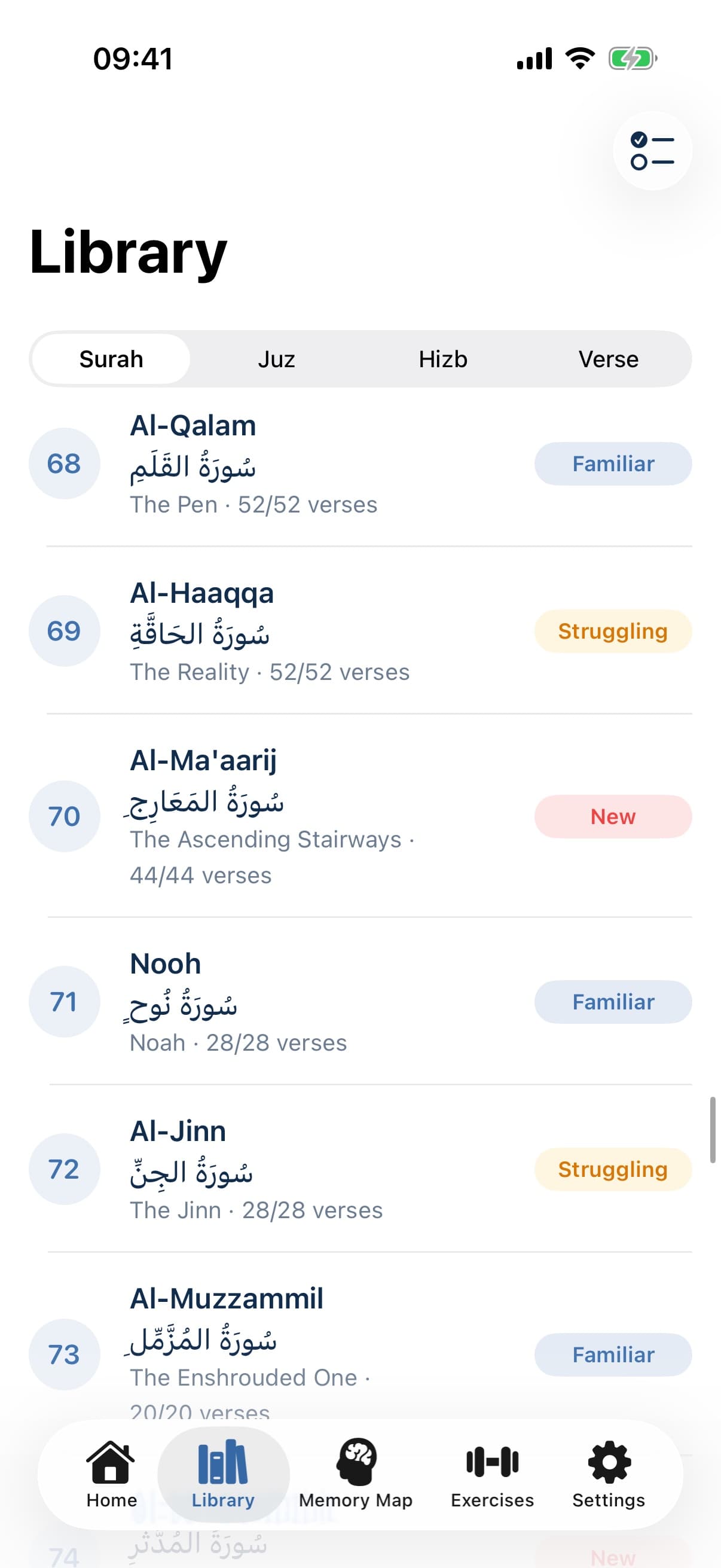
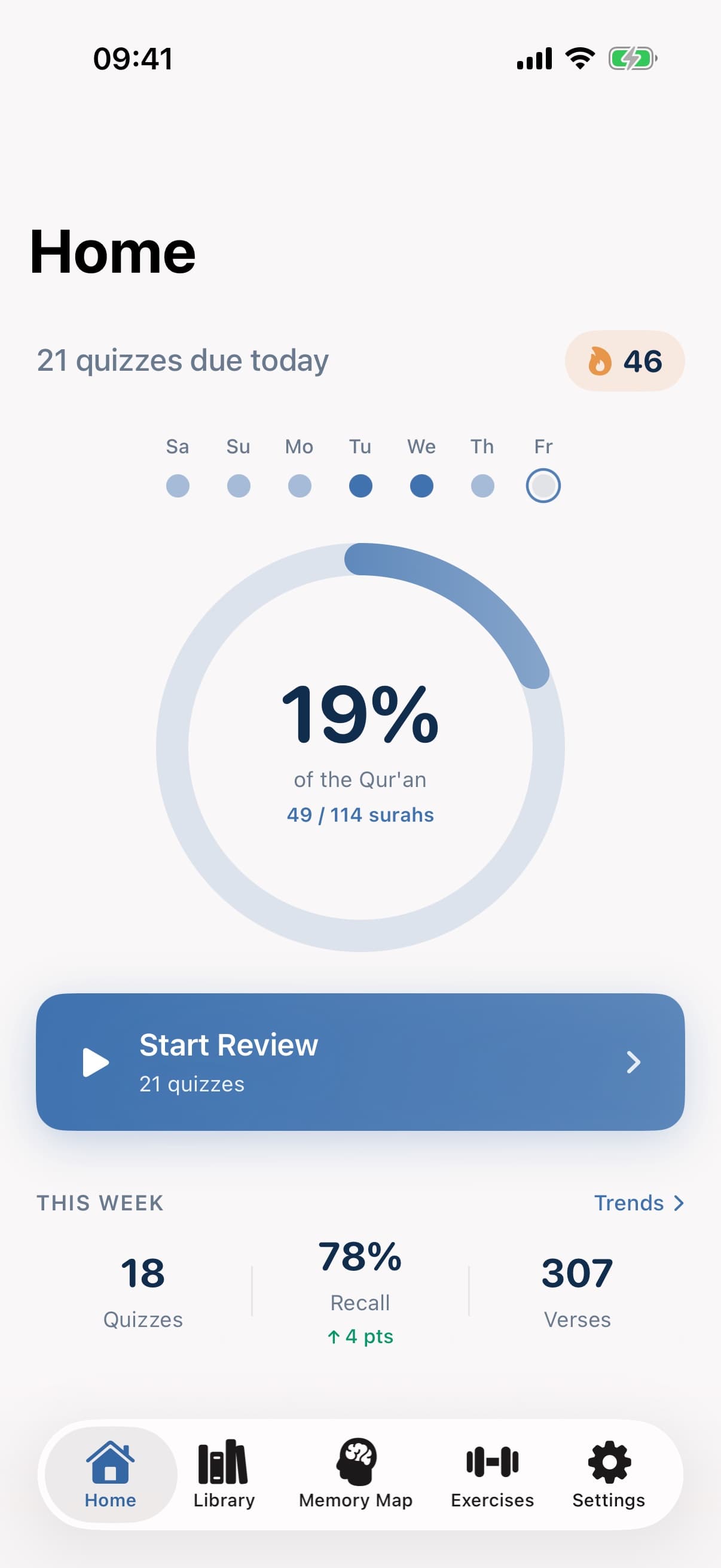
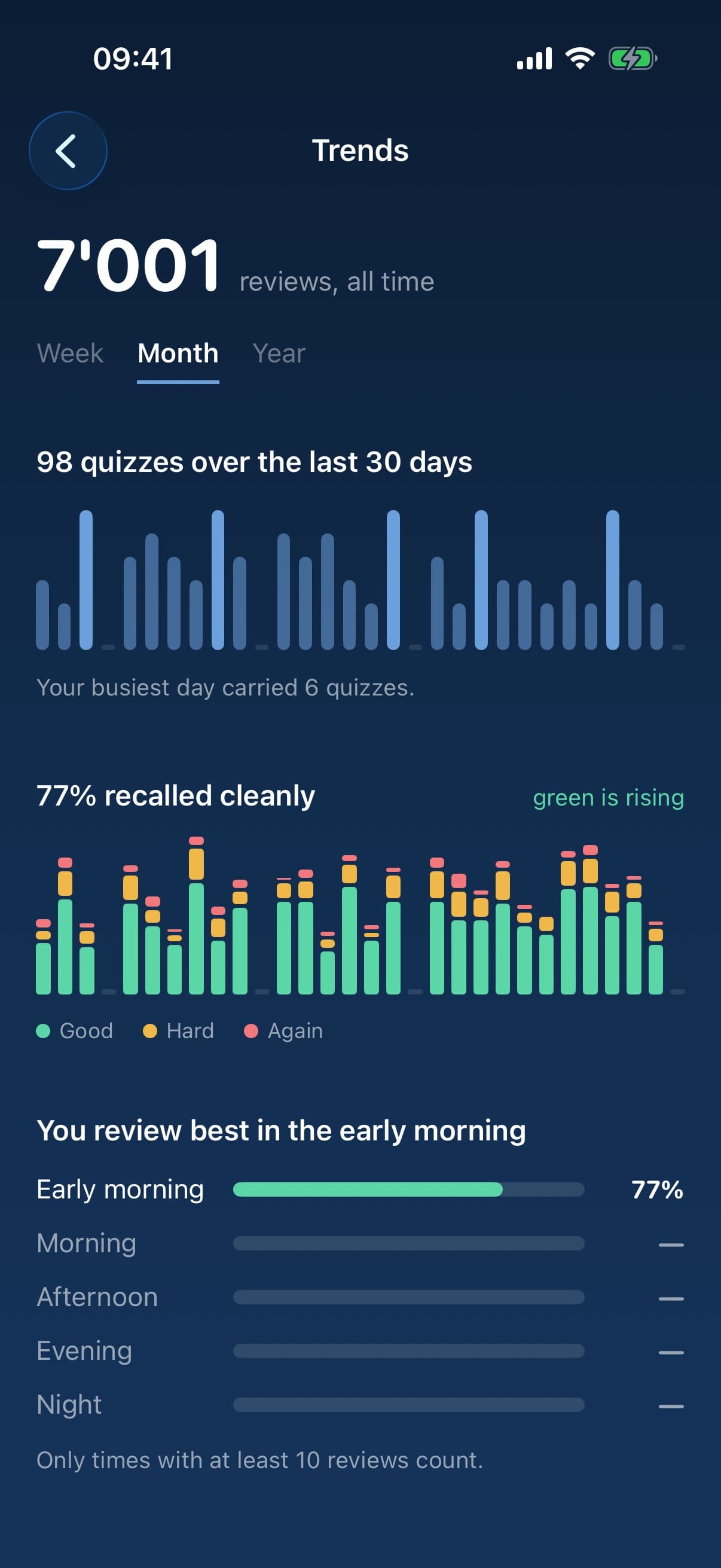
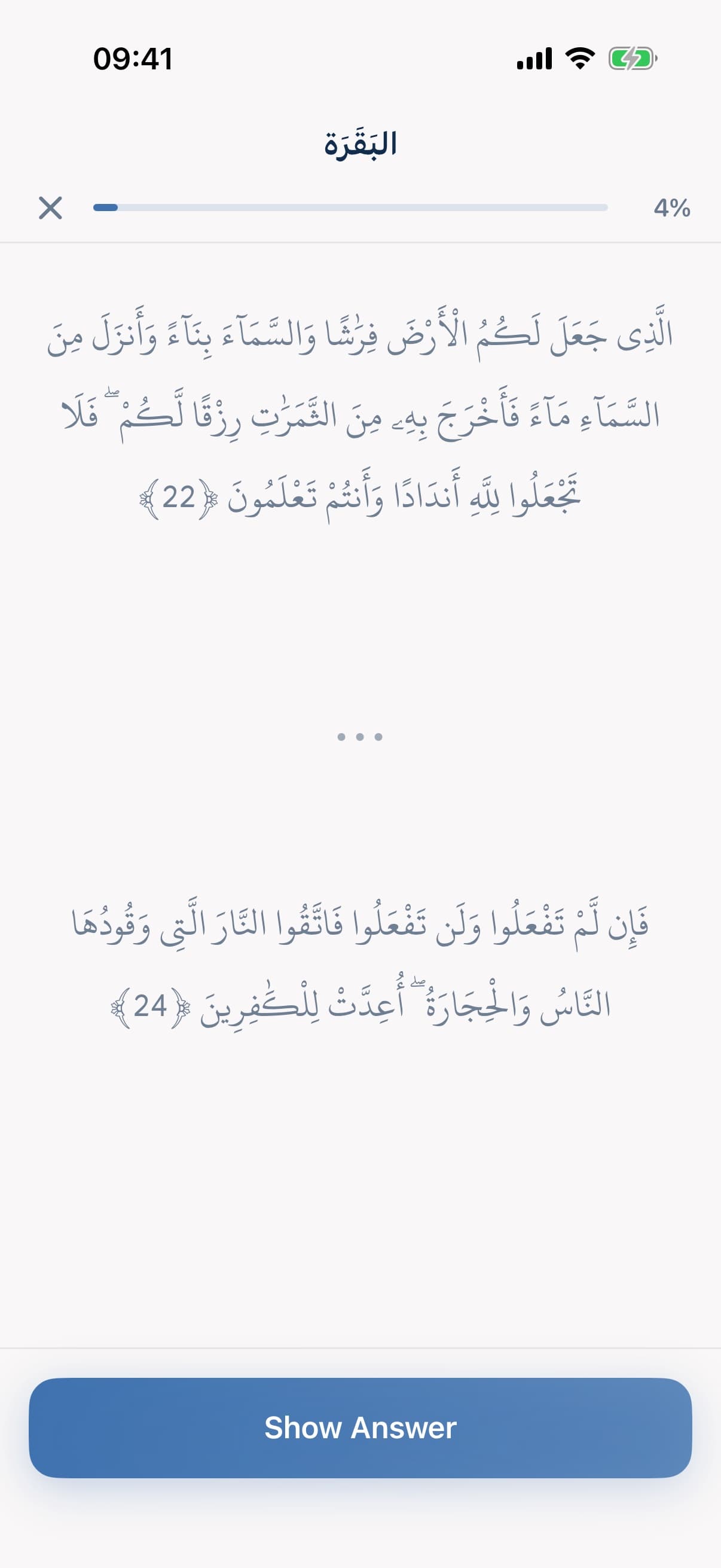
When nobody is there to listen, you can still test yourself. Qiyam's quiz shows the verse before and the verse after, and you recite what is in between from memory.
Every verse then has its own review schedule: verses you struggle with come back sooner, solid ones later.
An app doesn't replace a teacher who hears your tajweed. It keeps your revision going between lessons, so that what you recite to your teacher is still there.
How can you start teaching this week?
You know more than someone who is just starting. A short surah you know well is enough to begin with.
- Teach a child or a younger sibling one short surah this month, a few verses at a time.
- Ask a friend to swap: you recite a page to them, they recite one to you.
- Read one verse's translation with someone in your family this week.
- If you study in a halaqa, offer to listen to a newer student for ten minutes.
Keep it small and regular. Teaching a child Al-Ikhlas over a week is a complete act of teaching, not a rehearsal for a bigger one.
How do you teach a child a short surah?
Teaching a child is where most people start, and the research above applies to the child as much as to you. A simple method:
- Pick a short surah you know well, such as Al-Ikhlas, Al-Falaq or An-Nas.
- Teach one verse at a time. Recite it, have the child repeat it, then ask them to say it alone, without you.
- Join the verses. Once two verses are held, recite them together from the start before adding the third.
- Come back the next day. Ask the child to recite yesterday's verses before teaching anything new.
- Then space it out. A few days later, a week later. Ask them to recite it in salah, where they will use it.
Each of these steps asks the child to recall from memory, and each one has you reciting too. Done this way, you teach the surah and keep it at the same time.
Who is the hadith about?
It doesn't say the best are the scholars, or those with perfect tajweed. It names the people who learn and teach. That includes the adult who finds it hard, the parent reciting at bedtime, and the student who helps another after class.
Start where you are: one page to learn, one person to recite with, and one short surah to pass on.
Sources
- 1al-Bukhari Sahih al-Bukhari 5027: The best among you are those who learn the Qur'an and teach it. Sahih al-Bukhari (accepted as sahih), narrated by ʿUthman.
- 2al-Bukhari Sahih al-Bukhari 5028: The most superior among you are those who learn the Qur'an and teach it. Sahih al-Bukhari (accepted as sahih), narrated by ʿUthman bin ʿAffan.
- 3Muslim ibn al-Hajjaj Sahih Muslim 798a: He who falters in the Qur'an and finds it difficult will have two rewards. Sahih Muslim (accepted as sahih).
- 4al-Bukhari Sahih al-Bukhari 5049: "I like to hear it from others". Sahih al-Bukhari (accepted as sahih).
- 5Muslim ibn al-Hajjaj Sahih Muslim 1893a: One who guides to something good has a reward similar to that of its doer. Sahih Muslim (accepted as sahih).
- 6Koh AWL, Lee SC, Lim SWH (2018). The learning benefits of teaching: A retrieval practice hypothesis. Applied Cognitive Psychology, 32(3), 401–410.
- 7Adesope OO, Trevisan DA, Sundararajan N (2017). Rethinking the Use of Tests: A Meta-Analysis of Practice Testing. Review of Educational Research, 87(3), 659–701.
Frequently asked questions
Is "the best among you are those who learn the Quran and teach it" authentic?
Yes. It is recorded in Sahih al-Bukhari (5027, and in a second wording at 5028), narrated by ʿUthman ibn ʿAffan. Sahih al-Bukhari is accepted as authentic. The Arabic and its chain of narrators are on sunnah.com.
Who narrated this hadith?
ʿUthman ibn ʿAffan, from the Prophet ﷺ. Both narrations in Sahih al-Bukhari (5027 and 5028) come through him.
Do I need to be a hafiz to teach the Quran?
The hadith's words don't mention a level. Many people start by helping a child or a friend with a short surah they know well. Teaching tajweed formally is a different role, and a qualified teacher can advise you on it.
Does teaching the Quran help me remember it?
Research suggests it can, if you teach from memory. In a 2018 study, people who taught without notes, like people who practised recall, did better a week later than people who taught with notes. Reciting while you teach is also revision.
What is the reward for someone who finds learning the Quran hard?
Aisha reported that the Prophet ﷺ said that the one who falters in the Quran and finds it difficult will have two rewards (Sahih Muslim 798a). Difficulty is part of learning, not a reason to stop.