Qiyam
QiyamRevision
The best time of day to memorize the Quran
No single hour is proven best to memorize the Quran. Research suggests learning new verses when sleep follows soon, then reciting them the next morning.
By Amine Benlaroui, , updated , 5 min read

No single hour has been proven to be the best time of day to memorize the Quran. What research does support is a pattern: memorise new verses when you are alert and sleep will follow within a few hours, then recite them from memory the next morning. For many people that means new verses in the evening and revision after Fajr, but a fixed daily slot you actually keep matters more than the clock.
Below: what the Quran and Sunnah mention about the early morning and the night, what sleep studies found, a schedule built on both, and how to find and protect your own best time.
Is early morning really the best time to memorize?
The early morning is the classic answer, and the tradition gives it weight. The Prophet ﷺ said: "O Allah, bless my people in their early mornings."1 The Quran mentions the recitation of dawn:
أَقِمِ ٱلصَّلَوٰةَ لِدُلُوكِ ٱلشَّمْسِ إِلَىٰ غَسَقِ ٱلَّيْلِ وَقُرْءَانَ ٱلْفَجْرِ ۖ إِنَّ قُرْءَانَ ٱلْفَجْرِ كَانَ مَشْهُودًۭا
Establish prayer at the decline of the sun [from its meridian] until the darkness of the night and [also] the Qur'an of dawn. Indeed, the recitation of dawn is ever witnessed.
It also speaks of the hours of the night:
إِنَّ نَاشِئَةَ ٱلَّيْلِ هِىَ أَشَدُّ وَطْـًۭٔا وَأَقْوَمُ قِيلًا
Indeed, the hours of the night are more effective for concurrence [of heart and tongue] and more suitable for words.
These texts mention the dawn and the night. They don't set a memorization timetable, and this article won't add one to them. Many people memorise after Fajr because the house is quiet and the day hasn't started, and if that works for you, keep it.
For the practical question of when new verses hold best, research on sleep and memory adds something useful, and it changes the picture slightly.
What does research say about the time of day and memory?
Sleep soon after learning helps
In two experiments with high-school students learning vocabulary, memory was better when sleep followed within a few hours of learning, whatever the time of day2. Losing sleep hurt memory, and the effect was still there after a night of recovery sleep.
The study didn't find that evening is special. It found that the gap between learning and sleep matters. Memorising at 7 a.m. and staying awake for 16 hours is a different situation from memorising at 9 p.m. and sleeping at 11.
Learning, sleeping, then relearning halved the practice
A second study is even more practical. 40 people practised foreign vocabulary until they knew it perfectly, in two sessions 12 hours apart. Half learned in the morning and relearned in the evening of the same day. The other half learned in the evening, slept, and relearned the next morning.
The group that slept between the sessions needed half as much practice to relearn the words, and retained them much better one week and six months later3.
Why sleep matters
A major review of more than a century of research concludes that sleep benefits memory retention. In current theory, recently learned memories are reactivated during deep (slow-wave) sleep and integrated into long-term memory. The authors describe the sleeping brain as optimised for consolidation, and the waking brain for encoding, that is, taking in new material4.
None of these studies used the Quran. They used vocabulary, which is closer to memorising verses than most lab tasks, but still not the same. Together they suggest a simple rule: learn while awake and alert, let sleep come within a few hours, and recall soon after waking.
What is the best daily schedule for memorization and revision?
A pattern that fits both the research and a Muslim's day:
- Evening, after Isha: memorise your new verses. Recite them from memory until you get them right, then stop.
- Sleep within a few hours.
- After Fajr: recite last night's verses from memory first, before you open the mushaf. Then revise older pages.
This splits the work in a way that suits each time. New material goes in the evening, close to sleep. Recall and revision go in the morning, after it.
If your evenings belong to family or work, the same logic works at other hours. Memorise in the slot you have, and make sure the new verses get a recall from memory after your next sleep. If you prefer to memorise after Fajr, keep doing it, and add a short recital of the morning's verses before you sleep and again the next morning.
Does revision need the same time slot as new memorization?
No. New verses need your best, most focused minutes. Revision of pages you already hold is more flexible, and it can be split across the day.
What matters for revision is the form, not the hour. In a study with prose passages, students who recalled the text from memory remembered it substantially better 2 days and 1 week later than students who reread it, even though rereading made them more confident6. So a page recited from memory on the bus, before Dhuhr or in your sunnah prayers is a real revision. The same page read with your eyes in the mushaf at your desk is weaker, whatever the time.
A practical split:
- Best slot of the day: new verses.
- After Fajr: yesterday's new verses, recited from memory.
- Short gaps through the day: older pages, one at a time, recited without looking.
How do you find your own best time to memorize?
Your best time is where three things meet:
- You are alert. If you read the same verse ten times and nothing stays, that slot is wrong for new verses, though it may still suit revision.
- You won't be interrupted. A quiet 15 minutes is worth more than 45 minutes broken by messages and noise.
- It exists every day. Pick a slot you can keep on workdays and weekends alike.
Then test it for two weeks and judge it by results, not by how it feels. Feelings are a poor guide here. In one study, once students could recall foreign words, more studying had no effect on later recall while more testing had a large one, and the students' predictions of their own performance were unrelated to how they actually did5.
A simple test: each morning, recite yesterday's new verses before looking, and note whether you got them clean. After two weeks, compare the days you memorised at different times.
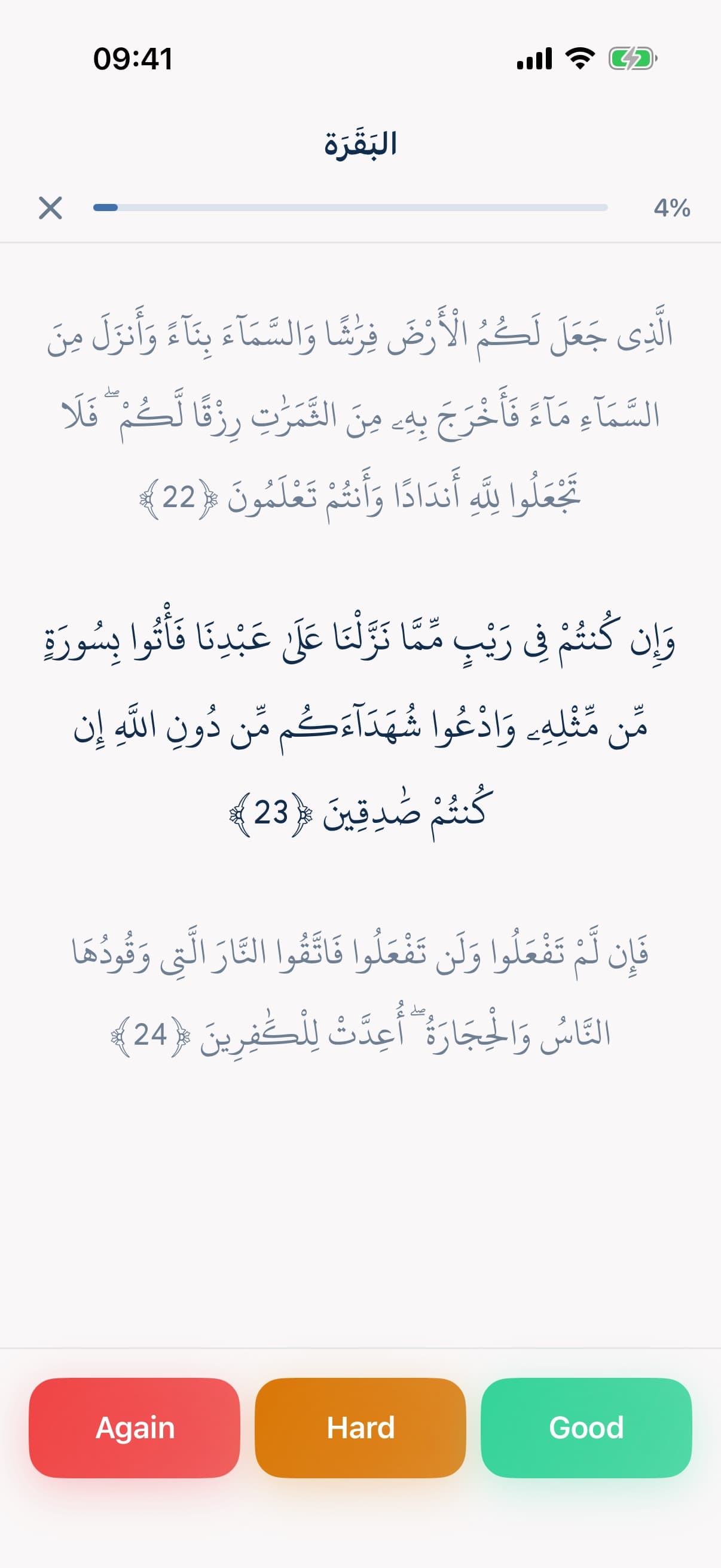
If you revise in Qiyam, its Trends view (Premium) shows whether your recall is getting stronger, how consistently you show up, and the time of day your recall is sharpest.
Qiyam also sends one daily reminder at the hour you usually review, with the number of quizzes due.
How do you protect your memorization time?
Knowing your time and keeping it are different problems. A few habits help:
- Prepare the night before. Know the surah and the verse you start from, and leave the mushaf open at the page.
- Memorise before you check messages. Open nothing else until the session is done.
- Start short. 15 minutes after Isha, or after Fajr, is enough at first. Lengthen it only once it has held for two weeks.
- Have a backup slot. If you miss your time, use the backup the same day rather than doubling tomorrow.
Does the time of day matter more than consistency?
It matters less than two other habits: reciting from memory, and coming back to each page after a gap. A slot you keep every day at 10 p.m. will do more for your hifz than a perfect 5 a.m. slot you manage twice a week.
Pick a time that fits your day, put sleep between learning and your first recall, and protect the slot. The rest is coming back to it tomorrow.
Sources
- 1Abu Dawud Sunan Abi Dawud 2606: "O Allah, bless my people in their early mornings". Sunan Abi Dawud, graded Sahih by al-Albani.
- 2Gais S, Lucas B, Born J (2006). Sleep after learning aids memory recall. Learning & Memory, 13(3), 259–262.
- 3Mazza S, Gerbier E, Gustin MP, Kasikci Z, Koenig O, Toppino TC, Magnin M (2016). Relearn Faster and Retain Longer. Psychological Science, 27(10), 1321–1330.
- 4Rasch B, Born J (2013). About Sleep's Role in Memory. Physiological Reviews, 93(2), 681–766.
- 5Karpicke JD, Roediger HL (2008). The Critical Importance of Retrieval for Learning. Science, 319(5865), 966–968.
- 6Roediger HL, Karpicke JD (2006). Test-Enhanced Learning. Psychological Science, 17(3), 249–255.
Frequently asked questions
Is it better to memorize the Quran at night or in the morning?
Neither is proven best on its own. Studies on vocabulary suggest memory holds better when sleep follows learning within a few hours, and that learning in the evening, then relearning the next morning, halves the practice needed. A practical pattern: new verses after Isha, recall from memory after Fajr.
Is after Fajr a good time to memorize the Quran?
It can be: the house is quiet and the day has not started. If you memorise after Fajr, add a short recital of the same verses before you sleep and again the next morning, so a night of sleep comes between learning and recall.
Should I memorize the Quran right before sleeping?
Learning shortly before sleep is supported by research: in two experiments with students learning vocabulary, memory was better when sleep followed within a few hours. Stop when you can recite the verses correctly from memory, and recite them again when you wake up.
How long should I memorize each day?
There is no proven number. Start with a slot you can keep every day, such as 15 or 20 minutes, and lengthen it only once it has held for two weeks. A short daily slot does more than a long one you keep twice a week.