Qiyam
QiyamMemory science
The forgetting curve and why memorization fades
The forgetting curve shows memory fades fastest just after learning. Why memorized surahs slip without review, and how spaced recall keeps them.
By Amine Benlaroui, , updated , 5 min read
The forgetting curve describes how memory fades over time: quickly in the hours and days after you learn something, then more and more slowly. That is why a surah you recited perfectly can slip within weeks if you never return to it. What slows the curve is not more effort on the first day, but review spread over time, recited from memory, with the gaps growing as the page gets stronger.
Forgetting is normal: the same curve shows up for words, faces and lists. Below: where the curve comes from, what its shape means for hifz, what research says slows it, and a simple way to plan review around it.
What is the forgetting curve?
In the 1880s, the German psychologist Hermann Ebbinghaus memorised lists and measured how much easier they were to relearn after different delays. The time saved when relearning showed how much was still held. Plotted against time, the result is the forgetting curve.
In 2015, two researchers repeated his experiment. One subject spent 70 hours learning lists and relearning them after 20 minutes, 1 hour, 9 hours, 1 day, 2 days or 31 days. The results were similar to Ebbinghaus' original data. They also found the curve is probably not perfectly smooth: it seems to jump upwards at the 24-hour point1.
The study had only one subject. Its value is that a famous result held up when someone checked it more than a century later.
What shape does forgetting take?
A 1991 study compared six ways to describe forgetting over time, across three experiments: recall of words, recognition of faces, and a memory task with pigeons. In every case a simple power function fit best, better than linear, exponential and three other curves. A reanalysis of Ebbinghaus' own data showed the same2.
In plain terms, a power curve drops steeply at first and then flattens. Most of what you lose, you lose early. A page that has held for a month is slipping far more slowly than a page you learned yesterday.
For hifz, this means two things:
- The first days after memorising a page matter most. That is when it most needs you to come back.
- Older, well-held pages can wait longer. Their curve is flatter.
Why do memorized surahs slip without review?
The Prophet ﷺ described this with an image. Ibn ʿUmar reported that he said: "The example of the person who knows the Qur'an by heart is like the owner of tied camels. If he keeps them tied, he will control them, but if he releases them, they will run away."3 In another narration, he said: "Commit yourself to the Qur'an, for by Him in whose Hand is my soul, it is surely more prone to break away than a camel in its bind."4
Research describes the same experience in numbers: without review, recall falls with time, fastest at first. The surahs you recite in salah every day stay clear because you recall them every day. The ones you memorised years ago and haven't recited since are the ones that feel unfamiliar.
None of this is a personal failing. It is how memory works for everyone.
Does review flatten the forgetting curve?
Yes, and how you space it matters as much as how often.
Longer gaps can do the work of more sessions
In a 9-year study, 4 people learned and relearned 300 word pairs, with 13 or 26 relearning sessions spaced 14, 28 or 56 days apart. 13 sessions spaced 56 days apart gave retention comparable to 26 sessions spaced 14 days apart5. Only four people took part, but the result is striking: half the sessions, the same retention.
The best gap depends on how long you need to remember
A review of 317 experiments found that the gap between sessions that gives the best retention grows as the time until the test grows6. A later study with more than 1,350 people put numbers on it. The best gap was about 20 to 40% of a 1-week test delay, but only about 5 to 10% of a 1-year delay7.
You need your hifz for life. So for an established page, the useful gaps are long ones, as long as you can still recall the page when it comes back.
Review at the right moment, not on a fixed day
A 2019 study treated review timing as an optimisation problem. For two well-known models of memory, the best review schedule turned out to be set by the probability of recalling each item. On data from the language app Duolingo, learners who followed that schedule memorised more effectively than learners on simpler rule-based schedules8.
For hifz, the lesson is to review a page when it is starting to get harder, not only because it is Thursday.
Is reading a page from the mushaf enough to review it?
Reading feels like review. Reciting from memory does more. In one study, once students could recall a foreign word, more studying of it had no effect on later recall, while more testing of it had a large positive effect. The students' predictions of how well they would do were unrelated to how they actually did9.
So a review is a recitation without looking, followed by a check. Open the mushaf after you recite, not before.
Does anything survive decades without review?
Some of it does. In a study of 733 people tested on Spanish they learned in school up to 50 years earlier, retention declined for the first 3 to 6 years, then stayed unchanged for up to 30 years before a final decline. How much remained depended mainly on how well the language was learned in the first place, since most people had barely practised it since10.
That was school Spanish, not memorised text, so don't stretch it. But it is a hopeful point for anyone who memorised long ago: a well-learned surah may not be as lost as it feels. Start reciting it again before you decide to memorise it from zero.
How do you plan review around the forgetting curve?
A simple plan from these findings:
- Day 0: memorise the page, and recite it correctly from memory before you stop.
- Day 1: recite it from memory before looking at the mushaf.
- Then widen the gaps: a few days, a week, two weeks, a month, as long as each recital stays clean.
- When a recital slips, shorten the gap again for that page, not for the whole juz.
- Recite in context: start a little before the page and go a little past it.
By hand, this is easy for a few pages. For several juz, it means tracking hundreds of separate gaps, each moving at its own speed. That bookkeeping is what Qiyam does for you.
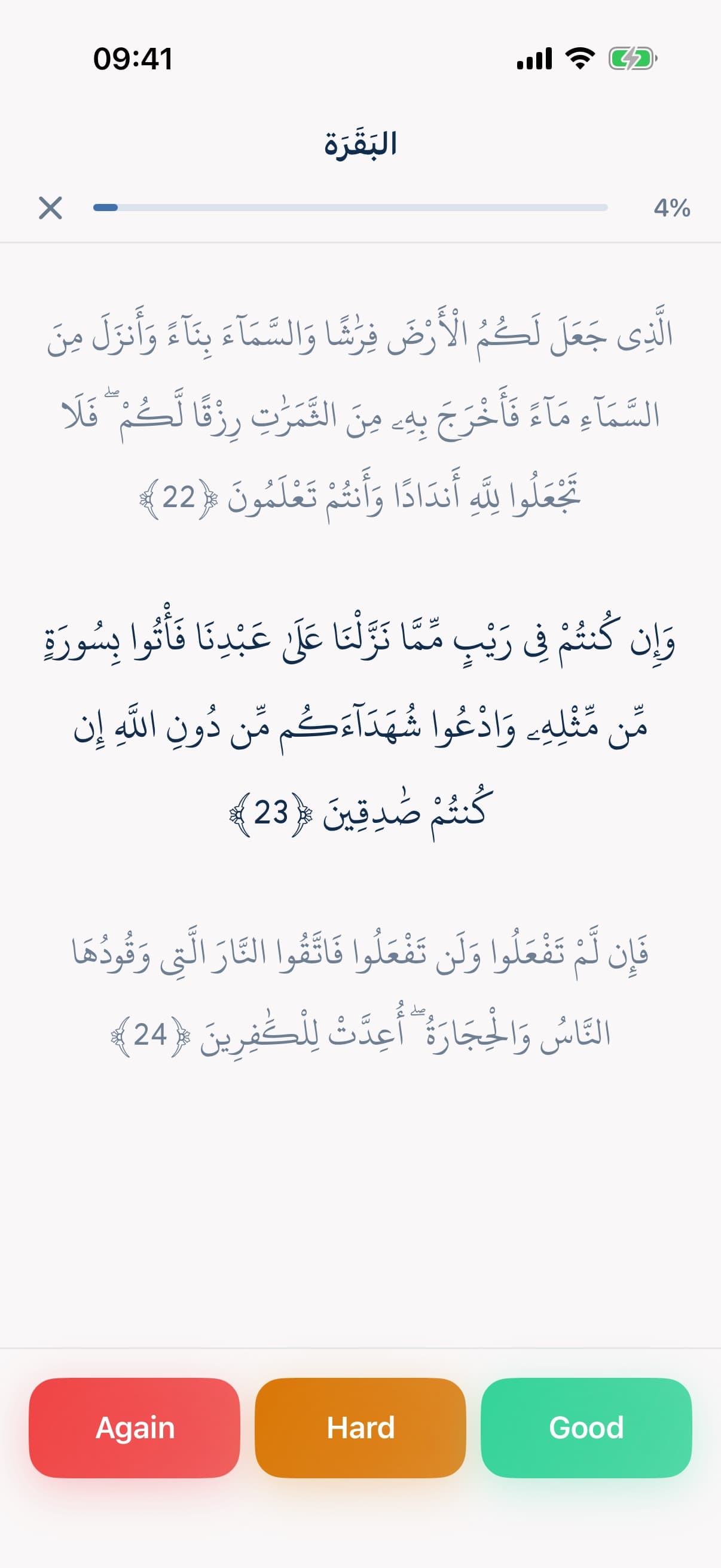
In Qiyam, every verse has its own review schedule (spaced repetition, SM-2): verses you struggle with come back sooner, solid ones later. A quiz shows the verse before and the verse after, and you recite what is in between from memory. You reveal the answer, then rate yourself Again, Hard or Good, and "Again" brings a verse back the next day.
Verses quizzed together share one rating, because the Quran is recited in context: a slip on one verse brings its neighbours back too.
Is forgetting a sign you memorized badly?
No. The curve shows up for everyone, across words, faces and lists. What changes the outcome is what you do after the first day: come back, recite without looking, and let the gaps grow as the page holds.
Sources
- 1Murre JMJ, Dros J (2015). Replication and Analysis of Ebbinghaus' Forgetting Curve. PLOS ONE, 10(7), e0120644.
- 2Wixted JT, Ebbesen EB (1991). On the Form of Forgetting. Psychological Science, 2(6), 409–415.
- 3al-Bukhari Sahih al-Bukhari 5031: The person who knows the Qur'an by heart is like the owner of tied camels. Sahih al-Bukhari (accepted as sahih), narrated by Ibn ʿUmar.
- 4al-Bukhari Sahih al-Bukhari 5033: Commit yourself to the Qur'an, it is more prone to break away than a camel in its bind. Sahih al-Bukhari (accepted as sahih), narrated by Abu Musa.
- 5Bahrick HP, Bahrick LE, Bahrick AS, Bahrick PE (1993). Maintenance of Foreign Language Vocabulary and the Spacing Effect. Psychological Science, 4(5), 316–321.
- 6Cepeda NJ, Pashler H, Vul E, Wixted JT, Rohrer D (2006). Distributed practice in verbal recall tasks: A review and quantitative synthesis. Psychological Bulletin, 132(3), 354–380.
- 7Cepeda NJ, Vul E, Rohrer D, Wixted JT, Pashler H (2008). Spacing Effects in Learning. Psychological Science, 19(11), 1095–1102.
- 8Tabibian B, Upadhyay U, De A, Zarezade A, Schölkopf B, Gomez-Rodriguez M (2019). Enhancing human learning via spaced repetition optimization. Proceedings of the National Academy of Sciences, 116(10), 3988–3993.
- 9Karpicke JD, Roediger HL (2008). The Critical Importance of Retrieval for Learning. Science, 319(5865), 966–968.
- 10Bahrick HP (1984). Semantic memory content in permastore: Fifty years of memory for Spanish learned in school. Journal of Experimental Psychology: General, 113(1), 1–29.
Frequently asked questions
What is the forgetting curve in simple terms?
It is a graph of how much you remember over time after learning something. It drops steeply at first, then flattens: most forgetting happens in the first hours and days. Hermann Ebbinghaus first measured it in the 1880s, and a 2015 replication found similar results.
How fast do we forget what we memorize?
Fastest just after learning, then more and more slowly; research finds forgetting follows a power curve. The exact amount depends on the material and on how well it was learned. That is why the first days after memorising a page matter most.
How often should I review my Quran memorization?
New pages need you the next day, then after gaps that grow: a few days, a week, a month. Well-held pages can wait longer. When a recital slips, shorten the gap for that page only. Always recite from memory before you open the mushaf.
Can I relearn a surah I memorized years ago and forgot?
Often more easily than you expect. In a 50-year study of school Spanish, much of what was well learned stayed accessible for decades. Start reciting the surah again and fill the gaps before deciding to memorise it from zero.
Is spaced repetition better than reviewing a fixed amount every day?
Research on spacing suggests the best gap between reviews grows as material gets older, and that reviewing when an item is getting harder to recall works better than fixed rules. A fixed daily rotation can still work; spacing aims to spend your time on the pages that need it.