Qiyam
QiyamHeart and hifz
The spiritual peace that comes from Quran memorization
Quran memorization brings peace by keeping the Qur'an with you in salah and at night. What the verses, hadith and early research say, and how to keep it.
By Amine Benlaroui, , updated , 6 min read
The peace that comes from Quran memorization is the peace of having the Qur'an with you at all times: in salah, in a sleepless night, on a commute, with no mushaf and no phone. The Qur'an says that hearts are assured by the remembrance of Allah, and the Prophet ﷺ named the tranquility, the sakinah, that came down when a man recited Surah Al-Kahf. Early research on people who memorise points the same way, with limits this article sets out honestly.
The rest of this article covers what the Qur'an and the Sunnah say about that peace, what research has measured so far, and how to keep it once the verses are yours, including when they start to slip.
What does the Qur'an say about peace of heart?
In Surah Ar-Ra'd, a verse speaks of those who believe and whose hearts are assured by the remembrance of Allah, and then says it a second time, for everyone: "by the remembrance of Allah hearts are assured."
ٱلَّذِينَ ءَامَنُوا۟ وَتَطْمَئِنُّ قُلُوبُهُم بِذِكْرِ ٱللَّهِ ۗ أَلَا بِذِكْرِ ٱللَّهِ تَطْمَئِنُّ ٱلْقُلُوبُ
Those who have believed and whose hearts are assured by the remembrance of Allah. Unquestionably, by the remembrance of Allah hearts are assured."
The Qur'an also describes itself, in Surah Yunus, as instruction from your Lord and "healing for what is in the breasts".
يَٰٓأَيُّهَا ٱلنَّاسُ قَدْ جَآءَتْكُم مَّوْعِظَةٌۭ مِّن رَّبِّكُمْ وَشِفَآءٌۭ لِّمَا فِى ٱلصُّدُورِ وَهُدًۭى وَرَحْمَةٌۭ لِّلْمُؤْمِنِينَ
O mankind, there has to come to you instruction from your Lord and healing for what is in the breasts and guidance and mercy for the believers.
These verses are not about memorization specifically. They are about remembrance of Allah and about the Qur'an itself. Memorization matters because it changes how often, and where, that remembrance can happen. A verse you have to look up is with you when you have the book. A verse you know by heart is with you always.
What did the Prophet ﷺ say about tranquility and recitation?
Two authentic hadiths connect recitation with sakinah, the tranquility that descends from Allah.
The first is about one man. Al-Bara' narrated that a man was reciting Surat Al-Kahf with his horse tied beside him. A cloud came down and spread over him, coming closer, until the horse started jumping. In the morning he told the Prophet ﷺ, who said: "That was As-Sakina (tranquility) which descended because of (the recitation of) the Qur'an."5
The second is about a group. In a long hadith in Sahih Muslim, the Prophet ﷺ said that when people assemble in one of the houses of Allah, recite the Book of Allah and learn and teach it among themselves, "there would descend upon them tranquility and mercy would cover them and the angels would surround them".6
A third hadith speaks to anyone who finds memorising hard. The Prophet ﷺ said that the person who recites the Qur'an and masters it by heart will be with the noble righteous scribes, "and such a person exerts himself to learn the Qur'an by heart, and recites it with great difficulty, will have a double reward."7 The struggle is not a sign that you are failing. It has its own reward.
Why does memorising bring something that reading doesn't?
Reading from the mushaf is a great good. Memorization adds three things reading cannot.
The Qur'an goes where you go
What you hold by heart is available in the places where you have nothing else: lying awake at 2 a.m., stuck in traffic, waiting at a hospital, walking to the mosque. You do not need a connection, a screen or a book. You recite, quietly, and you are back in the remembrance the verse in Ar-Ra'd describes.
Your prayer gets wider
Most people recite in salah what they know by heart. If you know four short surahs, your prayers rotate between those four. Each surah you add gives your prayer a new passage to stand in: a part of the Qur'an about patience on one night, about gratitude on another.
The words come back when you need them
A verse you have memorised can return on its own, in a hard conversation or a hard week. You don't go searching for it. That is not a technique; it is simply what knowing something by heart means.
What does research say about Quran memorization and well-being?
There is some research, and it is early.
A systematic review published in 2022 searched three databases for studies on listening to, reciting or memorising the Qur'an and health. Out of 230 articles, 20 met its criteria. Across them, listening, reciting or memorising had a favourable effect on depression, anxiety, physiological measures, quality of life, quality of sleep and IQ. The authors conclude that these practices "may be useful" as an intervention to improve physical and mental health.1
A 2025 study looked at 400 adult women in Qur'an memorization centres, grouped by how much they had memorised: the whole Qur'an, 15 to 29 juz, 5 to 14 juz, 1 to 4 juz, or only what they learned at school. Overall, the groups differed in life satisfaction, happiness and general reasoning, but not significantly when each was examined on its own. Attending the centres predicted life satisfaction more strongly than happiness or cognitive ability.2
Read these results with care:
- They show links, not causes. People who memorise may differ in other ways: community, routine, faith practice.
- The evidence base is small. Twenty studies in a review is not many, and they measured different things.
- They are not treatment. If you are dealing with anxiety or depression that doesn't lift, the Qur'an and a doctor are not rivals. Seeing a professional is part of caring for yourself.
What the research does suggest is that the peace people describe is not imagined, and that it may be worth studying further.
Does the peace fade when you start forgetting?
You may feel calm when a surah flows and uneasy when it starts to slip. The worry about forgetting can take the place of the peace.
The answer is not more guilt. It is a revision habit that keeps the verses within reach without taking over your day. Two findings from memory research help, even though neither was done on the Qur'an.
Recite from memory, don't only reread. Students who read prose passages and then recalled them from memory remembered more after 2 days and after 1 week than students who simply reread them, even though rereading made them feel more confident.3 For hifz, this suggests that reciting a page without looking does more than reading it again from the mushaf.
Space your revision. More than 1,350 people learned facts and reviewed them after gaps of up to 3.5 months. A longer gap first helped, then slowly hurt, and the best gap grew the longer people needed to remember.4 You want your hifz for life, which suggests revisiting each page after a gap long enough to be useful, but not so long that it slips.
Doing this by hand across many surahs is hard, because every page is at a different stage. This is the scheduling Qiyam does for you: every verse has its own review schedule, so the ones you struggle with come back sooner and the solid ones later. And because the whole Qur'an ships inside the app, you can review without a connection.
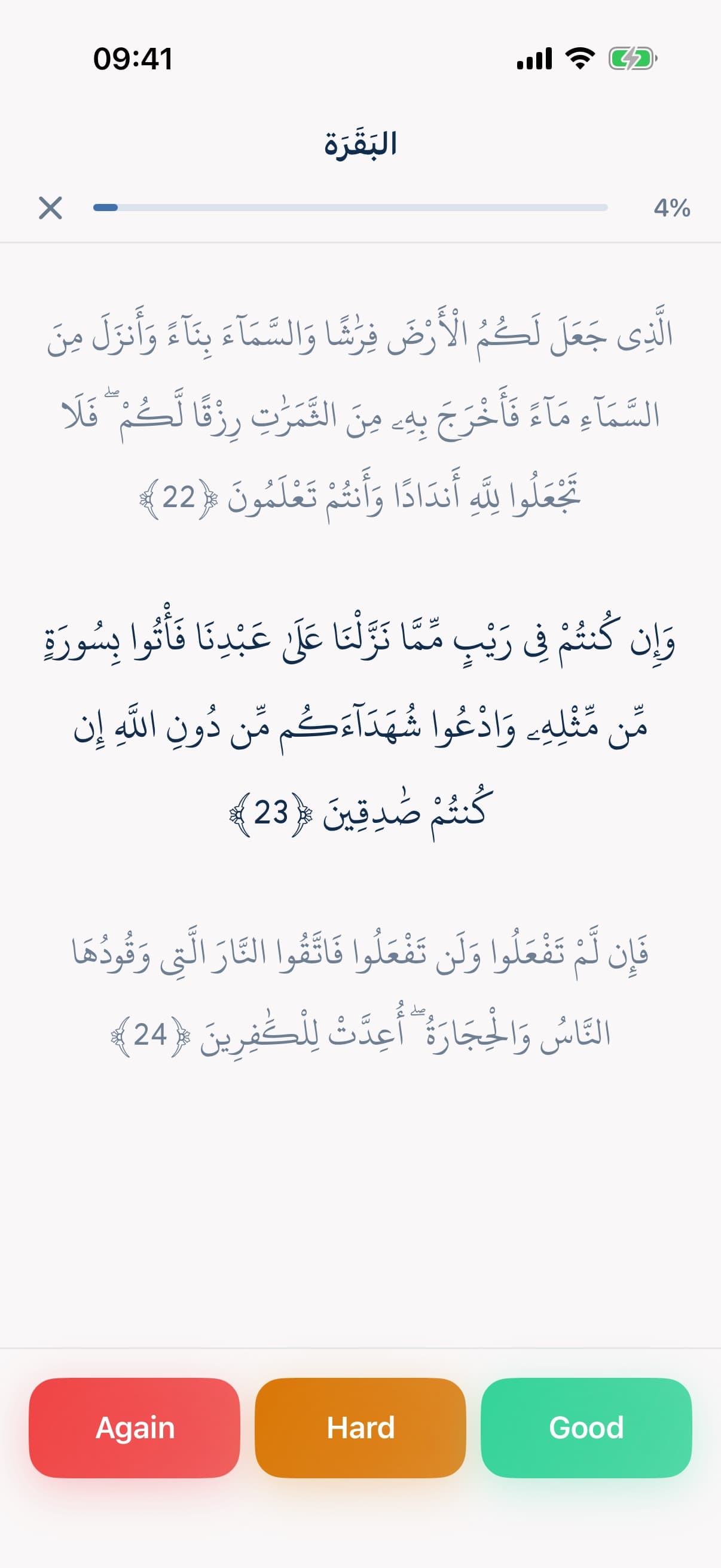
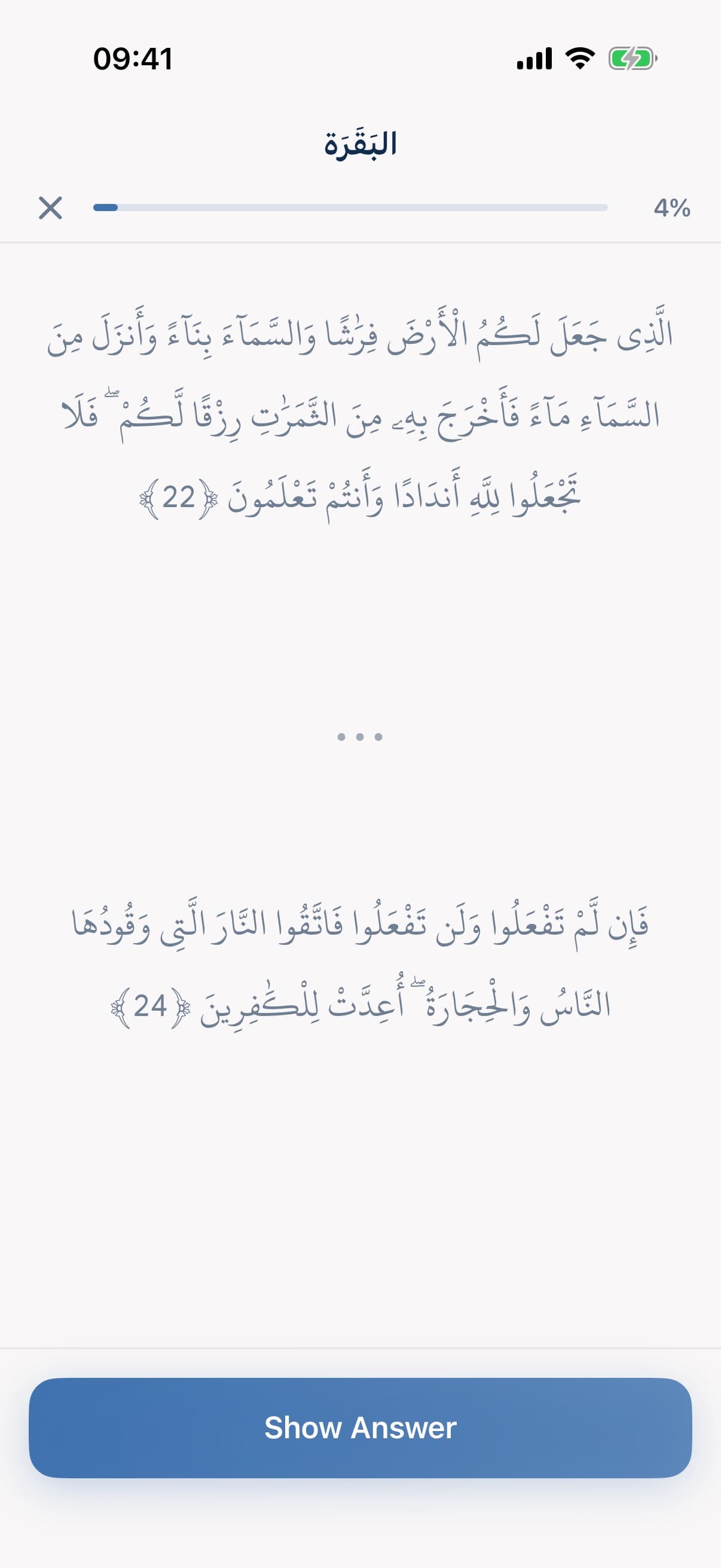
A Qiyam quiz shows the verse before and the verse after, and you recite what's in between from memory. It is the same act as reciting in prayer: one verse leading to the next, with nothing in front of you.
How do you start if you've only memorised a little?
The peace described in this article does not begin when you finish the Qur'an. It begins with the verses you already have.
- Start with what you pray with. Make sure the surahs you recite in salah are firm, with no hesitation. That is where memorization meets your day five times.
- Add one passage you love. A short surah, or a few verses you return to often. Memorise it, then recite it in your sunnah prayers so it gets used.
- Recite it in a quiet moment. Before sleep, after Fajr, on the way to work. The point is to have it with you, not to perform it.
- Find people to recite with. The hadith in Sahih Muslim describes tranquility descending on people who gather to recite and study the Book together.6 A halaqa, a teacher, or one friend you recite to each week all count.
- Revise a little, often. A few minutes of reciting from memory, spread over the week, keeps more than one long session once a month.
The verses in Ar-Ra'd and Yunus are not promises about how you will feel on a given day. They describe what the remembrance of Allah is. Memorization keeps that remembrance close: in your prayer, in your nights, and in the moments when you have nothing else to hold on to.
Sources
- 1Che Wan Mohd Rozali WNA, Ishak I, Mat Ludin AF, Ibrahim FW, Abd Warif NM, Che Roos NA (2022). The Impact of Listening to, Reciting, or Memorizing the Quran on Physical and Mental Health of Muslims: Evidence From Systematic Review. International Journal of Public Health.
- 2Alnajashi SA, Al Qasem M, Al-Mishaal K, Aluthman WAE (2025). The Impact of Attending Qur'an Memorization Programs on Psychological Wellbeing: A Study on Adult Females. Islamic Guidance and Counseling Journal.
- 3Roediger HL, Karpicke JD (2006). Test-Enhanced Learning. Psychological Science.
- 4Cepeda NJ, Vul E, Rohrer D, Wixted JT, Pashler H (2008). Spacing Effects in Learning. Psychological Science.
- 5al-Bukhari Sahih al-Bukhari 5011. sunnah.com.
- 6Muslim ibn al-Hajjaj Sahih Muslim 2699. sunnah.com.
- 7al-Bukhari Sahih al-Bukhari 4937. sunnah.com.
Frequently asked questions
Does memorizing the Quran reduce anxiety?
A 2022 systematic review of 20 studies found that listening to, reciting or memorising the Qur'an had a favourable effect on anxiety and depression, and suggests it may be useful as an intervention. The studies show links, not proof of cause, and they are not a replacement for professional help when anxiety persists.
Do I need to memorize the whole Quran to feel this peace?
No. The verses you already know by heart are with you in every prayer and every quiet moment. Start by making the surahs you pray with firm, then add one passage you love and recite it in your sunnah prayers.
What is sakinah?
Sakinah is the tranquility that descends from Allah. In Sahih al-Bukhari, the Prophet ﷺ named it when a cloud came over a man reciting Surat Al-Kahf: "That was As-Sakina (tranquility) which descended because of (the recitation of) the Qur'an."
What if memorizing is hard for me?
The Prophet ﷺ said that the one who exerts himself to learn the Qur'an by heart and recites it with great difficulty will have a double reward (Sahih al-Bukhari 4937). Difficulty is not a sign you should stop.
How do I keep the peace when I start forgetting?
Revise a little, often, and recite from memory rather than only rereading. Research on spacing and recall suggests short sessions spread over time keep more than occasional long ones, and they replace worry with a routine you can keep.