Qiyam
QiyamRevision
Strengths and limits of the traditional hifz schedule
The traditional hifz schedule keeps revision daily and recited from memory, but gives every old page the same 7-day gap. What research suggests to change.
By Amine Benlaroui, , updated , 6 min read
The traditional hifz schedule works because it makes revision daily, recited from memory, and checked by a teacher. Its main limit is that old pages all come back on the same fixed cycle, usually about a week, whether they are rock solid or about to slip. Memory research suggests keeping the daily habit and the recitation, and letting the gap for each page depend on how well you know it.
This article sets out how the traditional schedule is built, what it gets right, where it struggles, and how to keep its strengths while fixing its weak point.
What is the traditional hifz schedule?
Names and details vary between schools and countries, but most hifz programmes divide daily work into three parts:
- The new lesson (often called sabaq): the lines or page you memorise today.
- The recent portion (often sabqi): what you memorised over the last days or weeks, revised daily so it settles.
- The old portion (often manzil): everything else you hold, divided into equal parts and revised in rotation. A common rule is to divide it into seven, so that the whole hifz comes around once a week.
Many students recite all three to their teacher each day. Once someone has finished the Qur'an, the new lesson disappears and the rotation remains: a fixed share of the Qur'an, every day, for life.
What does the traditional schedule get right?
A lot. The schedule has produced generations of huffaz, and several of its habits are exactly what memory research recommends.
It is daily
Contact with the Qur'an every day is built in. Nobody decides whether to revise today; the only question is how much. This removes the hardest step in any habit, which is starting.
It is recited from memory
In a halaqa you recite without looking, to a teacher who catches mistakes. That is a test, not a reread. In one study, students who read prose passages and then recalled them from memory remembered more after 2 days and 1 week than students who reread them, even though rereading made students more confident.1 A meta-analysis of practice testing found practice tests more beneficial for learning than restudying and every other comparison condition.2 Reciting to a teacher is a form of practice testing.
New material gets extra attention
The recent portion exists because new pages are fragile. Forgetting has been measured this way since Ebbinghaus' forgetting curve: in a modern replication, one person spent 70 hours learning lists and relearning them after delays from 20 minutes to 31 days, with results similar to Ebbinghaus' original data.3 The sabqi tier protects pages during that steep early period.
It gives a shared structure
When a whole class follows the same plan, the teacher knows what each student should recite, and students keep each other going.
Where does the 7-day cycle fall short?
The weak point is the old portion. Once a page leaves the recent tier, it joins a rotation where every page gets the same gap.
Every old page gets the same gap
Surah Al-Mulk, which you recite every night, and a page of Surah An-Nisa you memorised eight months ago and barely remember, both come back every seven days. One of them needed far less. The other may need more.
Research suggests the best gap is not fixed. In a study of more than 1,350 people who learned facts and reviewed them after gaps of up to 3.5 months, a longer gap first helped, then slowly hurt, and the best gap grew as the time until the final test grew.4 A broad review of 317 experiments found the same: the gap between sessions and how long you need to remember work together.5
Solid pages could wait much longer
In a 9-year study, 4 people learned and relearned 300 word pairs. Thirteen relearning sessions spaced 56 days apart gave retention comparable to 26 sessions spaced 14 days apart.6 Only four people took part, and the material was vocabulary, not memorised text. Still, it suggests that for material you know well, longer gaps can keep it with half the sessions. A weekly cycle cannot use that.
The cycle grows with your hifz, not with your memory
Seven parts of 3 juz is less than half a juz a day. Seven parts of 30 juz is over 4 juz a day. The cycle length stays the same while the daily load becomes very large, and it is easy to end up shortening revision or skipping it, without a plan for which pages can safely wait.
A missed day has no clear answer
If you miss Tuesday's portion, a fixed cycle doesn't say whether Wednesday's slides back or you double up, so a busy week can turn into a backlog that feels too large to start.
Is spaced repetition a replacement for the traditional method?
No. Spaced repetition changes one thing: when each page comes back. Everything else the tradition does well stays.
| Traditional 7-day cycle | Spacing each page by strength | |
|---|---|---|
| Daily revision | Yes | Yes |
| Recited from memory | Yes | Yes |
| New pages revised often | Yes (the recent portion) | Yes (short gaps at first) |
| Gap for a solid old page | 7 days | Grows as the page stays solid |
| Gap for a weak old page | 7 days | Shrinks until it is firm again |
| After a missed day | Depends on the teacher | Overdue pages are shown, the rest stays on schedule |
You also don't need a perfect formula. In one experiment, people practised recalling items on 3 tests: long intervals between tests gave a 200% improvement in long-term retention over tests with no spacing, while whether the gaps expanded, stayed equal or shrank made no measurable difference.7 What matters is that strong pages get long gaps and weak ones short gaps, not the exact numbers.
How do you keep the tradition and fix its weak point?
You can do this on paper, with a teacher, or with an app.
- Keep the new lesson and the recent portion as they are. Daily, recited from memory, to a teacher if you have one.
- Rate each old page when you recite it. Three marks are enough: clean, hesitant, or mistakes.
- Let the mark decide the next gap. A clean page waits longer than last time. A hesitant one keeps the same gap. A page with mistakes comes back tomorrow.
- Keep the surahs you recite daily out of the rotation. If you pray with Al-Mulk every night, it doesn't need a revision slot too.
- When you miss a day, start with what is overdue. Don't double the next portion; take the oldest pages first.
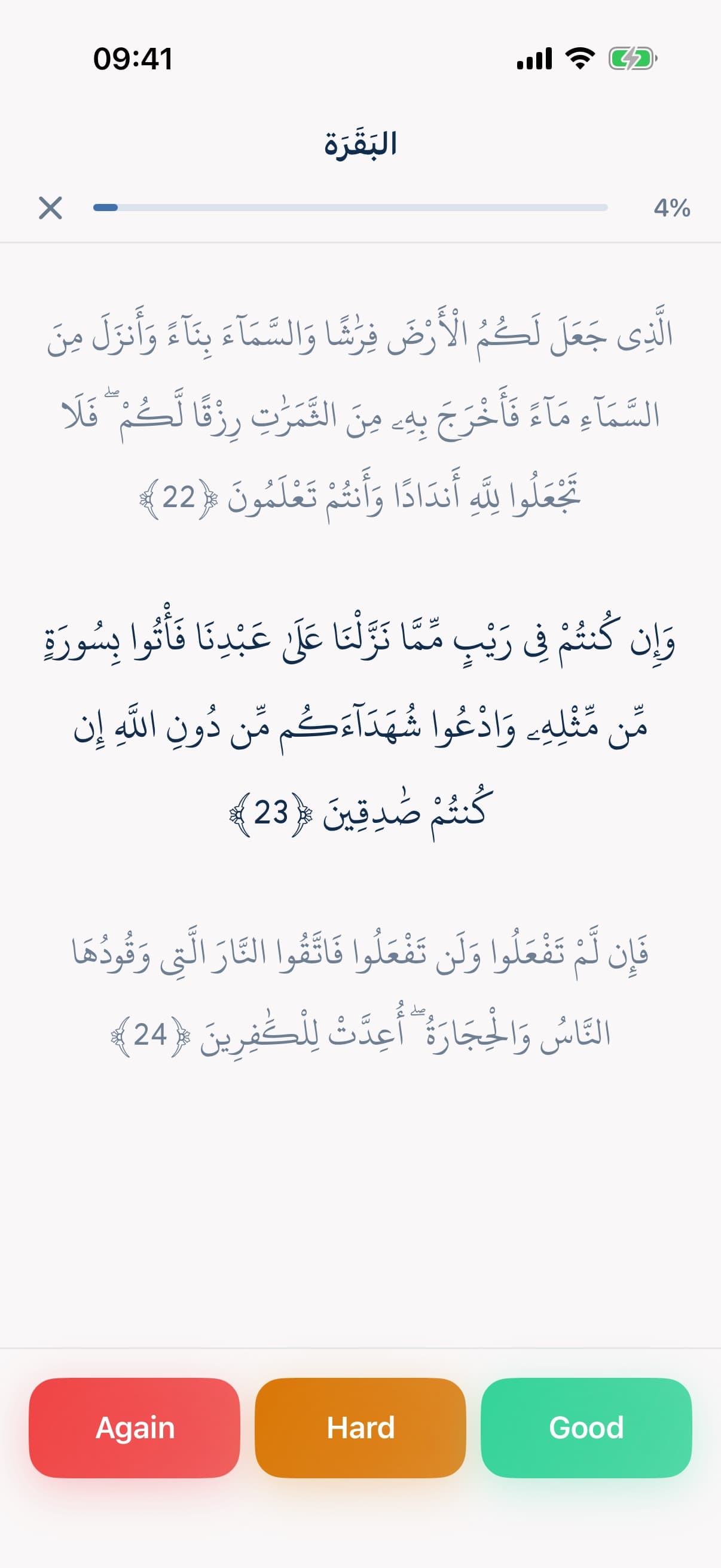
Doing step 3 by hand for 600 pages is where most people give up. This is the scheduling Qiyam does for you. Every verse has its own review schedule, so verses you struggle with come back sooner and solid ones later. After each quiz you rate yourself Again, Hard or Good, and "Again" brings a verse back the next day.
When you add what you have memorised, you set how well you know it, and solid content starts with longer gaps instead of going through every early review. You can exclude a surah you recite every day and include it again anytime. Reviews are spread so one day doesn't pile up, and all overdue verses are shown rather than hiding a backlog.
Research on optimal review times points the same way: treating review timing as an optimisation problem, one study found that the best time to review an item is governed by the probability of recalling it, and learners on Duolingo who followed that schedule memorised more effectively than those on heuristic schedules.8 The right day to revise a page is close to when you would otherwise start to lose it, not a fixed day of the week.
Should you leave your teacher's schedule?
If you study with a teacher, follow their plan. A teacher hears your recitation, which no schedule can, and the daily discipline of a halaqa is worth more than any optimisation. The ideas here are for the part of revision you do alone: the old portion, after the class, or after you have finished the Qur'an.
If the 7-day cycle is working, and your old pages are firm, there is nothing to fix. If things keep slipping although you follow it faithfully, the problem is probably not your effort. It is that a fixed cycle gives the same time to pages that need very different amounts.
Sources
- 1Roediger HL, Karpicke JD (2006). Test-Enhanced Learning. Psychological Science.
- 2Adesope OO, Trevisan DA, Sundararajan N (2017). Rethinking the Use of Tests: A Meta-Analysis of Practice Testing. Review of Educational Research.
- 3Murre JMJ, Dros J (2015). Replication and Analysis of Ebbinghaus' Forgetting Curve. PLOS ONE.
- 4Cepeda NJ, Vul E, Rohrer D, Wixted JT, Pashler H (2008). Spacing Effects in Learning. Psychological Science.
- 5Cepeda NJ, Pashler H, Vul E, Wixted JT, Rohrer D (2006). Distributed practice in verbal recall tasks: A review and quantitative synthesis. Psychological Bulletin.
- 6Bahrick HP, Bahrick LE, Bahrick AS, Bahrick PE (1993). Maintenance of Foreign Language Vocabulary and the Spacing Effect. Psychological Science.
- 7Karpicke JD, Bauernschmidt A (2011). Spaced retrieval: Absolute spacing enhances learning regardless of relative spacing. Journal of Experimental Psychology: Learning, Memory, and Cognition.
- 8Tabibian B, Upadhyay U, De A, Zarezade A, Schölkopf B, Gomez-Rodriguez M (2019). Enhancing human learning via spaced repetition optimization. Proceedings of the National Academy of Sciences.
Frequently asked questions
What are sabaq, sabqi and manzil?
Many hifz schools split daily work into three parts: sabaq, the new lesson; sabqi, the recent portion revised daily; and manzil, the older portion revised in rotation. Names and details vary between schools and countries.
How often should I revise each juz after finishing hifz?
No single number fits every page. Research on spacing suggests the best gap grows as material becomes more stable, so solid juz can wait longer than a week while weak pages come back within days. Let how well you recite a page decide its next gap.
Is the 7-day revision cycle bad?
No. It is daily, recited from memory and checked by a teacher, which are exactly the habits memory research supports. Its limit is only that every old page gets the same gap, whether it is solid or slipping.
Should I stop following my teacher's schedule?
If you study with a teacher, follow their plan: a teacher hears your recitation, which no schedule can. The ideas in this article are for the revision you do alone, especially after finishing the Qur'an.