Qiyam
QiyamRevision
You don't need 2 hours a day for Quran revision
You don't need 2 hours a day to keep your Quran memorization. Short daily revision, recited from memory and spaced out, is what research and the Sunnah favour.
By Amine Benlaroui, , updated , 6 min read

You don't need 2 hours a day to keep your Quran memorization. What keeps a page is reciting it from memory and coming back to it after a gap, not the length of any single session. A short daily revision you actually keep, even 10 or 15 minutes on hard days, will usually hold more over a year than a long plan you keep only now and then.
No study has measured the minimum minutes a day for hifz, and this article won't invent one. What follows is what the Sunnah and memory research do say about consistency and repetition, and how to build a short revision routine around them.
Why does the 2-hour standard stop people from revising?
The pattern is familiar. You decide today is the day for a full revision of everything that has slipped. You estimate two hours, maybe three. Then you look at the day: work, family, tiredness. Two hours doesn't fit, so nothing happens, and tomorrow the pile is bigger.
The trouble is not laziness. A big target makes starting expensive. You need a large block of free time, energy, and the will to begin. A small target needs none of that: ten minutes fits between Maghrib and Isha, after Fajr, or before sleep.
The 2-hour figure often comes from good places: a teacher's plan for a full-time student, a scholar's biography, someone else's schedule online. Those plans may be right for those people. They are not a minimum for everyone.
What did the Prophet ﷺ say about small, regular deeds?
ʿAisha narrated that the Messenger of Allah ﷺ said: "Do good deeds properly, sincerely and moderately and know that your deeds will not make you enter Paradise, and that the most beloved deed to Allah is the most regular and constant even if it were little."1
When she was asked whether the Prophet ﷺ chose particular acts for particular days, ʿAisha said no, and described his practice as "continuous".2
These hadiths are about deeds in general, not revision schedules, and this article draws no ruling from them. But they set a direction that fits revision well: what is regular and constant, even if little, is praised.
What does research say about short, spread-out revision?
None of these studies is about the Qur'an. They tested maths problems, word pairs and concepts. Together they suggest that how you spread your revision matters more than how long each session lasts.
Extra repetitions in one sitting didn't help
In two experiments, 216 college students learned a kind of maths problem. Doing 9 practice problems in one session instead of 3 had no effect on test scores 1 or 4 weeks later. But splitting 10 problems across two sessions a week apart, instead of doing them all at once, gave an extremely large benefit on a test 4 weeks later.3
For hifz, this suggests that reciting a page ten more times tonight may not hold it next month, while bringing it back next week will.
Fewer sessions, spread wider, kept as much
In a 9-year study, 4 people learned and relearned 300 word pairs. Thirteen relearning sessions spaced 56 days apart gave retention comparable to 26 sessions spaced 14 days apart.4 Only four people took part, so treat it as a hint. The hint is that keeping what you know, as opposed to learning it, can cost much less time than you expect if the gaps are right.
Coming back costs little
Across 3 experiments, 533 students practised recalling concepts, then relearned them in later sessions. Relearning had large effects on retention 1 to 4 months later, with relatively little extra practice. The authors recommend recalling something correctly 3 times when first learning it, then relearning it 3 times at widely spaced intervals.5
Reciting beats rereading
Students who recalled prose passages from memory remembered more after 2 days and 1 week than students who reread them, even though rereading made them feel more confident.6 Ten minutes of reciting without looking is likely to do more than ten minutes of reading from the mushaf.
How do you build a short daily revision habit?
Step 1: Set the floor for your worst day
Ask what you could do every day, including a tired Tuesday when everything goes wrong. Not what you hope to do. It might be 15 minutes, or it might be 5. That is your floor.
Step 2: Attach it to something you already do
Habit research supports this. In a study of 96 volunteers, each chose an eating, drinking or activity behaviour to do daily in the same context, such as "after breakfast", for 12 weeks. With repetition in a consistent context, the behaviour became more automatic, along a curve that levelled off. The time to reach 95% of that level ranged from 18 to 254 days: for some people it takes a long time.7 Pick one anchor you never skip: after Fajr, after Maghrib, before sleep.
Step 3: Count the days, not the minutes
Your win is showing up. Fifteen minutes done is a complete day, not a partial one. On days with more time, go further, but don't let a long session become the new floor.
Step 4: Don't let one missed day end it
The same habit study found that missing one opportunity did not materially affect the habit forming.7 One empty day is not a broken routine. What breaks routines is the guilt that turns one missed day into a missed month.
What can you revise in 15 minutes?
Fifteen minutes will not cover your whole hifz, and it doesn't need to. It needs to cover the right part of it each day:
- What you memorised most recently, recited from memory. New pages are the most fragile.
- A few older pages that are starting to weaken, chosen by how shaky they are, not by their place in a fixed cycle.
- Nothing that is solid and was revised recently. It can wait.
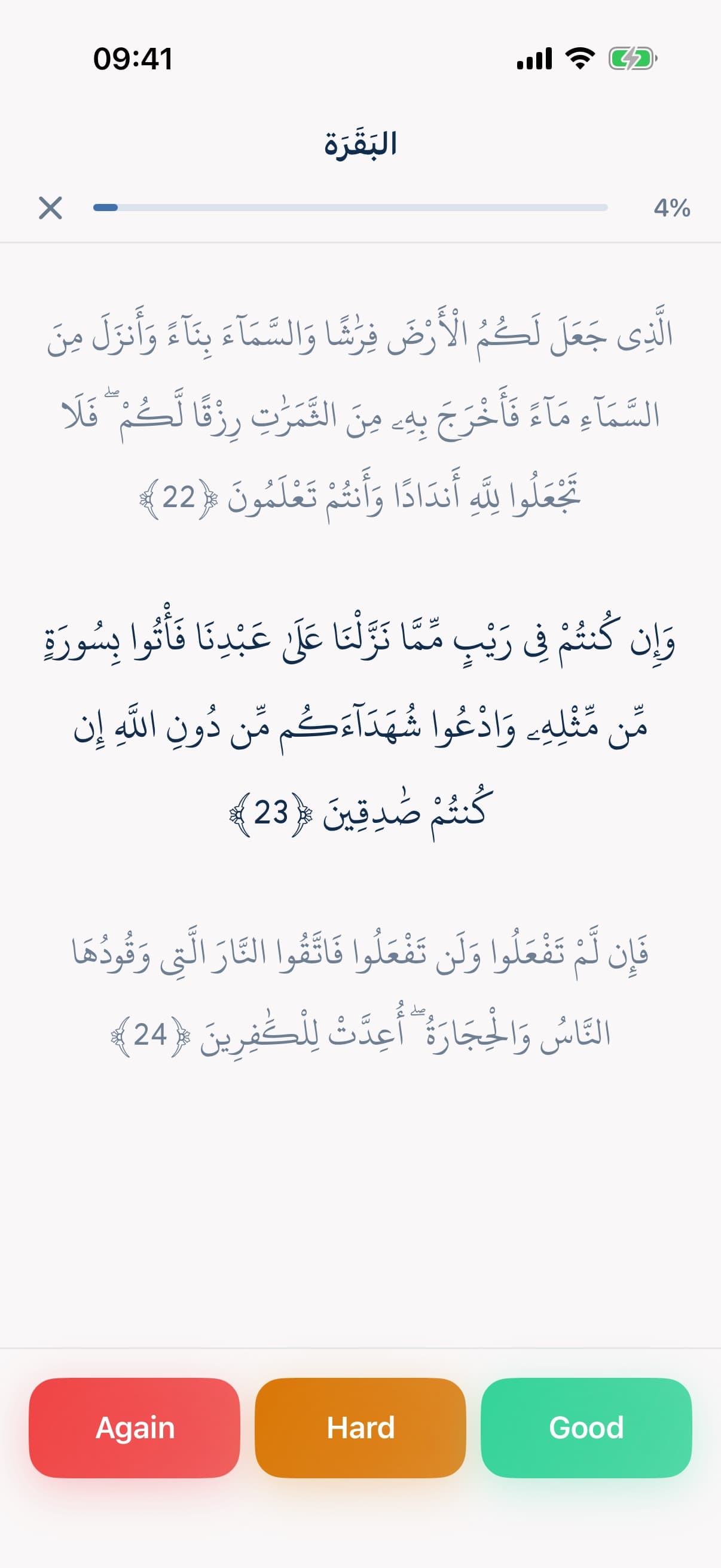
Choosing which older pages are due is the hard part to do by hand. This is the scheduling Qiyam does for you. Every verse has its own review schedule: verses you struggle with come back sooner, solid ones later. The verses due today are grouped into short passages from the same surah, up to 150 words each, so you recite a continuous stretch.
Reviews are spread so one day doesn't pile up, and the daily streak counts the days the schedule legitimately leaves empty, so a quiet day never breaks it. A freeze protects a missed day: one for everyone, earned every 7 days of an unbroken run.
You can also do all of this on paper: a notebook with each page, the date you last recited it, and a mark for how it went. What matters is the method, not the tool.
What if even 15 minutes is too much right now?
Some seasons are harder: a new baby, illness, grief, a new job. If your floor feels too high, lower it.
- Five minutes is a floor.
- One short surah recited from memory before sleep is a floor.
- Reciting what you know in your sunnah prayers is a floor.
Listening to recitation keeps you close to the Qur'an, and it is good. It is not the same as reciting from memory, so add even a few verses of your own when you can.
The aim in a hard season is to never fully stop. Rebuilding from a thin thread is far easier than restarting from nothing, and the season will pass.
The long view
A revision habit for hifz has to last decades, through every kind of year. That is not something intensity can carry. Short, regular sessions, recited from memory and spread out over time, are what the research on memory points to, and what the hadith praises: the most regular and constant, even if it were little.
Start today with the time you actually have. Then do it again tomorrow.
Sources
- 1al-Bukhari Sahih al-Bukhari 6464. sunnah.com.
- 2Muslim ibn al-Hajjaj Sahih Muslim 783a. sunnah.com.
- 3Rohrer D, Taylor K (2006). The effects of overlearning and distributed practise on the retention of mathematics knowledge. Applied Cognitive Psychology.
- 4Bahrick HP, Bahrick LE, Bahrick AS, Bahrick PE (1993). Maintenance of Foreign Language Vocabulary and the Spacing Effect. Psychological Science.
- 5Rawson KA, Dunlosky J (2011). Optimizing schedules of retrieval practice for durable and efficient learning: How much is enough?. Journal of Experimental Psychology: General.
- 6Roediger HL, Karpicke JD (2006). Test-Enhanced Learning. Psychological Science.
- 7Lally P, van Jaarsveld CHM, Potts HWW, Wardle J (2009). How are habits formed: Modelling habit formation in the real world. European Journal of Social Psychology.
Frequently asked questions
How many minutes a day should I revise the Quran?
No study has measured a minimum for hifz. Choose a floor you can keep on your worst day, for example 10 or 15 minutes, recite from memory, and spread your revision so each page comes back after a gap.
Is a long revision session once a week enough?
Research suggests spreading the same work over several sessions holds more than doing it all at once. In one study, extra repetitions in a single session had no effect a few weeks later, while splitting practice across a week gave a large benefit.
What should I revise first when I only have 15 minutes?
Your most recent memorization, recited from memory, then a few older pages that are starting to weaken. Solid pages you revised recently can wait.
What if I miss a day of revision?
Start again the next day without making up for it all at once. In a study of how habits form, missing one opportunity did not materially affect the process.