Qiyam
Memorisation
How many times should you repeat a verse to memorize it?
There's no proven number of times to repeat a verse to memorize it. Research suggests 3 correct recitations from memory, then a few spaced returns.
By Amine Benlaroui, , 7 min read
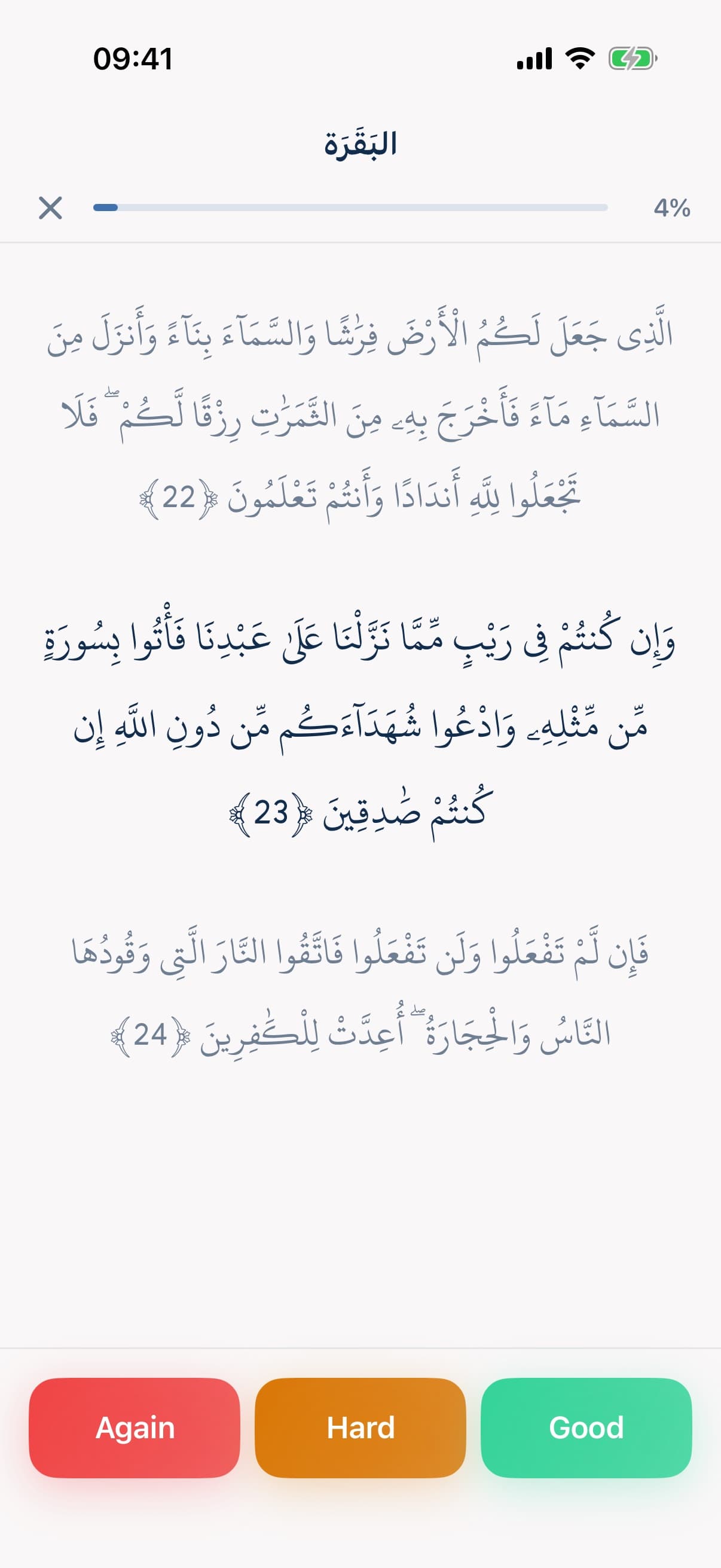
There is no proven number of times you should repeat a verse to memorize it. Research suggests counting something else: how many times you recite it correctly from memory. Get a new passage right from memory about three times on the day you learn it, then bring it back a few more times on later days, with wide gaps between them. Extra repetitions in one sitting add surprisingly little.
That changes how a memorisation session looks. Below: why a fixed count of repetitions is a weak target, what the studies found, a routine for a new page, and what to do when a verse still slips.
Why is "repeat it 20 times" a weak target?
A common piece of advice is to repeat each verse a set number of times before moving on. It is easy to follow, and repetition does help. The problem is that a count measures effort, not memory. Twenty readings with your eyes on the mushaf and twenty recitations with the mushaf closed are very different sessions, and the count treats them the same.
Two things make a fixed count misleading.
Reading is not recalling. Once you can produce something from memory, more studying of it may add nothing. In one experiment, students learned foreign words. Once a student had produced a word correctly, some kept studying it, while others kept being tested on it. Repeated studying after learning had no effect on delayed recall; repeated testing had a large positive effect.1 The same study found that students' predictions of their own performance were uncorrelated with how they actually did. Feeling that you "have it" is not a reliable guide.
Producing the words yourself leaves a stronger trace. Across five experiments, words that people generated themselves were remembered better than the same words simply read, on recognition and on recall tests.2 Reciting a verse from memory is generation; reading it along is not.
So the useful question is not "how many times did I repeat it?" but "how many times did I get it right without looking?"
How many correct recitations does research suggest?
The clearest answer comes from a large study on exactly this question: how much practice is enough.
Three correct recalls, then three spaced returns
Across three experiments, 533 students learned material through retrieval practice: they tried to recall it, then restudied it. Items were practised until they had been recalled correctly 1, 2, 3 or 4 times in the first session. Then they were practised again, to one correct recall, in 1 to 5 later relearning sessions. The researchers collected more than 100,000 recall answers and measured memory 1 to 4 months later.3
Two findings matter for hifz:
- Extra correct recalls on day one helped, but less and less once relearning was added. Before any relearning, practising to a higher number of correct recalls made a clear difference. As relearning sessions were added, that early advantage shrank.
- Relearning sessions had large effects on long-term memory at a small extra cost. Coming back to the material later took relatively few additional trials and made it last much longer.
The authors' recommendation for students: practise recalling to an initial target of 3 correct recalls, then relearn 3 times at widely spaced intervals.3
The material was concepts, not memorised text, and the participants were students, not huffaz. Treat it as a starting point, not a rule for the Qur'an. But it points in a clear direction: a few correct recitations today, then several returns later, beats many repetitions today.
More repetitions in one sitting added little
A second study tested the "just do more" approach directly. 216 college students learned to solve one kind of maths problem. Some did 3 practice problems in one session, others did 9. The six extra problems had no effect on test scores 1 week or 4 weeks later.4
In the same paper, students did 10 problems either in one session or split over two sessions a week apart. Tested 1 week later, splitting made no difference. Tested 4 weeks later, the benefit of splitting was extremely large.4
This is maths, not Qur'an, and repetition is not useless. A review of many studies on extra practice beyond the point of mastery (called overlearning) found a significant, moderate effect on retention, which depended on how much extra practice was done, the type of task, and how long people had to remember.5 The fair reading: extra repetitions tonight help a little; bringing the verse back next week helps far more.
What does a good routine for a new page look like?
Here is one way to put the research into practice. Adjust the size of the portion to your level; the shape matters more than the numbers.
On the day you memorise
- Listen and read first. Hear the passage recited correctly and read it with attention to every letter, so you don't memorise a mistake.
- Close the mushaf and recite. Start from the verse before the new one, so you learn the link as well as the verse. When you hesitate or slip, look, then close the mushaf and try again.
- Count the clean recitations, not the attempts. Stop when you have recited the passage correctly from memory about three times. If it takes ten attempts to get three clean ones, that is fine: the attempts are where the learning happens.
On the following days
- The next day: recite it from memory before anything else. It will feel harder than last night. That difficulty is expected.
- A few days later: recite it again, from memory, joined to the passage before it.
- About a week later, then further apart: keep bringing it back, each time with a longer gap, as long as it still comes out right.
How the gaps grow matters less than you might think. In one experiment, people practised recalling items on 3 repeated tests. Long intervals between the tests gave a 200% improvement in long-term retention over tests with no spacing, while the pattern of the gaps (expanding, equal or shrinking) made no measurable difference.6 You don't need a perfect schedule. You need the returns to happen, and to be spread out.
Why can you recite it today but not tomorrow?
Because recalling a verse right after reading it is easy. It is still in front of your mind, and getting it right tells you little about whether it will hold. A recitation after a night, or after several days, is the real test, and it is also the one that strengthens the memory most.
This is why the next-day recitation feels like a step backwards. You may need a glance at the mushaf, or several attempts, to get it clean again. That is not wasted work. In the study above, the later relearning sessions took relatively few trials and made the biggest difference to what was remembered months later.3
A practical rule: judge a verse by how it comes out after a gap, never by how it sounds at the end of the session where you learned it.
How do you keep track of every verse?
With one new page, the routine above is easy to follow on paper. With twenty pages, each at a different stage, it becomes hard. Some passages are due tomorrow, some in a week, some you keep missing and need sooner.
The honest options:
- A notebook: write the date you memorised each passage and tick each later recitation. Simple and reliable if you keep it up.
- A teacher: a teacher who hears you regularly does this tracking for you, and also catches mistakes you can't hear yourself.
- An app: a spaced repetition app keeps the dates for you.
This is the approach Qiyam takes. A quiz shows the verse before and the verse after, and you recite the one in between from memory, then reveal it and rate yourself Again, Hard or Good. Each verse has its own schedule: the ones you struggle with come back sooner, solid ones later, and "Again" brings a verse back the next day. It counts what the research says to count, recitations from memory, rather than readings.
Whatever you use, the principle is the same: record whether you recited it correctly from memory, and when, not how many times you read it.
What if a verse still keeps slipping?
Some verses resist, often because they resemble another verse, or because the link from the verse before is weak.
- Practise the link, not just the verse. Recite the verse before it, then continue. Many slips happen at the join between two verses, not inside one.
- Shorten the gap for that verse only. A verse you missed should come back the next day, while the rest of the page keeps its longer gap. There is no need to restart the whole page.
- Look for a twin. If the verse resembles another one elsewhere in the Qur'an, put the two side by side and name the difference out loud. The slip may be a mix-up, not a gap.
- Don't add twenty repetitions in one go. If tonight's extra practice feels necessary, keep it short, and put the effort into tomorrow's recitation instead.
The short answer
Stop counting repetitions. Count clean recitations from memory: about three on the day you learn a passage, then a few more on later days, spread wide. That is less work in the moment and, according to the research we have, more Qur'an that stays.
Sources
- 1Karpicke JD, Roediger HL (2008). The critical importance of retrieval for learning. Science, 319(5865), 966–968.
- 2Slamecka NJ, Graf P (1978). The generation effect: Delineation of a phenomenon. Journal of Experimental Psychology: Human Learning and Memory, 4(6), 592–604.
- 3Rawson KA, Dunlosky J (2011). Optimizing schedules of retrieval practice for durable and efficient learning: How much is enough?. Journal of Experimental Psychology: General, 140(3), 283–302.
- 4Rohrer D, Taylor K (2006). The effects of overlearning and distributed practise on the retention of mathematics knowledge. Applied Cognitive Psychology, 20(9), 1209–1224.
- 5Driskell JE, Willis RP, Copper C (1992). Effect of overlearning on retention. Journal of Applied Psychology, 77(5), 615–622.
- 6Karpicke JD, Bauernschmidt A (2011). Spaced retrieval: Absolute spacing enhances learning regardless of relative spacing. Journal of Experimental Psychology: Learning, Memory, and Cognition, 37(5), 1250–1257.
Frequently asked questions
Is repeating a verse 20 times enough to memorize it?
A count of repetitions measures effort, not memory. Twenty readings with the mushaf open do less than a few recitations with it closed. A better target is to recite the passage correctly from memory about three times, then bring it back the next day and on later days.
Should I read the verse or recite it from memory when memorizing?
Read and listen first, so you learn it correctly. Then close the mushaf and recite. Research on retrieval practice suggests that once you can produce something from memory, more studying adds little, while more recalling helps a lot.
Why do I forget a verse the day after memorizing it?
Reciting it right after reading it is easy because it is still fresh, so it says little about whether it will hold. The recitation the next day is the real test, and it may need a glance at the mushaf. That return is what makes the verse last.
How many verses should I memorize a day?
There is no proven number. Choose a portion you can recite correctly from memory a few times in your session, and that leaves time for yesterday's portion. Half a page to a page a day is a reasonable starting pace.