Qiyam
Revision
How to revise Juz Amma so you don't forget it
How to revise Juz Amma so it stays: recite from memory in rotating portions, give weak surahs shorter gaps, and keep similar verses apart, like 81:27 and 68:52.
By Amine Benlaroui, , 5 min read
To revise Juz Amma well, recite it from memory on a schedule rather than only in salah: a few surahs each day, with the ones you stumble on coming back more often. Pay special attention to the middle surahs you rarely pray with, and to the verses that are almost identical to others. Juz Amma is short, 37 surahs on 23 pages, so a steady daily portion can cover all of it regularly.
If you memorised Juz Amma as a child, or as your first step into hifz, it can feel like the part you will never lose. Often the opposite happens: the surahs you pray with every day stay sharp, and the ones in between quietly fade.
Why do you forget parts of Juz Amma?
Mainly because some surahs get far more practice than others. The last surahs of the juz, from Al-Kawthar to An-Nas, are short and easy to pray with, so they often come back every day. Longer surahs at the start, such as An-Naba, An-Naziat and Abasa, take more effort to recite in salah, and a surah you never choose stops being revised at all.
A second reason is that Juz Amma feels known. You recognise every surah when you hear it, and that recognition can hide the fact that you could no longer recite one through alone. Research on the testing effect suggests that this feeling is a poor guide: in one experiment, students who reread a passage felt more confident, yet remembered less a week later than students who had recalled it from memory.1
A third reason is the similar verses. Juz Amma has many short verses that repeat the same pattern with one change, and these are exactly the places where a recitation jumps from one surah to another.
How do you know which surahs are slipping?
Test yourself before you plan anything. Recognition will tell you every surah is fine; only recall shows where the gaps are. Three quick checks, each done without the mushaf:
- Start in the middle. Pick a verse from the middle of a surah and continue from there. If you can only recite a surah by starting at its first verse, the middle is weaker than it feels.
- Say the next opening. At the end of each surah, recite the first verse of the surah that follows it. Moving from one surah to the next is a common place to hesitate.
- Recite the surahs you never pray with. Go through the juz and note the surahs you have not chosen in salah for a month or more. Recite each one through.
Write down every surah where you hesitated, and where. That list, not the whole juz, is where your extra time should go. Repeat the checks every few weeks: a surah that was solid in spring can be shaky by winter if it never comes back.
How should you revise Juz Amma?
Treat it as real revision with its own place in your week, not something that "happens" in salah.
Recite it in portions, from memory
Divide the juz into portions you can recite in 15 to 20 minutes. For many people, that is three or four of the longer surahs, or a larger group of the short ones. Recite each portion from memory first, then open the mushaf only where you hesitated.
Rotate the order
If you always start at An-Naba, the opening surahs are the most revised and the middle ones the least. Rotate your starting point, or start some days from the end of the juz and work backwards, so that no surah is always last.
Give the weak surahs shorter gaps
Not every surah needs the same rhythm. A surah you recite flawlessly can wait a week or two; a surah where you stumbled should come back within a couple of days. A large study on spacing found that the best gap between reviews depends on how long you want to remember: it grew as the test delay grew, but as a share of that delay it fell from about 20 to 40% for a week to about 5 to 10% for a year.2 For a juz you want to keep for life, that suggests long gaps for solid surahs, as long as you can still recite them.
Revise the way you pray
Some of your revision should be standing, reciting aloud as you would in salah. In a classic experiment, divers learned words either on land or underwater, and recalled them best in the same place they had learned them.3 That was a study of word lists, not of the Qur'an, but it may explain why a surah that flows at your desk can stall when you lead a prayer. Revising some surahs in the position you recite them in salah brings the two closer.
What about the similar verses in Juz Amma?
Find them, and give each pair its own attention. Two examples:
Al-Inshiqaq and At-Tin end with almost the same verse. At-Tin adds a single letter, fa, before "lahum":
إِلَّا ٱلَّذِينَ ءَامَنُوا۟ وَعَمِلُوا۟ ٱلصَّٰلِحَٰتِ لَهُمْ أَجْرٌ غَيْرُ مَمْنُونٍۭ
Except for those who believe and do righteous deeds. For them is a reward uninterrupted.
إِلَّا ٱلَّذِينَ ءَامَنُوا۟ وَعَمِلُوا۟ ٱلصَّٰلِحَٰتِ فَلَهُمْ أَجْرٌ غَيْرُ مَمْنُونٍۢ
Except for those who believe and do righteous deeds, for they will have a reward uninterrupted.
At-Takwir has a verse that also appears, with one changed word at the start, in Al-Qalam at the end of Juz 29. At-Takwir's begins with "in"; Al-Qalam's begins with "wa-ma":
إِنْ هُوَ إِلَّا ذِكْرٌۭ لِّلْعَٰلَمِينَ
It is not except a reminder to the worlds
وَمَا هُوَ إِلَّا ذِكْرٌۭ لِّلْعَٰلَمِينَ
But it is not except a reminder to the worlds.
Across the whole Qur'an, six verses contain the phrase "huwa illa dhikr". Five introduce it with "in"; Al-Qalam 68:52 is the only one that introduces it with "wa-ma". If you have memorised Juz 29 too, that single fact keeps the two apart.
A good habit for each pair:
- Put the two verses side by side and name the difference out loud.
- Recite the verse before each one, then the verse itself, from memory.
- Bring both back together over the next few days, until the right version comes without thinking.
How often should you revise Juz Amma?
There is no fixed rule, but the whole juz should come back regularly, with weak surahs more often than strong ones. A simple pattern:
- Daily: one portion recited from memory, plus the surahs you pray with.
- Every few days: the surahs you stumbled on recently.
- Every week or two: a full recitation of the juz, if you can, ideally standing.
If you are also memorising new parts, keep Juz Amma in your daily revision anyway. For many people it is the part they recite most in salah, so a mistake there gets repeated often.
How Qiyam helps with Juz Amma
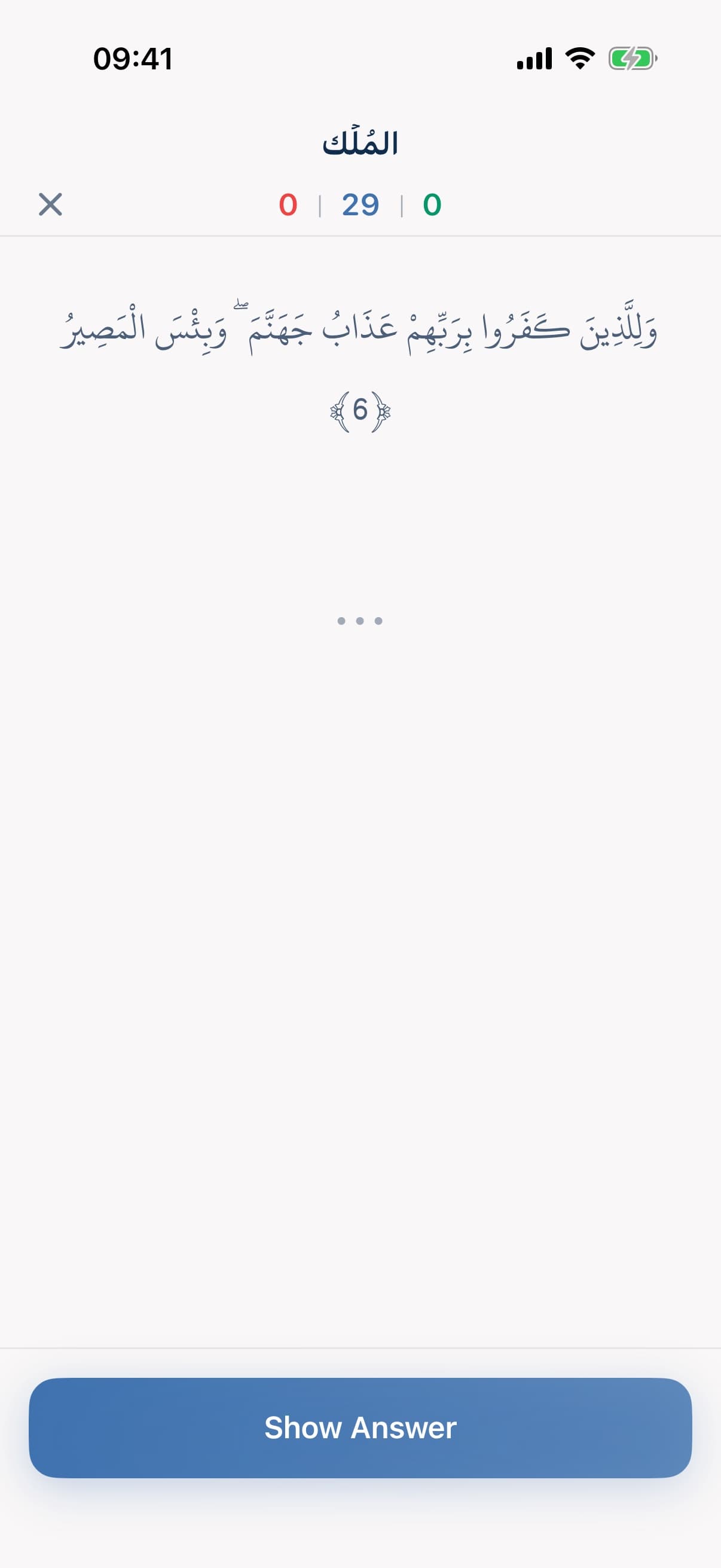
Scheduling every surah by hand, with different gaps for strong and weak ones, is the hard part to keep up. Qiyam does it per verse: every verse has its own review schedule, so verses you struggle with come back sooner and solid ones later. A quiz shows the verse before and the verse after, and you recite what is in between from memory.
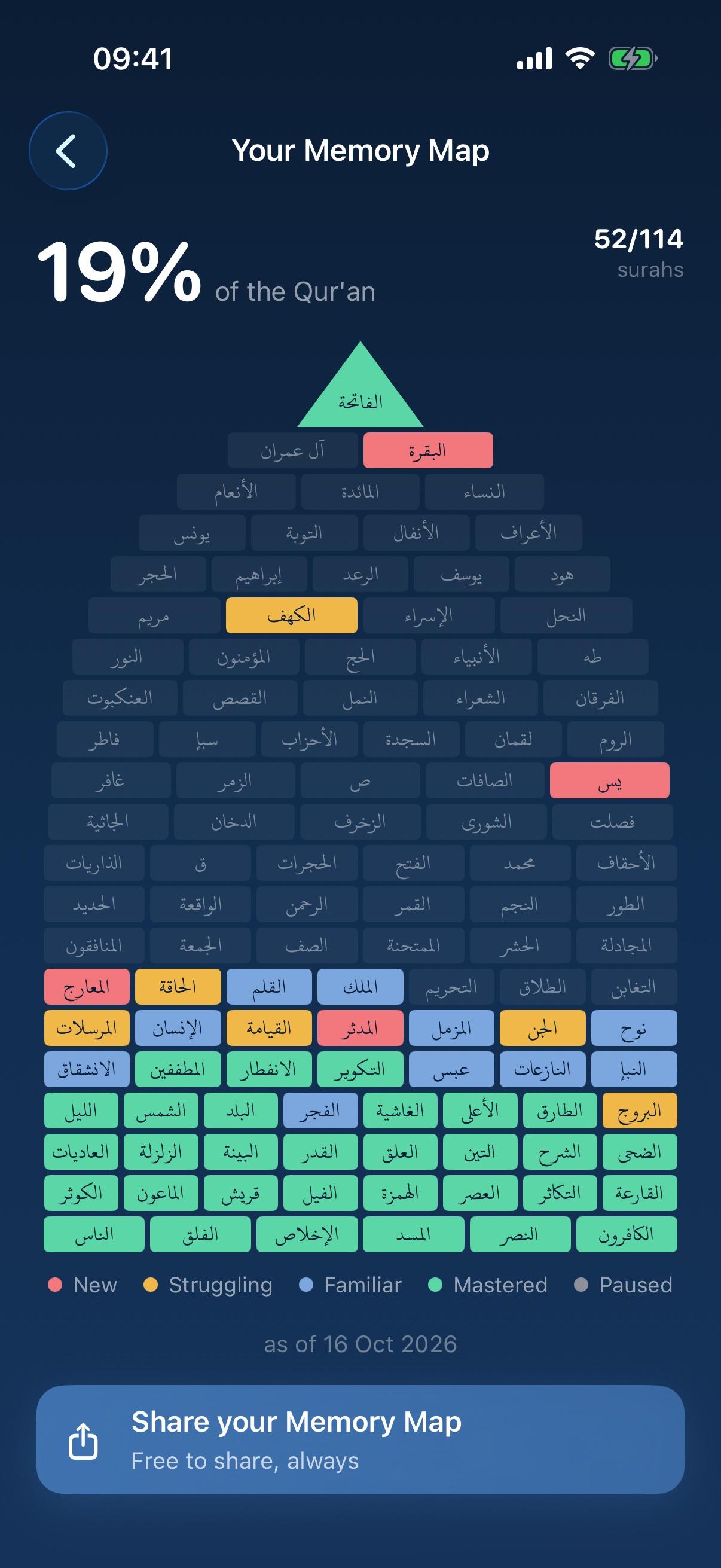
You can add Juz Amma as a juz, set how well you already know it, and solid content starts with longer gaps instead of going through every early review. The free Memory Map then shows each surah as a tile, coloured by how well it is held, so the fading ones in the middle of the juz are easy to see.
Sources
- 1Roediger HL, Karpicke JD (2006). Test-Enhanced Learning. Psychological Science.
- 2Cepeda NJ, Vul E, Rohrer D, Wixted JT, Pashler H (2008). Spacing Effects in Learning. Psychological Science.
- 3Godden DR, Baddeley AD (1975). Context-dependent memory in two natural environments: On land and underwater. British Journal of Psychology.
Frequently asked questions
How long does it take to revise Juz Amma?
Juz Amma is 37 surahs on 23 pages. How long a full recitation takes depends on your pace, which is why it works well split into daily portions of 15 to 20 minutes, so the whole juz comes back every few days.
Why do I forget surahs I memorized as a child?
Often because they are never recited. Surahs you pray with every day stay sharp, while the ones you rarely choose get no practice. Recognising a surah when you hear it is not the same as being able to recite it alone.
Should I revise Juz Amma from the start or the end?
Rotate. Always starting at An-Naba gives the first surahs the most revision and the middle ones the least. Start from different points, or from the end, so each surah gets its turn.
How do I stop mixing up similar verses in Juz Amma?
Put each pair side by side, name the exact difference out loud, and recite the verse before each one from memory. Bring both back together over several days until the right version comes without thinking.