Qiyam
Surah Al-Mulk
How to memorize Surah Al-Mulk and keep it
Memorize Surah Al-Mulk in five short sections, reciting from memory, with its look-alike verses learned as pairs. A plan for its 30 verses and how to keep them.
By Amine Benlaroui, , 5 min read
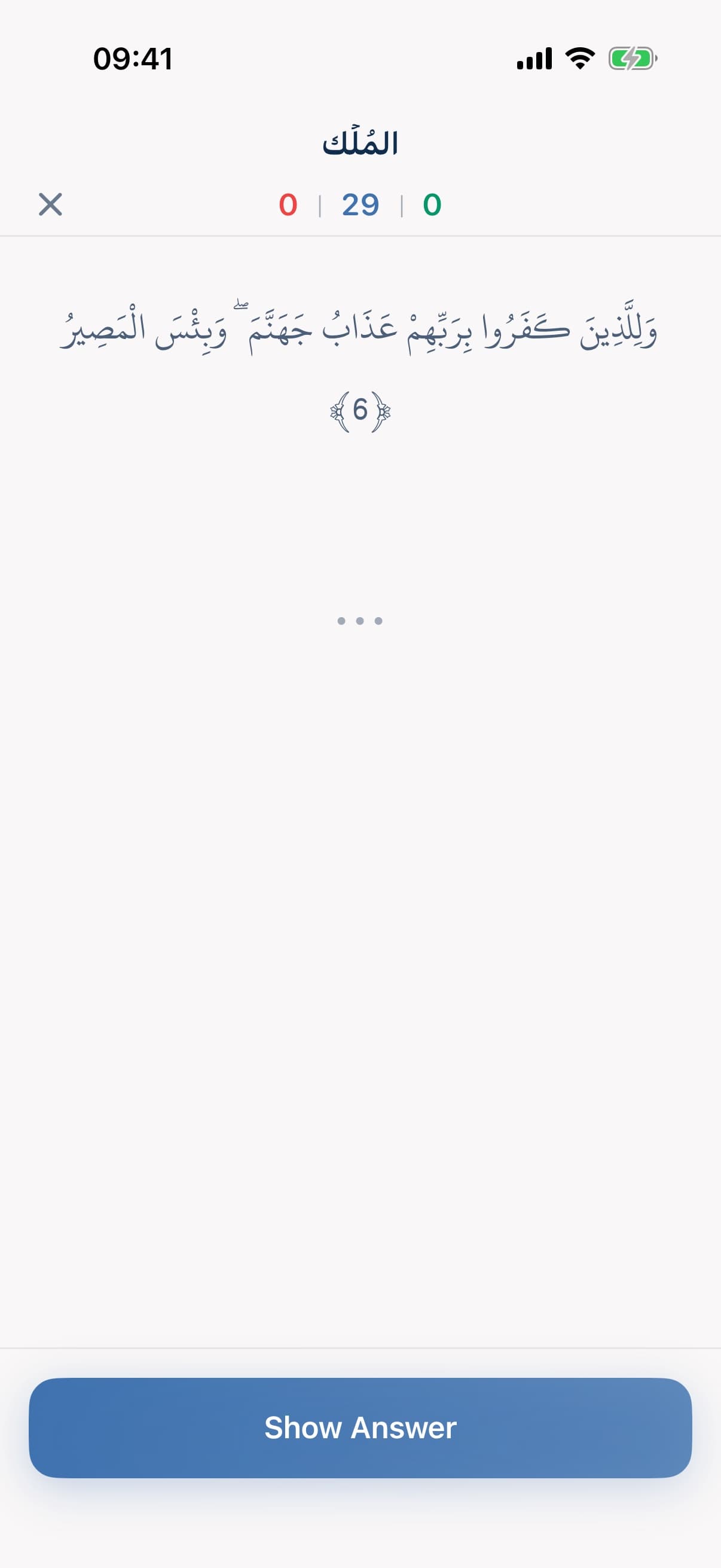
To memorize Surah Al-Mulk, split its 30 verses into five short sections, learn one section per sitting by reciting it from memory before you look, and spend as much effort on the joins between sections as on the verses themselves. In the common 604-page mushaf it fills just under three pages, so five sittings, one per section, take you through the whole surah once; the revision afterwards is what makes it stay. The surah also has several pairs of verses that start the same way: learn them as pairs from the first day and you will not swap them later.
What does the hadith say about Surah Al-Mulk?
Surah Al-Mulk is the 67th surah, at the start of Juz 29. It opens:
تَبَٰرَكَ ٱلَّذِى بِيَدِهِ ٱلْمُلْكُ وَهُوَ عَلَىٰ كُلِّ شَىْءٍۢ قَدِيرٌ
Blessed is He in whose hand is dominion, and He is over all things competent -
In Jami' at-Tirmidhi, in a hadith from Abu Hurairah graded hasan, the Prophet ﷺ said: "Indeed there is a Surah in the Qur'an of thirty Ayat, which intercedes for a man until he is forgiven. It is [Surah] Tabarak Alladhi Biyadihil-Mulk."1 The same hadith is reported in Sunan Abi Dawud and Sunan Ibn Majah, graded hasan and sahih.2
Other narrations about Al-Mulk circulate widely online. Some of them are graded weak by the scholars sunnah.com lists, so check a narration's grade before you repeat it. The hadith above is enough reason to carry these thirty verses with you.
How long is Surah Al-Mulk?
Al-Mulk has 30 verses. In the 604-page mushaf, verses 1 to 12 are on page 562, verses 13 to 26 on page 563, and verses 27 to 30 at the top of page 564. Most verses are one line or two, and none is very long.
That size matters for planning. Thirty verses are too many for one sitting if you want them exact, and few enough that you don't need a months-long plan.
How do you split Al-Mulk for memorizing?
Split it where the subject changes, so each section has its own picture in your mind. Here is one split that follows the English meaning of the verses:
| Section | Verses | What the verses describe |
|---|---|---|
| 1 | 1–5 | Dominion, death and life as a test, the seven heavens, the lamps of the nearest sky |
| 2 | 6–12 | The Fire, its keepers' question "Did there not come to you a warner?", and those who fear their Lord unseen |
| 3 | 13–18 | He knows what is in the breasts, the earth made tame, "Do you feel secure…" |
| 4 | 19–22 | The birds held aloft, "who is it that could…", walking on a straight path |
| 5 | 23–30 | Six verses that begin with "Say" |
Learn one section per sitting, and don't start the next section until you can recite the last one from memory without a slip.
Which verses in Al-Mulk look alike?
Verses that begin the same way are a common place to slip in a surah you know well. Al-Mulk has five such pairs. None of the tips below explains why the verses differ: they are memory hooks you can check against the text, nothing more.
Verses 3 and 4: once, then twice. Verse 3 ends "so return [your] vision"; verse 4 begins "then return [your] vision twice again". The word karratayn (twice) is what verse 4 adds.
Verses 16 and 17: the earth, then the sky.
ءَأَمِنتُم مَّن فِى ٱلسَّمَآءِ أَن يَخْسِفَ بِكُمُ ٱلْأَرْضَ فَإِذَا هِىَ تَمُورُ
Do you feel secure that He who [holds authority] in the heaven would not cause the earth to swallow you and suddenly it would sway?
أَمْ أَمِنتُم مَّن فِى ٱلسَّمَآءِ أَن يُرْسِلَ عَلَيْكُمْ حَاصِبًۭا ۖ فَسَتَعْلَمُونَ كَيْفَ نَذِيرِ
Or do you feel secure that He who [holds authority] in the heaven would not send against you a storm of stones? Then you would know how [severe] was My warning.
Both begin "Do you feel secure that He who [holds authority] in the heaven would not…". The first continues with the earth swallowing you (an yakhsifa), the second with a storm of stones sent against you (an yursila). The second also adds am before amintum. A hook: the earth comes first in the order, then what falls from above.
Verses 20 and 21: help, then provision. Both start amman hadha alladhi, "or who is it that…". Verse 20 is about an army to aid you, verse 21 about who could provide for you.
Verses 23 and 24: ansha'akum, then dhara'akum. Both start qul huwa alladhi. Verse 23 is "who has produced you" and goes on to hearing, vision and hearts; verse 24 is "who has multiplied you throughout the earth". Verse 29 then starts qul huwa ar-Rahman, so keep these three apart by their third word.
Verses 28 and 30: the last two "Have you considered".
قُلْ أَرَءَيْتُمْ إِنْ أَهْلَكَنِىَ ٱللَّهُ وَمَن مَّعِىَ أَوْ رَحِمَنَا فَمَن يُجِيرُ ٱلْكَٰفِرِينَ مِنْ عَذَابٍ أَلِيمٍۢ
Say, [O Muhammad], "Have you considered: whether Allah should cause my death and those with me or have mercy upon us, who can protect the disbelievers from a painful punishment?"
قُلْ أَرَءَيْتُمْ إِنْ أَصْبَحَ مَآؤُكُمْ غَوْرًۭا فَمَن يَأْتِيكُم بِمَآءٍۢ مَّعِينٍۭ
Say, "Have you considered: if your water was to become sunken [into the earth], then who could bring you flowing water?"
Both begin qul ara'aytum in. Verse 28 continues with "Allah should cause my death"; verse 30, the last verse of the surah, with "your water".
One count holds the whole last section together: of the last eight verses, six begin with qul (23, 24, 26, 28, 29 and 30). Only verse 25, "And they say, 'When is this promise…'", and verse 27, "But when they see it approaching…", don't. If you know which two don't, you won't skip one of the others.
How do you memorize Al-Mulk step by step?
- Listen to the section first. Play it from a slow, careful reciter several times while you follow the text. Learn it from a teacher if you can.
- Learn one verse until you can say it without looking, then add the next, starting again from the section's first verse each time.
- Close the mushaf and recite the whole section from memory. This is the step that makes it stay. In one study, students who recalled prose passages from memory kept substantially more 2 days and 1 week later than students who reread them, even though rereading made them more confident.3 That study used prose, not the Qur'an; it suggests why reciting beats reading along.
- Learn in the evening, check in the morning. In two experiments with high-school students learning vocabulary, memory was better when sleep followed within a few hours of learning, whatever the time of day.4 Recite the section from memory the next morning before you open the mushaf, then fix what slipped.
- Join the new section to the one before. Before learning section 3, recite sections 1 and 2 together. The join is where a section you know well can still stop you.
Practise the page turns
Two joins in Al-Mulk fall on a page turn: from verse 12 to verse 13 (page 562 to 563) and from verse 26 to verse 27 (page 563 to 564). If you learned with the mushaf, a page turn can be where your picture of the page runs out and your recitation stalls. Recite those two joins on their own a few extra times: the end of verse 12 into "And conceal your speech", and the end of verse 26 into "But when they see it approaching".
How do you keep Surah Al-Mulk once you know it?
A surah you memorize in a week can fade in a month if it never comes back. Three habits keep it:
- Recite it from memory on a regular rhythm, not only when you happen to pray with it. Thirty verses take a few minutes.
- Revise more often at first, then less. A new surah needs frequent returns in its first weeks. Once it is solid, longer gaps are enough, as long as you can still recite it when it comes back.
- Revise the weak verses on their own. If one join keeps catching you, drill that join instead of reciting the whole surah again.
That last habit is easy to forget. Qiyam's Exercises have a mode for it, Verse by Verse: one verse is shown and you recite only the next one, the link that matters in recitation. Here it is in Surah Al-Mulk:
In Qiyam every verse also has its own review schedule: verses you struggle with come back sooner and solid ones later. In Al-Mulk that means verses 16 and 17 can come back more often than verse 1, without you tracking it by hand.
Start tonight
Play verses 1 to 5 from a careful reciter, repeat them until you can say them without looking, and recite them from memory once before you sleep. Tomorrow morning, recite them again before you check. When you reach verses 16 and 17, learn them together, earth first, then the storm of stones.
Sources
- 1al-Tirmidhi Jami' at-Tirmidhi 2891: a surah of thirty verses that intercedes (graded hasan). Jami' at-Tirmidhi 2891.
- 2Ibn Majah Sunan Ibn Majah 3786: the surah of thirty verses (graded sahih). Sunan Ibn Majah 3786.
- 3Roediger HL, Karpicke JD (2006). Test-Enhanced Learning. Psychological Science.
- 4Gais S, Lucas B, Born J (2006). Sleep after learning aids memory recall. Learning & Memory.
Frequently asked questions
How long does it take to memorize Surah Al-Mulk?
It depends on how familiar the Arabic sounds are to you. Split into five sections, one per sitting, with a check from memory the next morning, you go through all 30 verses in five sittings. Keeping it exact afterwards takes regular revision.
How many verses and pages is Surah Al-Mulk?
Surah Al-Mulk has 30 verses. In the common 604-page mushaf, it runs from page 562 to the top of page 564, at the start of Juz 29.
What is the authentic hadith about Surah Al-Mulk?
In Jami' at-Tirmidhi 2891, graded hasan, the Prophet ﷺ said that a surah of thirty verses intercedes for a man until he is forgiven, and that it is Tabarak Alladhi Biyadihil-Mulk. It is also reported in Sunan Abi Dawud 1400 and Sunan Ibn Majah 3786. Some other narrations about Al-Mulk are graded weak, so check a narration's grade on sunnah.com before sharing it.
Which verses of Surah Al-Mulk are easy to confuse?
Verses 16 and 17 both begin "Do you feel secure…", verses 20 and 21 both begin "Or who is it that…", verses 23 and 24 both begin "Say, It is He who…", and verses 28 and 30 both begin "Say, Have you considered…". Learn each pair together and note the word where they part.
Can I memorize Surah Al-Mulk without knowing Arabic?
Yes. Many people memorize the Qur'an without speaking Arabic. Reading the translation of each section before you start helps, because you know where each verse leads, and a teacher or careful reciter keeps your pronunciation right.