Qiyam
Planning your hifz
How long does it take to memorize the Quran?
At one page a day, five days a week, memorizing the Quran takes about 2.3 years. The time for every daily pace, and why revision sets the real limit.
By Amine Benlaroui, , 6 min read
At one page a day, five days a week, memorizing the whole Quran takes about two years and four months. At half a page a day it takes about four and a half years; at five lines a day, about seven. Those figures count only new memorization: what really sets your pace is how much revision you can keep up as the pages you hold add up, so the honest answer is the fastest pace your revision can carry.
How many pages is the Quran?
In the common 604-page mushaf, the Quran has 6,236 verses on 604 pages of 15 lines each, divided into 30 juz. Most juz are about 20 pages long, and Juz 30 (Juz Amma) runs to 23: it holds 37 short surahs, each with its own heading.
That makes the arithmetic simple. Pick how much you memorize on each learning day, divide 604 pages by it, and you have the number of learning days. Then decide how many days a week you learn new pages, and leave the other days for revision only.
How long does it take at each pace?
Here is the arithmetic for four common daily amounts, learning new verses five days a week and revising only on the other two:
| New memorization per learning day | One juz (20 pages) | The whole Quran (604 pages) |
|---|---|---|
| 5 lines (a third of a page) | 12 weeks | about 7 years |
| Half a page | 8 weeks | about 4.6 years |
| One page | 4 weeks | about 2.3 years |
| Two pages | 2 weeks | about 1.2 years |
If you learn new verses every day of the week, divide by seven instead of five: one page a day is 604 days, about 1 year and 8 months.
These are not promises. They assume you never stop for illness, travel, exams or a busy month, and that every page you learn stays learned. In practice the second assumption is the one that breaks, and that is where the real answer lies.
Why does revision decide how long it takes?
New memorization is the visible part. Revision is the part that grows. On your first day you have one page to keep; after a year at a page a day, five days a week, you have about 260. Every one of them needs to come back before it fades, and the time those returns take comes out of the same hours as your new pages.
A rough way to see it: if every page you hold came back once every two weeks, 260 pages would mean about 19 pages of revision a day. If solid pages could wait four weeks between returns, the same 260 pages would need about 9 a day. The gap between revisions, more than the number of new lines, decides whether your plan survives its second year.
The research on spacing points in the hopeful direction: longer gaps can hold memory as well as frequent ones. In a nine-year study, four people learned and relearned 300 word pairs. Thirteen relearning sessions spaced 56 days apart gave retention comparable to 26 sessions spaced 14 days apart.1 That is half the sessions for the same result, though with only four participants and word pairs, not the Quran.
A larger study shows the gap should grow with how long you need to remember. More than 1,350 people learned facts, reviewed them after a gap of up to 3.5 months, and were tested up to a year later. The best gap grew as the test got further away: about 20 to 40% of a one-week delay, but about 5 to 10% of a one-year delay.2 For a page you want to keep for life, that suggests the gaps between its revisions can stretch to weeks once it is solid, as long as you can still recite it when it comes back.
The catch is that pages are not equally solid. A page you learned last month needs to come back much sooner than a surah you have recited in salah for years, and one weak page in a juz can need more attention than the rest of it together.
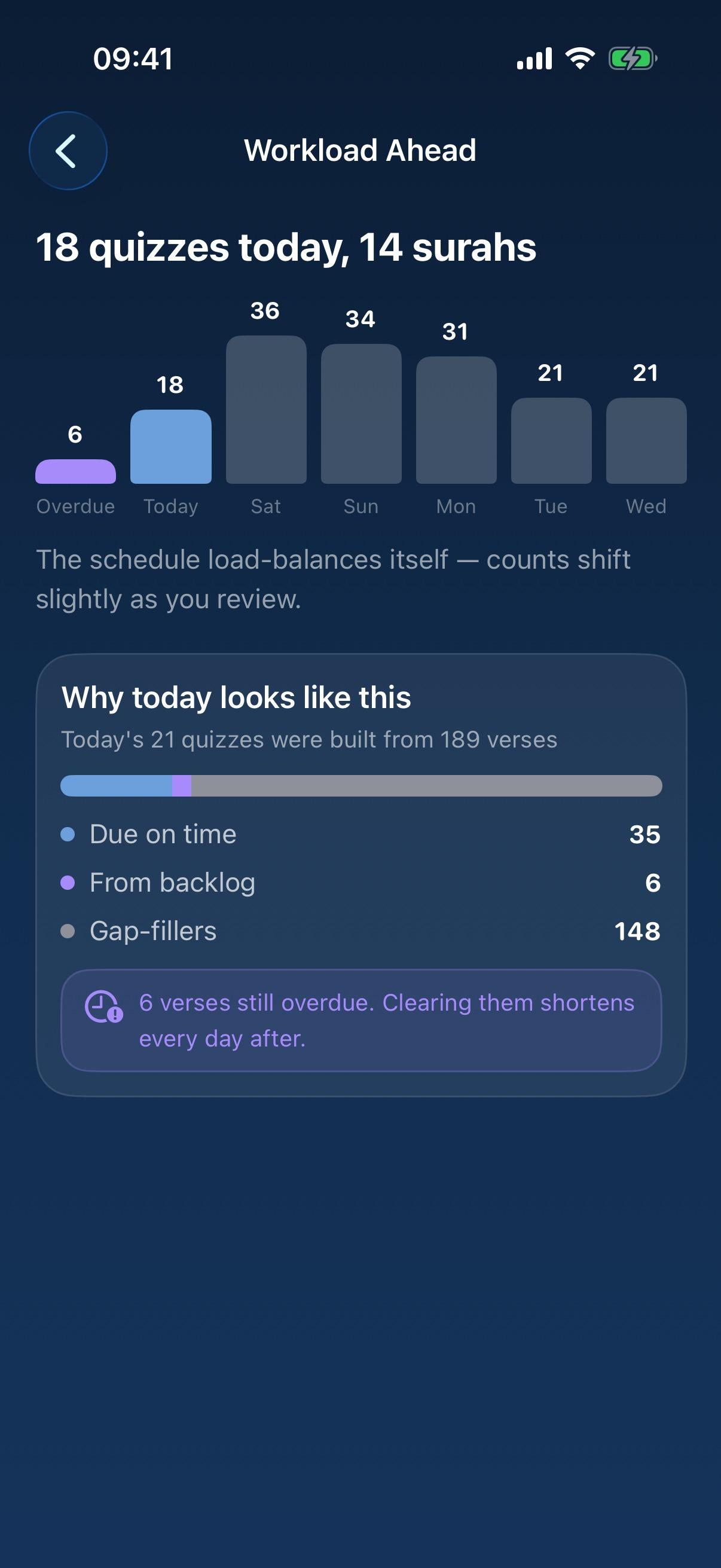
This is the planning Qiyam does for you. Every verse has its own review schedule, so the ones you struggle with come back sooner and the solid ones later, and reviews are spread so one day doesn't pile up. In Premium, Workload Ahead shows how many quizzes are coming over the next days and why today's were chosen, so you can see your revision load before you add new pages to it.
How do you choose your daily amount?
Choose the amount you can recite from memory the next morning, not the amount you can read through today. A simple test for a week:
- Learn your new lines in one sitting, reciting them from memory before you stop.
- The next morning, recite them before you open the mushaf. If you make more than a slip or two, your amount is too big.
- Check your revision too. If new pages are pushing old ones out of your week, slow down before the old ones fade.
Start smaller than you think. Five lines that are still exact a month later are worth more than a page you have to learn twice. When the next-morning test stays easy for several weeks and your revision keeps up, add a few lines.
Should you stop new memorization to revise?
Sometimes, yes. When a review keeps showing the same weak pages, a week with no new lines and more revision is not lost time: it protects pages that would otherwise cost you a second round of memorization.
How do you keep going for years?
A plan of two or seven years only works if the daily habit outlasts the first few weeks. Tie your memorization to a fixed moment, such as after Fajr or before you sleep, so it doesn't depend on finding time.
Research on habits suggests this takes longer than people expect, and that a missed day matters less. In one study, 96 volunteers repeated a chosen behaviour daily in the same context, such as "after breakfast", for 12 weeks. The time to reach close to their full level of automaticity ranged from 18 to 254 days, and missing one opportunity did not materially affect the habit.3 That study was about eating, drinking and exercise habits, not memorization, but it suggests patience: if revision still feels like an effort after a month, that is normal, and one lost day is not a reason to stop.
Can you memorize the Quran faster?
You can, if your revision keeps up. Someone studying full time can memorize more each day only because they also have the hours for the growing revision. If you study part time, adding new lines without adding revision time usually means relearning pages later, which is slower overall.
Three things shorten the total honestly:
- Revise from memory, not by reading. Reciting a page without looking tells you exactly which verses slipped; reading along hides it.
- Revise weak pages more and solid pages less. Equal turns for every page spend time where it isn't needed.
- Protect the joins. The end of one page into the next, and one surah into the next, are where recitation stops. Practise them on their own.
If you are starting later in life, the same arithmetic applies; our article on memorizing the Quran as an adult covers what changes. And if your days are short, you don't need two hours a day to keep revision going.
A plan you can start this week
- Pick a daily amount: five lines if you are new, half a page if you have memorized before.
- Choose your learning days: five a week, with two kept for revision only.
- Do the next-morning test every day this week, and adjust your amount on Sunday.
- Count your pages each month. As the number grows, give revision more of your time before you add more new lines.
At five lines a day, the first juz takes about twelve weeks. Start with the first five lines tonight and recite them tomorrow before you look.
Sources
- 1Bahrick HP, Bahrick LE, Bahrick AS, Bahrick PE (1993). Maintenance of Foreign Language Vocabulary and the Spacing Effect. Psychological Science.
- 2Cepeda NJ, Vul E, Rohrer D, Wixted JT, Pashler H (2008). Spacing Effects in Learning: A Temporal Ridgeline of Optimal Retention. Psychological Science.
- 3Lally P, van Jaarsveld CHM, Potts HWW, Wardle J (2009). How are habits formed: Modelling habit formation in the real world. European Journal of Social Psychology.
Frequently asked questions
How long does it take to memorize one juz?
Most juz are about 20 pages in the 604-page mushaf. Learning five days a week, one juz takes about 12 weeks at five lines a day, 8 weeks at half a page, 4 weeks at one page and 2 weeks at two pages, plus the revision that keeps it.
Can you memorize the Quran in one year?
The arithmetic says it needs about 1.7 new pages every day of the year, or about 2.3 pages a day if you learn five days a week. That is only realistic if you also have the hours to revise everything you already hold, which grows every week.
How long does it take to memorize Juz Amma?
Juz 30 is 23 pages in the 604-page mushaf. At half a page a day, five days a week, that is 46 learning days, a little over 9 weeks. Its short surahs make the joins between surahs as important as the verses themselves.
Is it better to memorize a lot quickly or a little every day?
A little every day that you can still recite the next morning. A large amount that has to be learned again later costs more time in total, and the revision of what you hold is what decides whether a pace lasts.
Do I need to stop memorizing to revise?
Sometimes. When the same weak pages keep showing up in revision, a week with no new lines and more revision protects pages that would otherwise need a second round of memorization.