Qiyam
Starting later
Can you memorize the Quran as an adult?
Yes, you can memorize the Quran as an adult. What research on memory and habits suggests for starting late, how much to learn a day, and how to keep it.
By Amine Benlaroui, , 5 min read
Yes, you can memorize the Quran as an adult. The methods research supports for long-term memory, reciting from memory instead of rereading, spacing your revision out, and sleeping on what you learned, worked for adults in the studies below, including older adults. What usually changes after school is not your ability but your time and your structure: so start with a small daily amount, plan revision from the first day, and tie it to a fixed moment of your day.
Is it harder to memorize the Quran as an adult?
The studies cited here don't measure Qur'an memorization by age, so this article won't give you a number for how much slower or faster an adult is. What they do show is that the principles of good memorization hold for adults.
In one study, young and older adults learned to recognize paintings by different artists. Spacing the practice helped both age groups, for remembering the paintings and for recognizing each artist's style, even though participants rated massed practice as better.1 The authors conclude that challenging learners of any age has benefits that don't feel intuitive. Paintings are not verses, but the finding suggests that an older memorizer gains from the same spaced method as a young one.
The real differences are practical:
- Time. A child in a hifz school may spend hours a day on the Qur'an. You may have 20 minutes before work.
- Structure. A halaqa decides what you learn, when you recite, and who listens. Alone, you decide all of that yourself.
- Feeling slow. Adults compare themselves with children who memorized young, and give up before the method has had time to work.
The first two you can plan around. The third is answered in the Sunnah itself.
What did the Prophet ﷺ say about finding the Qur'an hard?
In Sahih Muslim, A'isha reported that the Prophet ﷺ said: "One who is proficient in the Qur'an is associated with the noble, upright, recording angels; and he who falters in it, and finds it difficult for him, will have two rewards."2
If you stumble over verses that a twelve-year-old recites fluently, you are not behind: you are in the second half of that hadith.
How should an adult start memorizing the Quran?
Start where you already have something
Most adults already know some short surahs from prayer. Start there: Juz Amma, or the surahs you recite most. You will relearn some of them properly, with each word exact, and you get early proof that the method works.
Recite from memory, don't reread
When you learn a few verses, close the mushaf and recite them before you check. Then recite them again later in the session. In a set of experiments with 533 students and more than 100,000 recall answers, the researchers recommended recalling each item correctly 3 times when first learning it, then relearning it 3 times at widely spaced intervals.3 Relearning had pronounced effects on retention 1 to 4 months later, at little extra cost. The material was concepts, not memorized text, but the pattern fits hifz well: a few clean recitations on the first day, then a few returns spread wide.
Have someone hear you recite
Reciting from memory to yourself catches forgotten words, but not wrong ones. An adult who learns alone can repeat a small mistake, a shortened vowel or a skipped letter, until it becomes the version they know best. Recite to a teacher, a friend who knows the surah well, or your spouse with the mushaf open, at least once a week. If no one is available, record yourself and compare it, verse by verse, with a careful reciter.
Let the app or a notebook keep the schedule
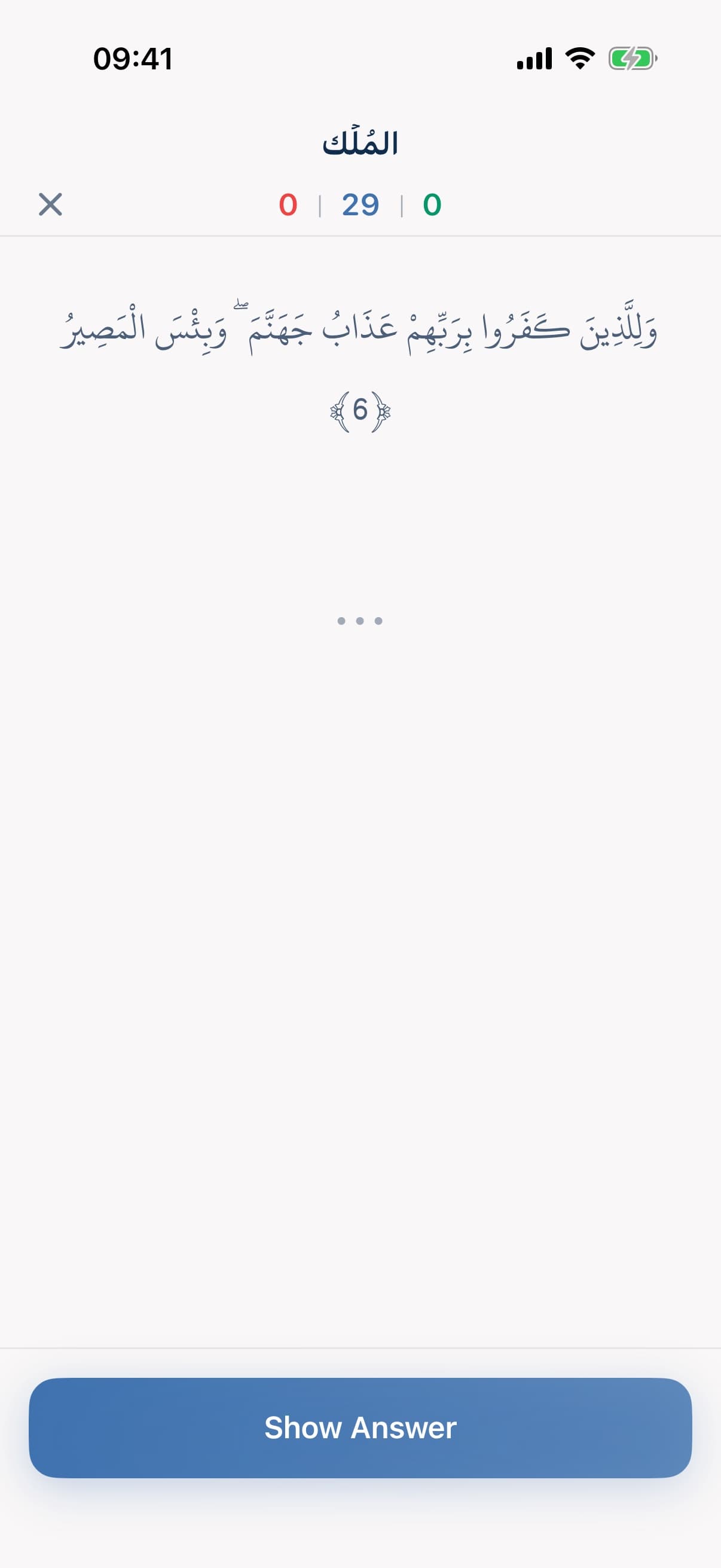
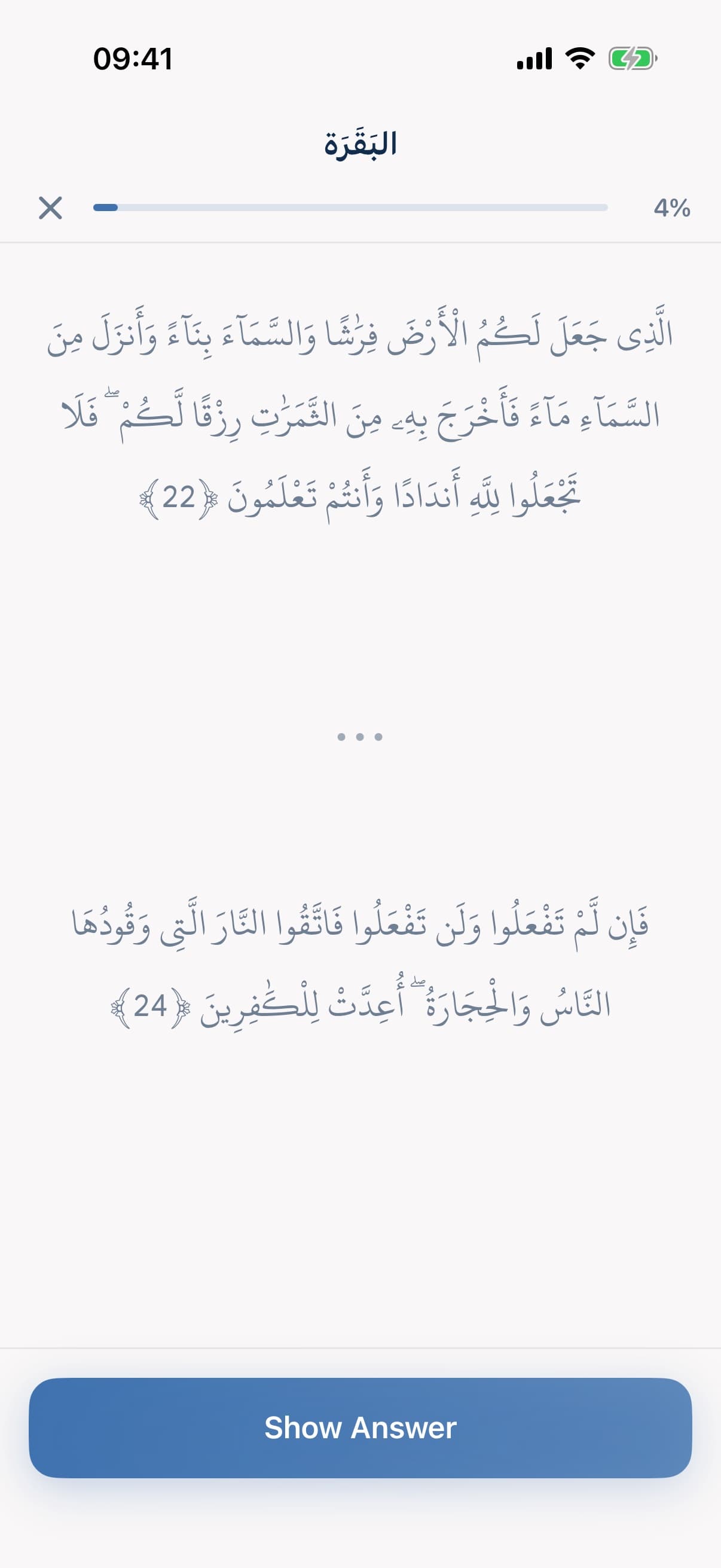
Spacing only works if the old pages actually come back. Write down what you memorized and when, or let an app do it for you. In Qiyam, every verse has its own review schedule, and the verses due come back as quizzes: each shows the verse before and the verse after, and you recite what's in between from memory.
Learn in the evening, check in the morning
In two experiments with high-school students learning vocabulary, memory was better when sleep followed within a few hours of learning, whatever the time of day. Losing sleep hurt memory, and the harm was still there after a night of recovery sleep.4 If your evenings are freer than your mornings, use them for new verses, and use a few minutes in the morning to recite them from memory before you open the mushaf.
How much should an adult memorize per day?
There is no right number, and a large one is the most common reason adults stop. A better rule is this: memorize only as much as you will be able to revise. Every page you add will need to come back again and again, and the revision grows with every page.
A practical way to start:
- Choose a daily amount small enough to finish on a tired day: a few verses, or half a page.
- Keep it for a few weeks before you raise it.
- Once revision takes most of your time, hold the new amount steady instead of adding more.
For example: if you start with five verses of a Juz Amma surah a day, you have a few minutes of new work and a few minutes of revision. After two months, the revision has grown to cover every surah you added, and five new verses may be all the new work a busy day can hold. That is the moment to keep the pace steady, not to push.
Some days you will memorize nothing new and only revise. That still counts.
How do you make it a daily habit?
Tie your memorization to something you already do every day: after Fajr, after Isha, or on your commute. In a study of how habits form, 96 volunteers repeated a behaviour daily in the same context, such as "after breakfast", for 12 weeks. The time it took to become automatic ranged from 18 to 254 days, and missing one opportunity did not materially affect the habit.5
Two lessons follow for an adult memorizer. Expect it to take months, not days, before it feels natural. And a missed day is not a broken habit: come back the next day at the same moment.
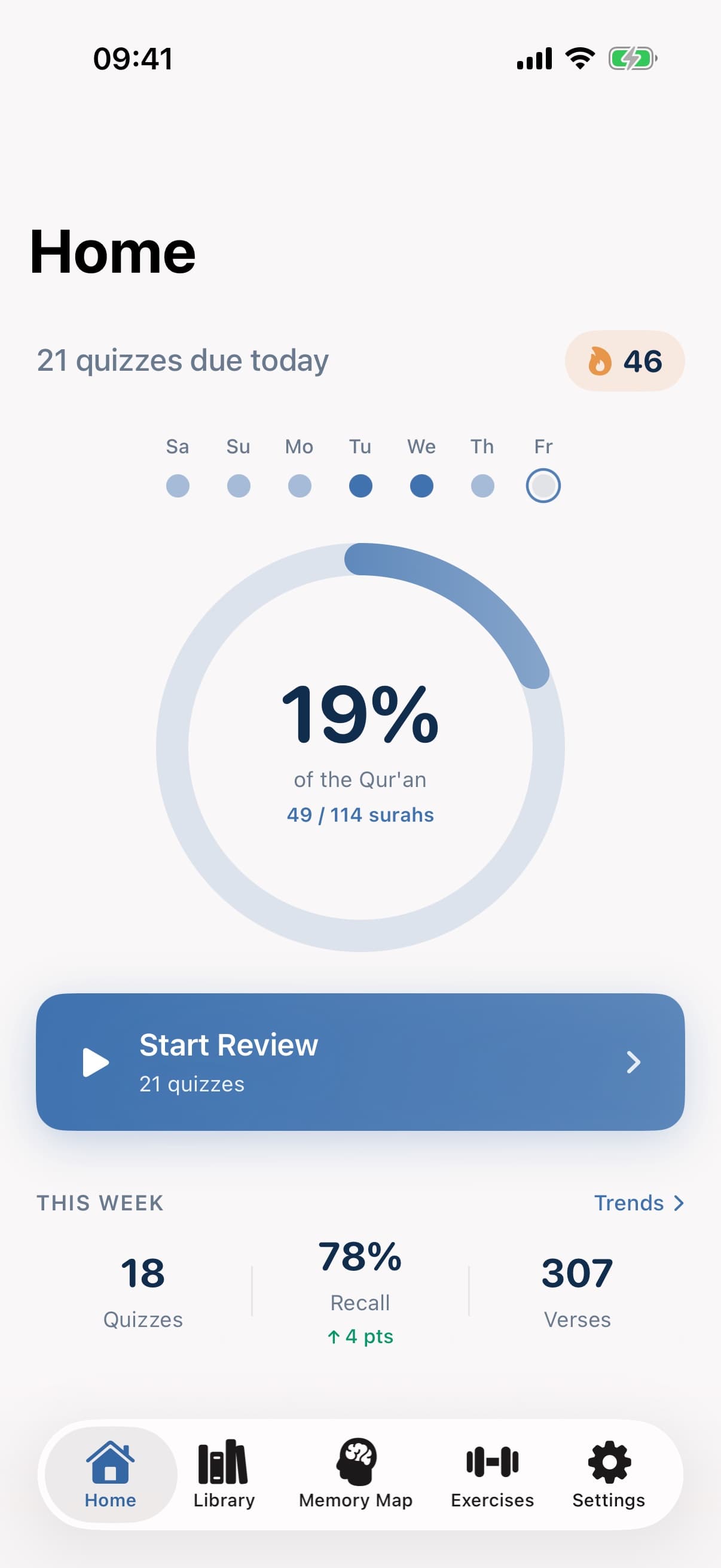
Qiyam's streak works the same way: a freeze protects a missed day, and everyone gets one, earned every 7 days of an unbroken run.
Will you keep what you memorize as an adult?
How well you learn something at the start seems to matter for how long it lasts. In a study of 733 people tested on the Spanish they learned at school, up to 50 years earlier, what they kept depended on how well they had learned it in the first place. Most of the forgetting happened in the first 3 to 6 years; after that, what remained stayed unchanged for up to 30 years.6 Most of them had barely used their Spanish since.
That study was about a school language, not memorized text, and hifz depends on regular revision in a way school Spanish doesn't. But it supports a simple rule: take the time to learn each page thoroughly, with your recitation checked, rather than moving on as soon as you can just about recite it.
Start this week
Pick the surah you'll begin with, and a fixed moment in your day. Tonight, learn three to five verses and recite them from memory three times. Tomorrow morning, recite them before you look. Do the same the next day, and the one after. The habit, not the age you start at, is what carries you through.
Sources
- 1Kornell N, Castel AD, Eich TS, Bjork RA (2010). Spacing as the friend of both memory and induction in young and older adults. Psychology and Aging.
- 2Muslim ibn al-Hajjaj Sahih Muslim 798a: the one who falters has two rewards. Sahih Muslim 798a.
- 3Rawson KA, Dunlosky J (2011). Optimizing schedules of retrieval practice for durable and efficient learning: How much is enough?. Journal of Experimental Psychology: General.
- 4Gais S, Lucas B, Born J (2006). Sleep after learning aids memory recall. Learning & Memory.
- 5Lally P, van Jaarsveld CHM, Potts HWW, Wardle J (2009). How are habits formed: Modelling habit formation in the real world. European Journal of Social Psychology.
- 6Bahrick HP (1984). Semantic memory content in permastore: Fifty years of memory for Spanish learned in school. Journal of Experimental Psychology: General.
Frequently asked questions
Am I too old to memorize the Quran?
No age is given as a limit, and spaced practice helped older adults as well as young ones in the research on memory. What matters more is a small daily amount you keep, recited from memory and revised regularly.
How long does it take an adult to memorize the whole Quran?
There is no honest single answer: it depends on your daily time, how much you revise, and how familiar the Arabic is to you. Plan by what you can revise, not by a finish date, and the pace will become clear after a few months.
Should an adult memorize alone or with a teacher?
A teacher who hears you recite is the best way to keep your pronunciation exact and to stay consistent. If you memorize alone, recite to someone whose recitation you trust from time to time, or record yourself and compare it with a careful reciter.
Do I need to understand Arabic to memorize the Quran as an adult?
No. Many people memorize without speaking Arabic. Reading the translation of a passage before you learn it helps you hold the order of the verses.