Qiyam
Surah guide
How to memorize Surah Al-Kahf and keep it
How to memorize Surah Al-Kahf: start with its first ten verses, learn one story at a time, and watch the repeated phrases, like 18:72 and 18:75.
By Amine Benlaroui, , 6 min read
To memorize Surah Al-Kahf, start with its first ten verses, then learn the rest one story at a time, about half a page to a page a day, reciting each new portion from memory before you move on. Al-Kahf is 110 verses on 12 pages of the standard mushaf (pages 293 to 304), so a steady pace takes a few weeks. Keeping it is the bigger task: bring each story back on later days, and give the surah's repeated phrases their own attention.
Below: how the surah is built, a plan for learning it, the verses inside Al-Kahf that people mix up, and how to keep it once it's yours.
Why start with the first ten verses?
Because the Prophet ﷺ singled them out. Abu Darda' reported him as saying: "If anyone learns by heart the first ten verses of the Surah al-Kahf, he will be protected from the Dajjal."1
That makes verses 1 to 10 a complete goal of their own, and a good first step even if you plan to memorise the whole surah. They sit on the first two pages of the surah (293 and 294) and end with the du'a of the youths as they took refuge in the cave:
إِذْ أَوَى ٱلْفِتْيَةُ إِلَى ٱلْكَهْفِ فَقَالُوا۟ رَبَّنَآ ءَاتِنَا مِن لَّدُنكَ رَحْمَةًۭ وَهَيِّئْ لَنَا مِنْ أَمْرِنَا رَشَدًۭا
[Mention] when the youths retreated to the cave and said, "Our Lord, grant us from Yourself mercy and prepare for us from our affair right guidance."
Learn them until you can recite all ten from memory without a pause, and keep them in your revision even while you move on to the rest.
How is Surah Al-Kahf structured?
Al-Kahf is easier to memorise once you see its shape. Most of it is four stories, each with a clear beginning and end, joined by shorter passages of reminder.
| Verses | What they contain | Pages |
|---|---|---|
| 1–8 | The opening: praise, the Book, the warning | 293–294 |
| 9–26 | The companions of the cave | 294–296 |
| 27–31 | Reminder: patience with those who call on their Lord | 296–297 |
| 32–44 | The man with two gardens | 297–298 |
| 45–59 | Reminder: this world, the Day, Iblees | 298–300 |
| 60–82 | Musa and the servant he follows | 300–302 |
| 83–98 | Dhul-Qarnayn | 302–304 |
| 99–110 | The closing | 304 |
Two things in this table help when you memorise. First, the surah is split across two juz: verses 1 to 74 are in Juz 15, and Juz 16 begins at verse 75, in the middle of the story of Musa. Second, each story is a natural unit. When you revise, you can recite "the cave" or "the two gardens" as one piece, which is easier to plan than an arbitrary number of lines.
A plan for memorizing Al-Kahf
There is no proven pace. What follows is a plan built on what research suggests about learning and keeping memorised material. Make the portions smaller if you are new to hifz, larger if you have memorised a lot before.
Learn one portion a day
Half a page to a page a day is a reasonable starting pace. At that rate, the 12 pages take between two and four weeks, plus a few days for revision.
For each new portion:
- Listen first. Hear a reliable reciter, and read along carefully, so your first version is correct.
- Recite with the mushaf closed. Start from the last verse you already know, so the new portion is joined to the old.
- Stop after a few clean recitations. A large study on how much practice is enough recommended recalling new material correctly 3 times when you first learn it, then relearning it 3 times at widely spaced intervals.2 It used conceptual material, not memorised text, but the pattern fits hifz well: a few correct recitations today, several returns later.
Recite yesterday's portion before today's
Begin each session by reciting yesterday's portion from memory, then the one before it. Only then start the new verses. This way every portion gets its next-day return without a separate plan.
Finish one story before starting the next
Try to end a week on the last verse of a story, not halfway through one. When a story is complete, recite it whole, from its first verse to its last. Those full recitations are where the joins between pages get practised.
Which verses in Al-Kahf are easy to mix up?
Al-Kahf repeats some sentences with small changes, and these are exactly where recitations go wrong. Three to know before you start.
The servant's sentence grows each time
Three times in the story of Musa, the servant he follows tells him he will not be able to be patient. The sentence gets longer each time.
The first time (18:67) he simply says it. The second time, after the ship, he adds "did I not say":
قَالَ أَلَمْ أَقُلْ إِنَّكَ لَن تَسْتَطِيعَ مَعِىَ صَبْرًۭا
[Al-Khidh r] said, "Did I not say that with me you would never be able to have patience?"
The third time, after the boy, he adds one more word, "laka", to you:
۞ قَالَ أَلَمْ أَقُل لَّكَ إِنَّكَ لَن تَسْتَطِيعَ مَعِىَ صَبْرًۭا
[Al-Khidh r] said, "Did I not tell you that with me you would never be able to have patience?"
The trick is checkable in the text: two words added the second time, one more the third. And the longest version is the verse that opens Juz 16, so if you know where the juz begins, you know which version you are in.
"So they set out, until when…"
The three episodes of the same story each open with the same words, "fa-ntalaqa hatta idha": so they set out, until when. Verses 71, 74 and 77 begin this way, and then they diverge: they embarked on the ship, they met a boy, they came to the people of a town. Know the order of the three episodes, ship, boy, town, and the right continuation follows.
"So he followed a way", then "Then he followed a way"
In the story of Dhul-Qarnayn, the same short verse comes three times, but the first is different from the other two:
فَأَتْبَعَ سَبَبًا
So he followed a way
ثُمَّ أَتْبَعَ سَبَبًا
Then he followed a way
Verse 85 begins with "fa": so he followed a way. Verses 89 and 92 begin with "thumma": then he followed a way. The first journey takes "fa", the second and third take "thumma".
How to drill them
For each of these places, put the verses side by side and name the difference out loud. Then recite the verse before each one, followed by the verse itself, from memory, so you practise the moment where the slip happens. Bring them back together over the next few days.
One study points to a reason to keep both versions in practice. People who repeatedly recalled some members of a category (for example some fruits) later had more trouble recalling the other members of that same category, for 20 minutes or more.3 That was word lists, not the Qur'an, and it doesn't prove why verses get mixed up. But it suggests a sensible habit: when you revise one version of a repeated phrase, revise its twin too.
How do you keep Al-Kahf once you've memorized it?
Memorising the surah is the start. Keeping it means bringing each part back before it fades, from memory, not only by reading.
- Recite it from memory, by stories. A full recitation of all 12 pages is a long session. Splitting it by story lets you revise one part on a busy day and the whole surah when you have time. If you already recite Al-Kahf every week, try doing it from memory first and opening the mushaf only where you hesitate.
- Space the returns, and let them grow. In an experiment where people recalled items on 3 repeated tests, long intervals between the tests gave a 200% improvement in long-term retention over tests with no spacing; whether the gaps grew, stayed equal or shrank made no measurable difference.4 The rule is simple: return often at first, then less often, and never let a story go untouched for long.
- Give the weak stories more turns. You will probably find one story harder than the others. Note where you hesitate, and bring that story back sooner while the strong ones wait longer.
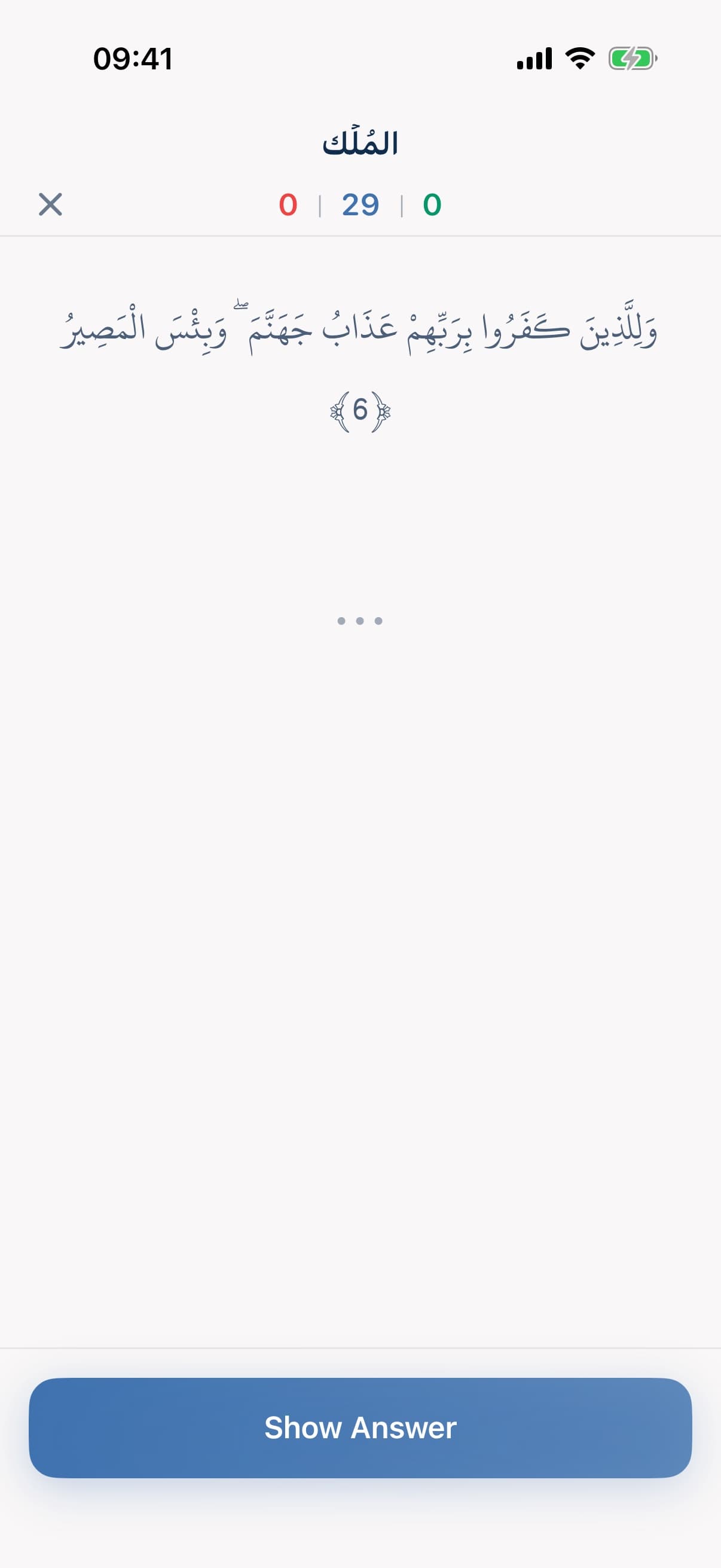
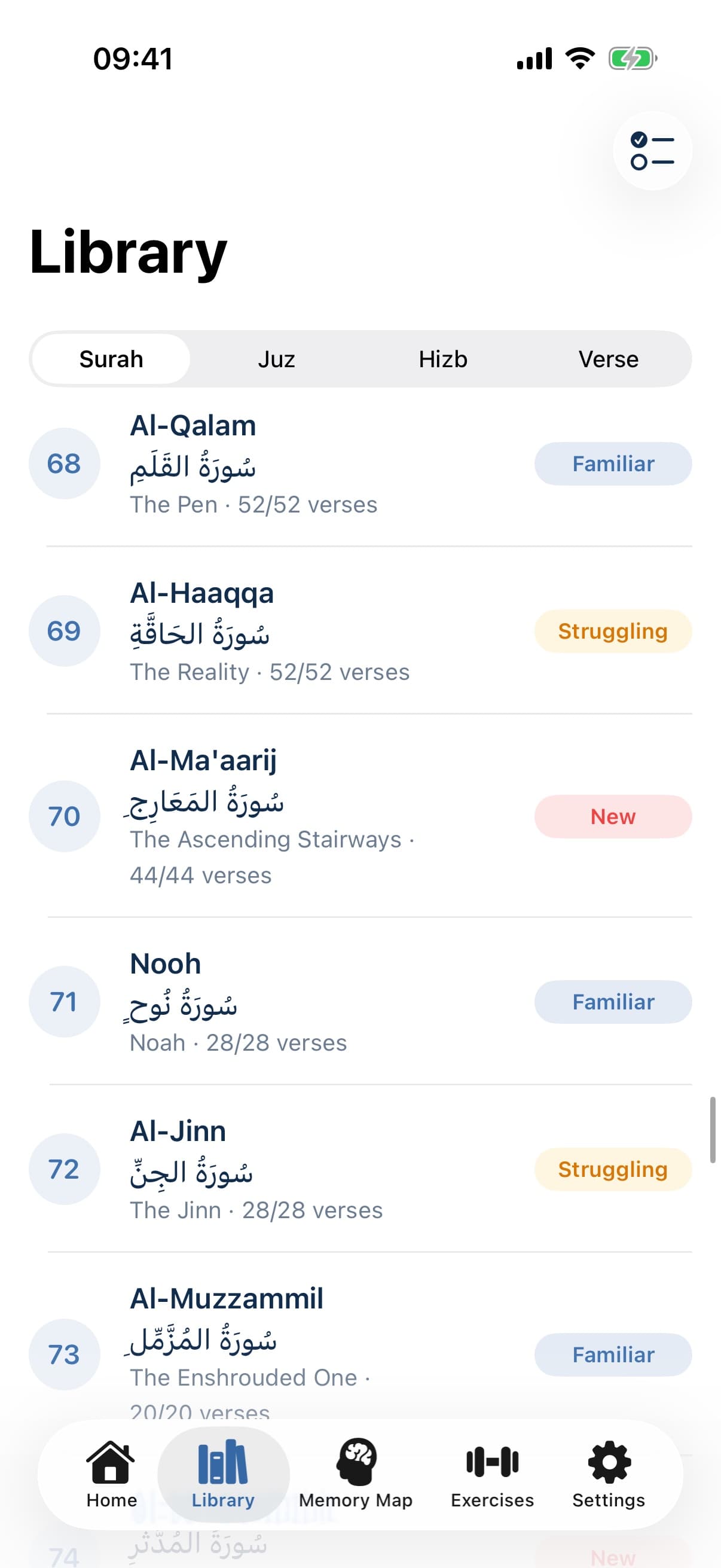
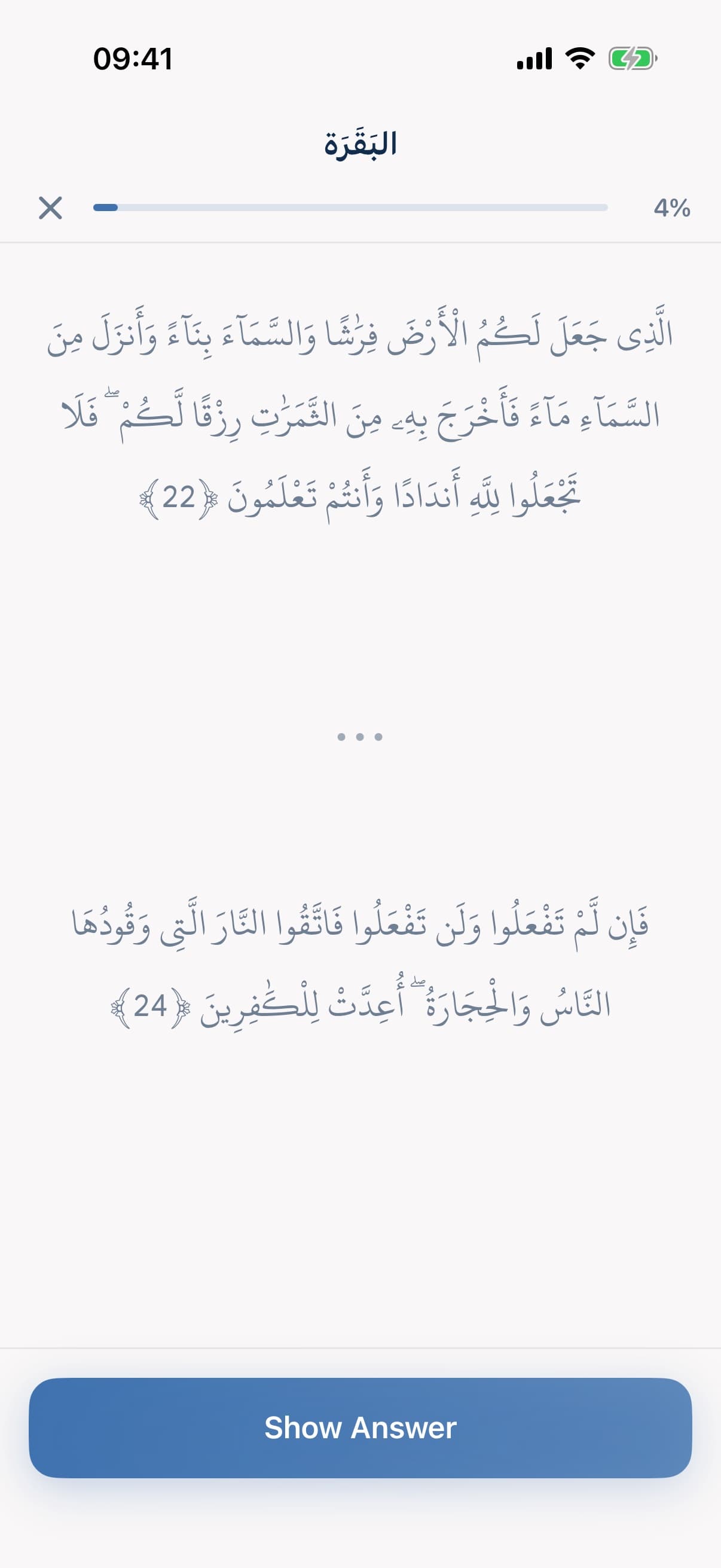
Tracking all of this by hand works, but it gets harder as the pages add up. In Qiyam, you add what you've memorised by surah or page, and each verse gets its own review schedule, so the verses you struggle with come back sooner. A quiz shows the verse before and the verse after, and you recite what's in between from memory. Verses quizzed together share one rating, so a slip on one verse brings its neighbours back too, which suits a surah where the joins matter as much as the verses.
Learn it well the first time
How thoroughly you learn something at the start shapes what survives much later. In a study of 733 people tested on the Spanish they had learned in school, up to 50 years earlier, how much remained was predicted by how well they had learned it in the first place; most had barely practised since.5 School Spanish is not the Qur'an, but the lesson carries: the weeks you spend learning Al-Kahf carefully, with clean recitations and early returns, are the best investment in keeping it.
A summary you can follow this month
- Memorise verses 1 to 10 first, and keep them in daily revision.
- Learn half a page to a page a day, joined to what you already know.
- Recite each new portion correctly from memory a few times, then bring it back the next day, a few days later and a week later.
- Finish stories, then recite each story whole.
- Learn the three repeated sentences: the servant's growing sentence, "so they set out, until when", and "fa" before "thumma".
- Once it's memorised, revise it from memory, story by story, with the weakest story coming back most often.
Sources
- 1Muslim Whoever learns by heart the first ten verses of Surat al-Kahf will be protected from the Dajjal. Sahih Muslim 809.
- 2Rawson KA, Dunlosky J (2011). Optimizing schedules of retrieval practice for durable and efficient learning: How much is enough?. Journal of Experimental Psychology: General, 140(3), 283–302.
- 3Anderson MC, Bjork RA, Bjork EL (1994). Remembering can cause forgetting: Retrieval dynamics in long-term memory. Journal of Experimental Psychology: Learning, Memory, and Cognition, 20(5), 1063–1087.
- 4Karpicke JD, Bauernschmidt A (2011). Spaced retrieval: Absolute spacing enhances learning regardless of relative spacing. Journal of Experimental Psychology: Learning, Memory, and Cognition, 37(5), 1250–1257.
- 5Bahrick HP (1984). Semantic memory content in permastore: Fifty years of memory for Spanish learned in school. Journal of Experimental Psychology: General, 113(1), 1–29.
Frequently asked questions
How long does it take to memorize Surah Al-Kahf?
Al-Kahf is 110 verses on 12 pages. At half a page to a page a day, that is two to four weeks, plus some days for revision. Your pace depends on your experience; a portion you can recite cleanly from memory each day matters more than speed.
Which verses of Al-Kahf should I memorize first?
The first ten. In Sahih Muslim 809, the Prophet ﷺ said that whoever learns by heart the first ten verses of Al-Kahf will be protected from the Dajjal. They are on pages 293 and 294 and end with the du'a of the youths in 18:10.
Where does Juz 16 start in Surah Al-Kahf?
At verse 75, in the story of Musa: "Did I not tell you that with me you would never be able to have patience?" Verses 1 to 74 are in Juz 15, verses 75 to 110 in Juz 16.
How do I stop mixing up the similar verses in Al-Kahf?
Put each pair side by side and name the difference out loud: 18:72 has "alam aqul", 18:75 adds "laka"; 18:85 begins with "fa", 18:89 and 18:92 with "thumma". Then recite the verse before each one into it, from memory, over several days.