Qiyam
Memory science
Is reading the Quran enough to keep your hifz?
Reading the mushaf is worship, but to keep your hifz, research suggests reciting from memory first. Why rereading feels enough, and how to revise instead.
By Amine Benlaroui, , 5 min read
Reading the Qur'an from the mushaf is worship with its own reward, but on its own it is usually not enough to keep a page you have memorised. Research on memory suggests that recalling something from memory strengthens it far more than reading it again. To keep your hifz, recite each portion without looking first, then use the mushaf to check and correct.
This is not a choice between two good things. You can keep reading for its own sake and still make sure your revision is recitation.
Why does reading the mushaf feel like enough?
Because reading a page you once memorised feels easy. The words are in front of you, your tongue runs ahead of your eyes, and the page seems secure. That feeling of fluency is real, but it measures how familiar the page looks, not whether you could produce it alone in salah.
Researchers have measured this gap directly. In one experiment, students read prose passages and then either recalled them from memory or read them again. Rereading made students more confident in their ability to remember the material.1 In another, students' predictions of how well they would do were uncorrelated with how they actually did.2 The feeling "I know this page" is not a reliable guide.
What does the research say about reciting from memory?
It suggests that recall, not rereading, is what makes memory last. These studies were on prose passages and foreign vocabulary, not on the Qur'an, so they point in a direction rather than prove anything about hifz.
Reading again versus recalling
Roediger and Karpicke had students study prose passages, then either take one or three free-recall tests, without feedback, or reread the passage the same number of times. On a test 5 minutes later, rereading won. On tests 2 days and 1 week later, the students who had recalled the passage remembered substantially more.1
That reversal matters for revision. Reading a page just before salah may help you in that salah. Reciting it from memory is what helps you next week.
Once you know it, more reading adds little
Karpicke and Roediger then looked at what happens after a student can already produce an answer. Students learned foreign-language vocabulary. Once a word had been recalled correctly, some students kept studying it, others kept being tested on it. More studying had no effect on delayed recall; more testing had a large positive effect.2
For a hafiz, the closest parallel is a page you already know. Reading it again with the mushaf open may add little to how long you keep it; reciting it again from memory adds a lot.
Producing beats recognising
A large meta-analysis of the testing effect found that recall tests gave larger benefits than recognition tests, and pointed to effortful processing as part of the reason.3 Recognising a verse when someone else recites it, or when you see it, is the easy kind of memory. Producing the next verse yourself is the hard kind, and it is the kind that strengthens recall.
Is listening or reading along the same as revising?
They are closer to recognition than to recall. Listening to a reciter while following in the mushaf, or reading along with a recording, keeps the sound of the Qur'an in your ears and helps your tajwid. But your memory is not being asked to produce anything: the next word always arrives before you have to find it.
Use listening and reading for what they do well, such as learning a new page's sound, correcting pronunciation, and staying close to the Qur'an when you are tired. For keeping a page, add a moment where nothing is in front of you and the words have to come from you.
How do you turn reading into reciting?
Change the order of what you already do. For each portion:
- Recite it first, without looking. Mark where you hesitate or stop.
- Check with the mushaf. Read only the places you missed, carefully.
- Recite those places again from memory, right away.
- Bring the portion back later, after a gap, rather than repeating it many times in one sitting.
A quick test of whether you can recite a passage in context is to look at the verse before it, close your eyes, and recite the verse that comes next. That link from one verse to the next is exactly what salah asks of you.
Does teaching or reciting to someone count?
Yes, if you do it from memory. In one study, learners who taught material without notes did as well a week later as learners who simply practised recalling it, and both beat learners who taught with their notes in front of them.4 The authors suggest the benefit of teaching is possibly a retrieval benefit.
That fits the traditional practice of reciting to a teacher or a partner: the listener catches mistakes, and you get the recall. Reading aloud to someone with the mushaf open gives you neither as much.
What if a page won't come without the mushaf?
Then that page needs rebuilding, not more reading. Reciting from memory only helps when there is something to recall; if you cannot get past the first line, testing yourself again and again just repeats the same gap.
Work in small pieces instead:
- Read three or four lines carefully, with attention on the words where you were stuck.
- Close the mushaf and recite those lines. Open it only to check.
- Add the next few lines and recite from the start of the piece each time.
- Recite the whole page once more later that day, and again the next day.
The point is that every round still ends with recall. Reading opens the door; reciting from memory is what you do once you are through it. Over a few days, the page moves from "I need the mushaf" to "I need it only to check", which is where every page you keep should be.
Where does reading the Qur'an still fit?
Everywhere it already does. Reading the Qur'an is rewarded letter by letter: "Whoever recites a letter from Allah's Book, then he receives the reward from it, and the reward of ten the like of it."5 Nothing here suggests reading less. The point is only that reading and revising are two different jobs, and a hafiz who wants to keep a page needs to do the second one too.
A simple way to hold both:
- Reading: your daily portion of the Qur'an from the mushaf, for its own sake, including surahs you have not memorised.
- Revising: your memorised portions, recited from memory first, checked with the mushaf after.
How Qiyam builds recall into revision
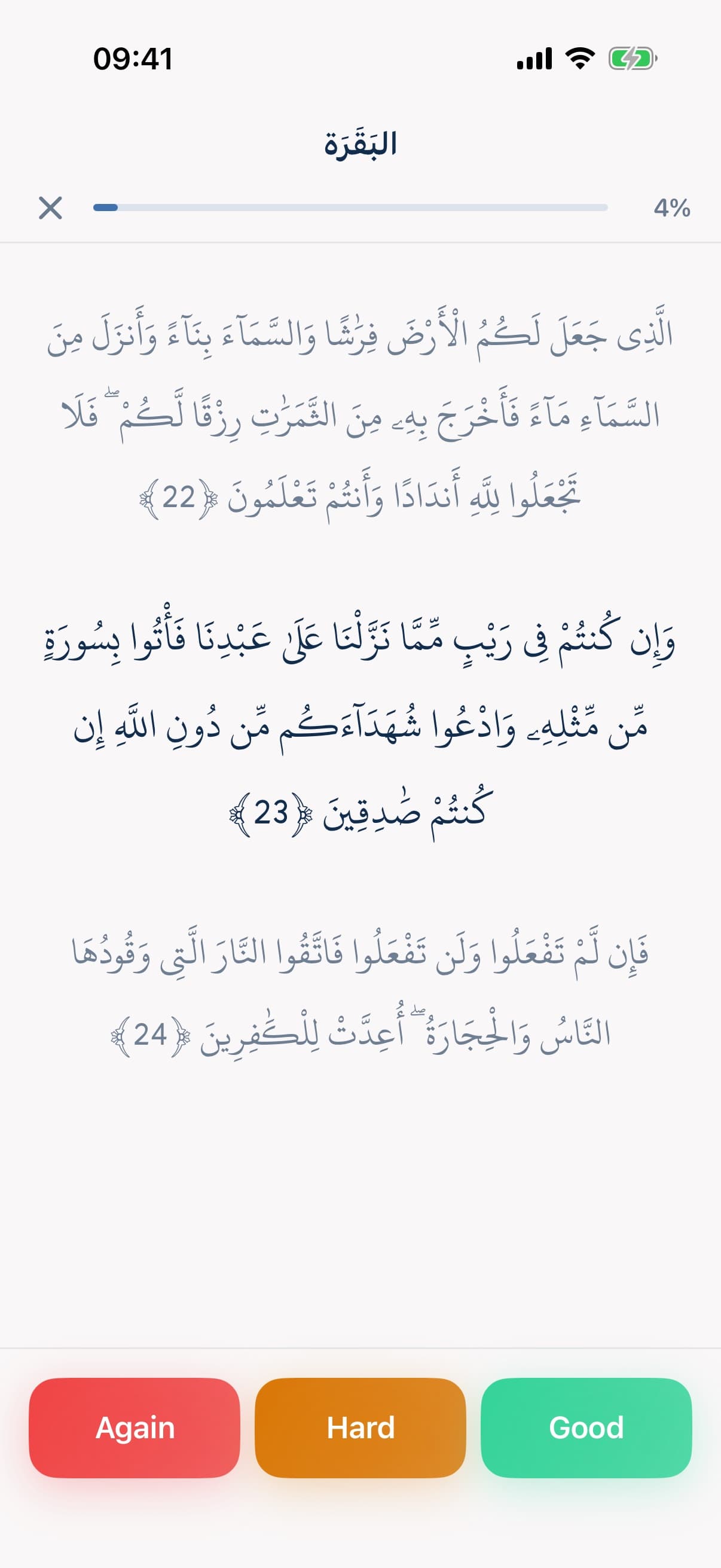
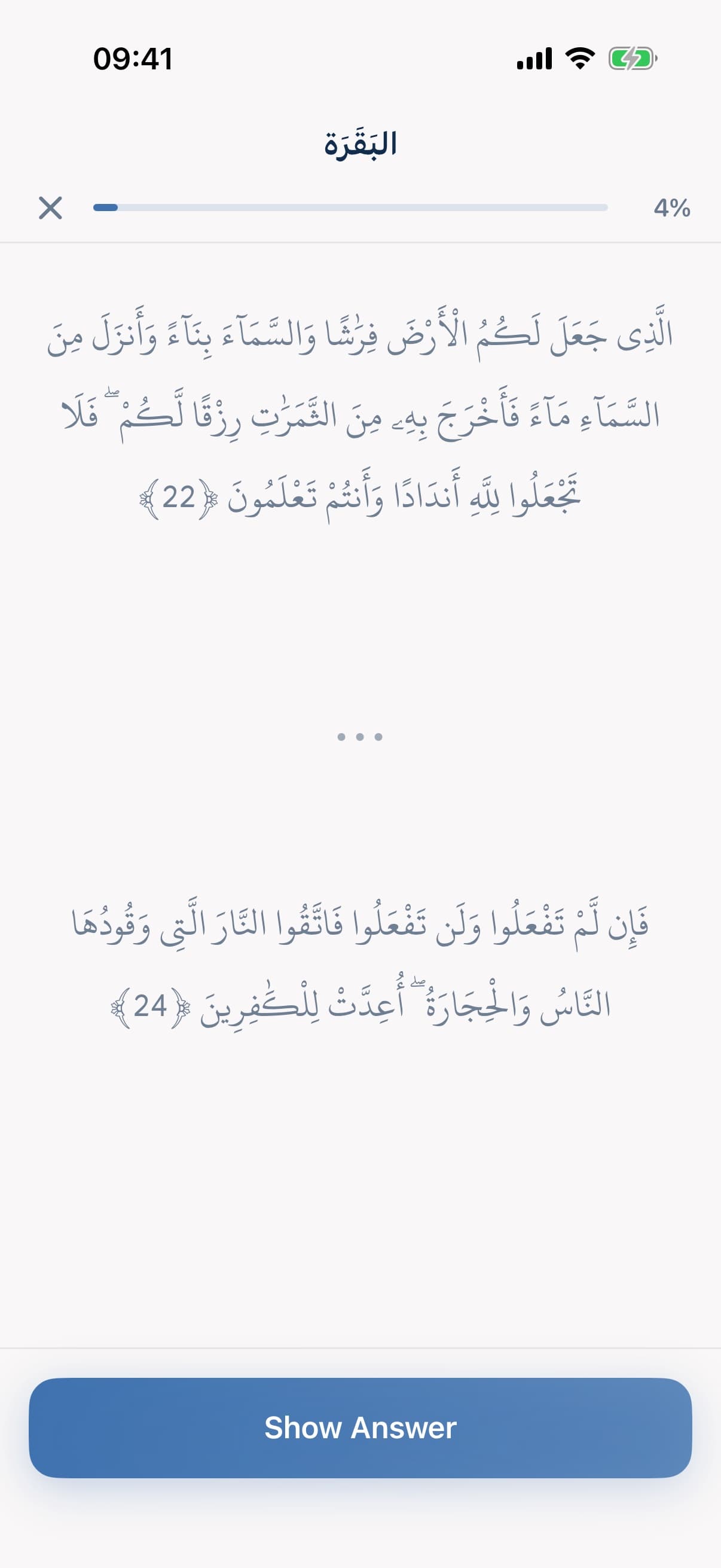
This is why Qiyam's revision is a quiz rather than a reading list. A quiz shows the verse before and the verse after, and you recite what is in between from memory. You reveal the answer all at once or verse by verse, then rate yourself Again, Hard or Good, and each verse comes back on its own schedule.
The free Verse by Verse exercise works the same way in a smaller form: one verse is shown and you recite only the next one, the link that matters in recitation. Whatever you use, a teacher, a partner, a notebook or an app, the habit to keep is the same: produce the words first, then look.
Sources
- 1Roediger HL, Karpicke JD (2006). Test-Enhanced Learning. Psychological Science.
- 2Karpicke JD, Roediger HL (2008). The critical importance of retrieval for learning. Science.
- 3Rowland CA (2014). The effect of testing versus restudy on retention: A meta-analytic review of the testing effect. Psychological Bulletin.
- 4Koh AWL, Lee SC, Lim SWH (2018). The learning benefits of teaching: A retrieval practice hypothesis. Applied Cognitive Psychology.
- 5at-Tirmidhi Each letter recited is rewarded tenfold. Jami` at-Tirmidhi 2910 (graded sahih).
Frequently asked questions
Does listening to Quran recitation help memorization?
Listening helps you learn a page's sound and correct your pronunciation, and it keeps you close to the Qur'an. For keeping a page you have memorised, it works more like recognition than recall, so pair it with reciting from memory.
How many times should I recite a page from memory?
There is no single number from research for the Qur'an. A practical rule is to recite it through from memory until it comes without stopping, check it, and then bring it back after a gap rather than repeating it many more times in the same sitting.
Is it wrong to read from the mushaf instead of reciting from memory?
No. Reading the Qur'an is rewarded, and this article gives no ruling on worship. It is only about revision: if your goal is to keep what you have memorised, add recitation from memory to your reading.
Why do I make mistakes in salah on pages I just read?
Reading a page shows the words to you, so it can feel secure without testing whether you can produce it alone. In salah nothing is in front of you. Reciting the page from memory beforehand is a closer rehearsal of what salah asks.