Qiyam
Revision
How to get back to Quran revision after a break
How to restart Quran revision after weeks or months away: recite before you read, start small, revise daily, and rebuild lost pages over time.
By Amine Benlaroui, , 6 min read
If you have stopped revising for a few weeks or months, start again with a small, fixed amount each day, and recite from memory before you open the mushaf. Begin with the surahs you recite most, let the pages you have lost come back over several weeks instead of in one sitting, and expect more of your hifz to still be there than you fear.
A break happens to almost everyone who memorises: an exam season, a new baby, a move, an illness, a hard year. The way back is the same in each case, and it is gentler than most people think.
How much of your hifz is really gone?
Usually less than it feels like on the first day back. Forgetting is fast at first and then slows down. In three experiments on word recall, face recognition and memory in pigeons, Wixted and Ebbesen found that forgetting followed a power curve: most of the loss came early, and the rate kept falling as time went on.1 A page does not lose the same amount every week you leave it.
What you learned thoroughly also lasts. Bahrick tested 733 people on the Spanish they had learned at school, up to 50 years earlier. What they remembered declined for the first 3 to 6 years, then stayed unchanged for up to 30 years, and how much survived depended on how well they had learned it in the first place.2 That study was on school Spanish, not on memorised text, so it can only suggest something for hifz: the surahs you memorised carefully and recited for years are likely to come back much faster than the ones you added just before the break.
So the first job is not to panic about everything at once. It is to find out what is still there.
Where should you start again?
Start with what you recite most, and test it before you read it.
- Recite before you look. Take a surah you used to know well and recite it from memory, without the mushaf. Mark where you stop or hesitate. This tells you more in five minutes than an hour of reading.
- Go from strongest to weakest. Juz Amma and the surahs you recite in salah often come back first. They give you quick wins and something to pray with while the rest returns.
- Make a short list of weak places. Not "Al-Baqarah", but "the last page of Al-Baqarah" or "the middle of Ya-Sin". A precise list is something you can work through; a vague worry is not.
- Leave new memorisation for later. Adding new pages while old ones are shaky spreads your time too thin: secure what you have, then move on.
How much should you revise per day after a break?
Less than you think you should, every single day. A common mistake is to try to win everything back in one weekend: five juz on Saturday, nothing for the next ten days. It feels serious, but the pages crammed on Saturday are the ones that slip again by the next weekend.
Research on spacing points the other way. When the same amount of practice is spread out over time, people remember more weeks and months later than when it is crammed together, and this has been found in hundreds of studies.3 For a returning hafiz, that means a fixed daily portion you can actually keep, for example:
- 15 to 20 minutes after Fajr or before sleep;
- one page or one short surah recited from memory;
- the weak places from your list, read and then recited again.
If one day is busy, keep only the recitation and drop the rest. A smaller portion done daily beats a large portion done once.
What if you miss a day while getting back?
Then you carry on the next day. In a study of how habits form, 96 volunteers repeated a chosen behaviour every day in the same context, such as "after breakfast", for 12 weeks. How long it took for the behaviour to feel automatic varied from 18 to 254 days, and missing one opportunity did not materially affect how the habit formed.4
That was a study of eating, drinking and exercise habits, not of revision, but it is a useful reminder. A single missed day is not the end of a restart. What matters is tying revision to a fixed moment, such as after Fajr or after Isha, and coming back to it.
The Prophet ﷺ described the Qur'an you hold as something to keep watching over: "Commit yourself to the Qur'an, for by Him in whose Hand is my soul, it is surely more prone to break away than a camel in its bind."6 The image is of steady care, done again and again, not of one heroic effort.
Should you reread the mushaf or recite from memory?
Both have their place, but recite first. Reading is how you correct a word you have lost. Reciting from memory is what strengthens it for next time.
In a well-known experiment, students who recalled a passage from memory remembered more of it two days and one week later than students who read it again, even though rereading made them feel more confident.5 Those were prose passages, not the Qur'an, but it may explain a common experience: a page you only read along with feels familiar, and then breaks in salah.
A simple order for each portion:
- Recite it from memory.
- Open the mushaf and check the places you stumbled.
- Read those places a few times, then close the mushaf and recite them again.
How do you deal with the pages you have really lost?
Treat them as new memorisation, in small pieces. If a page has gone, trying to recite it from memory every day only repeats the same mistakes. Rebuild it a few lines at a time, the way you learned it, and only add it to your daily recitation once you can recite it through without looking.
Two things help:
- Short gaps at first. A page you just rebuilt needs to come back the next day, then a few days later, then after a week. A page you still know well can wait much longer.
- Similar verses. Breaks often reveal the places where two passages are almost the same. When a mix-up appears, put both passages side by side in the mushaf and note exactly which word differs.
Can an app help you get back to revision?
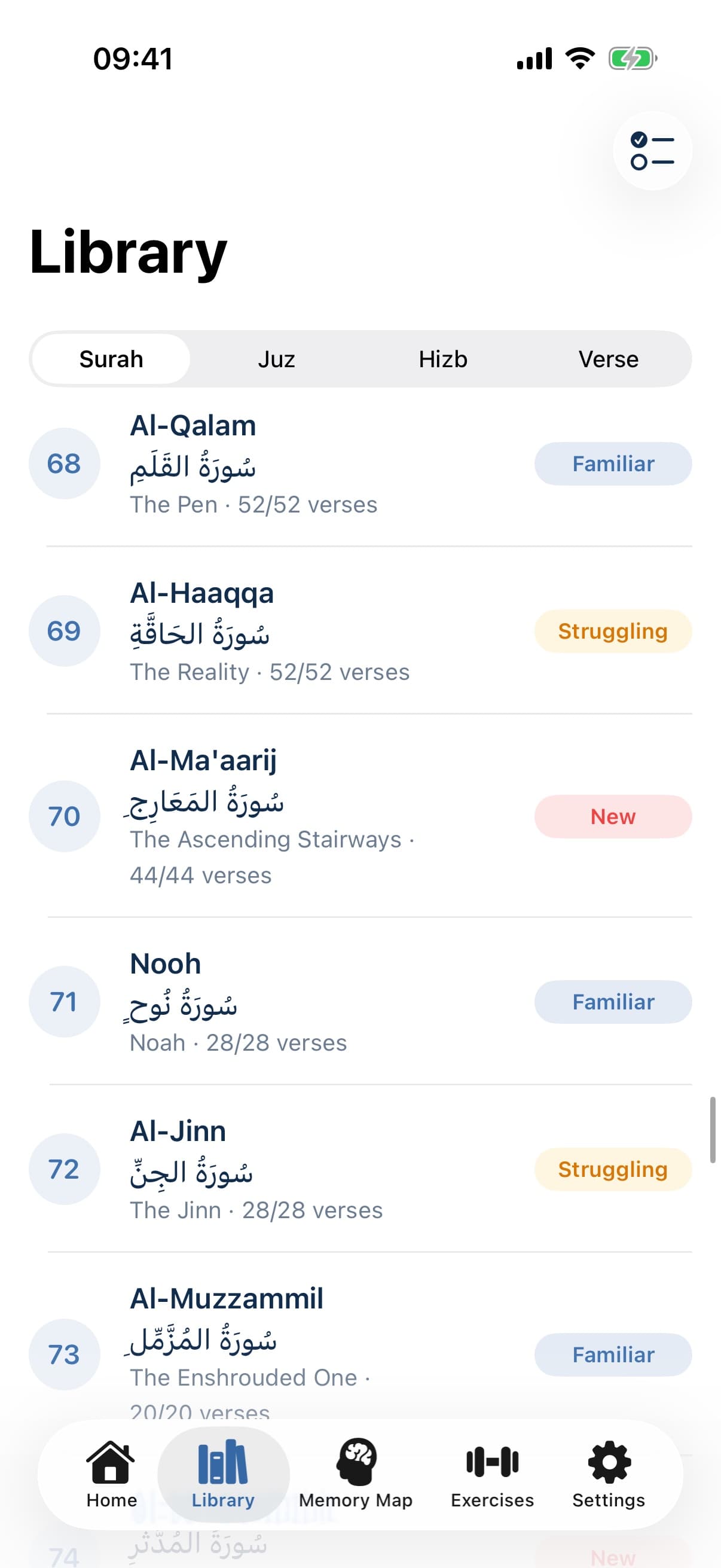
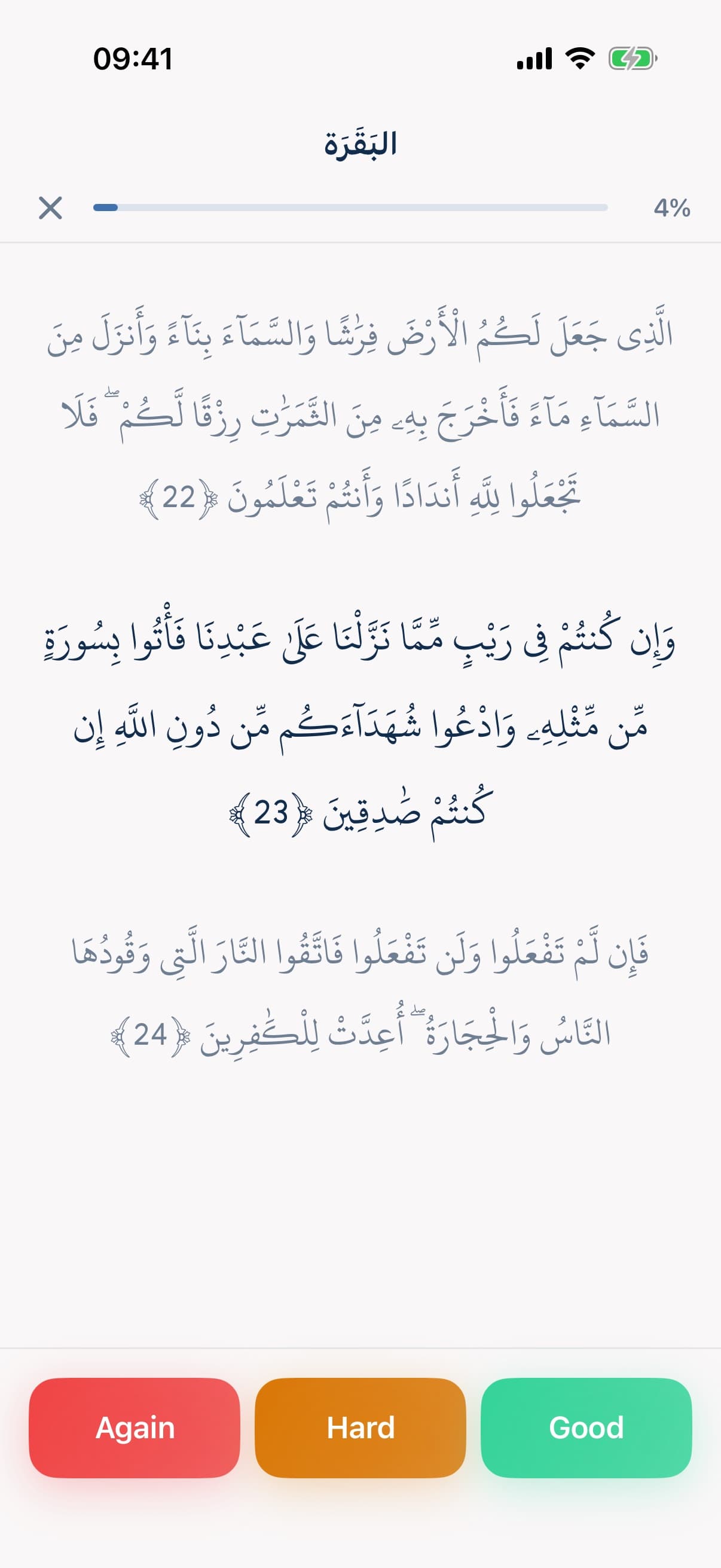
It can take over the scheduling, which is the hardest part to keep up by hand after a break. This is what Qiyam does: every verse you add has its own review schedule, so the ones you struggle with come back sooner and the solid ones later. After each quiz you rate yourself Again, Hard or Good, and "Again" brings a verse back the next day.
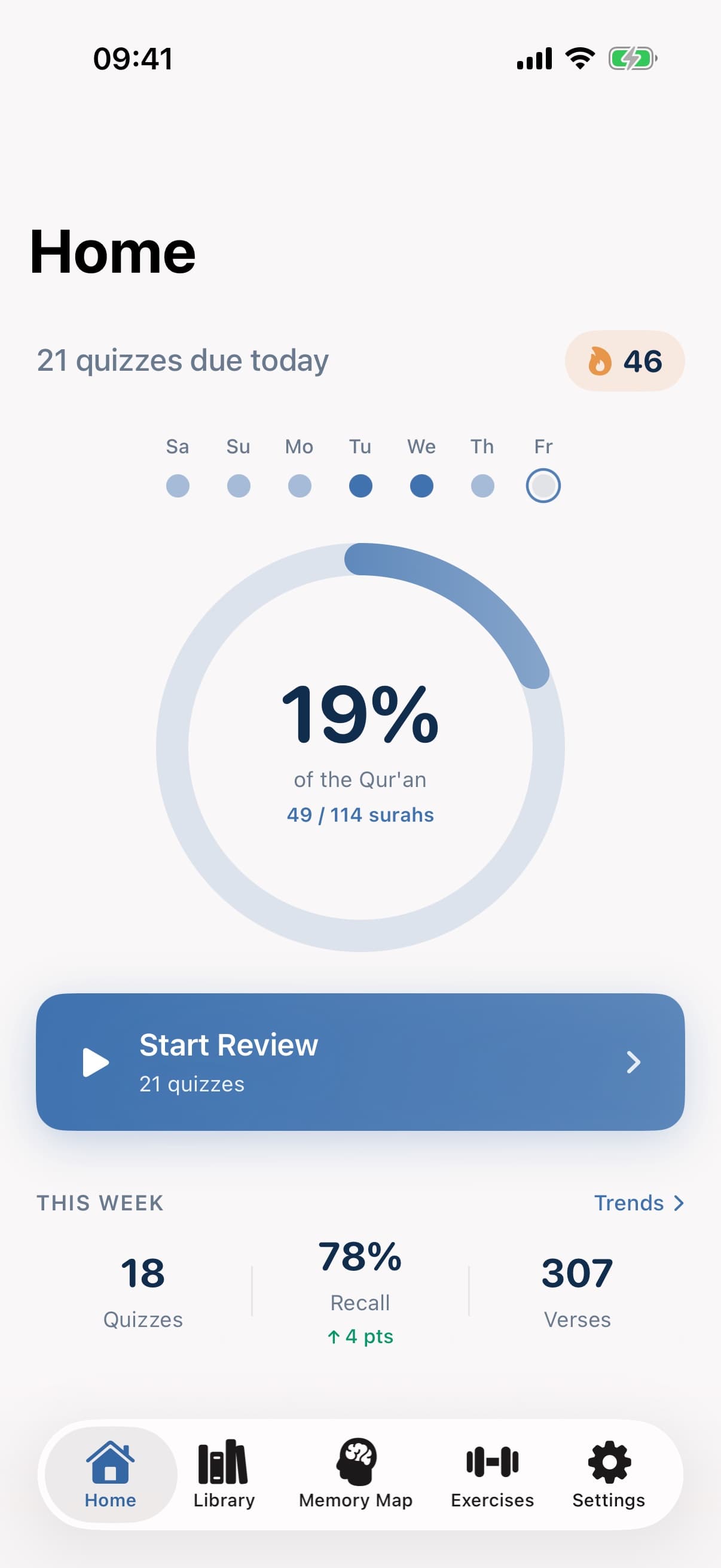
When you return after a gap, Qiyam shows every overdue verse rather than hiding the backlog, and it spreads reviews so that one day does not pile up. The daily streak counts the days the schedule legitimately leaves empty, so a quiet day does not break it, and a freeze protects a missed day. A paper plan or a teacher's schedule can do the same job if you keep to it; the point is that something other than your mood decides what comes back today.
A four-week plan for coming back
- Week 1: recite your strongest surahs from memory every day, and write your list of weak places.
- Week 2: keep the daily recitation, and add one weak place a day: read, then recite.
- Week 3: rebuild the first lost page in small pieces, and bring it back the next day and a few days later.
- Week 4: check the whole list again. Move what has come back into your normal revision, and keep working on the rest.
After four weeks you will not have everything back, but you will have a routine, a clear list, and far more of the Qur'an in your recitation than on the first day.
Sources
- 1Wixted JT, Ebbesen EB (1991). On the form of forgetting. Psychological Science.
- 2Bahrick HP (1984). Semantic memory content in permastore: Fifty years of memory for Spanish learned in school. Journal of Experimental Psychology: General.
- 3Kang SHK (2016). Spaced Repetition Promotes Efficient and Effective Learning. Policy Insights from the Behavioral and Brain Sciences.
- 4Lally P, van Jaarsveld CHM, Potts HWW, Wardle J (2009). How are habits formed: Modelling habit formation in the real world. European Journal of Social Psychology.
- 5Roediger HL, Karpicke JD (2006). Test-Enhanced Learning. Psychological Science.
- 6al-Bukhari Commit yourself to the Qur'an. Sahih al-Bukhari 5033.
Frequently asked questions
How long does it take to get my hifz back after a break?
It depends on how well you knew each part before the break and how long you stopped. Surahs you memorised thoroughly and recited for years tend to return within days of daily recitation; pages you added just before the break may need rebuilding. Plan on weeks, not a single weekend.
Should I keep memorising new pages while I get my revision back?
It is usually better to pause new memorisation until your daily revision is steady again. New pages need short gaps and close attention, and that time is better spent securing what you already hold. Restart new memorisation once your weak list is shrinking.
I feel guilty about forgetting. Where do I start?
Start with one surah you know well and recite it today. Every hafiz meets breaks; what matters is coming back. A small portion each day, tied to a fixed time like after Fajr, will do more than worrying about everything at once.
Is it better to revise a lot on weekends or a little every day?
A little every day. Research on spacing suggests that the same amount of practice spread out over time leads to better long-term retention than practice massed together. If you have more time on weekends, add to your daily portion rather than replacing it.